Proof & getting started · No. 40
Write your first architecture fitness test
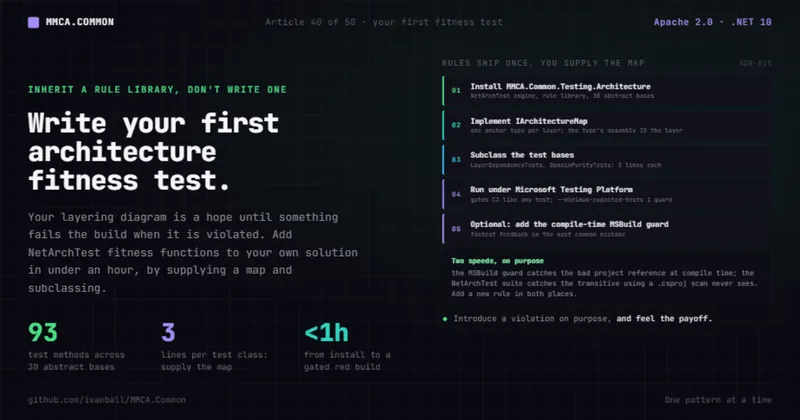
Your Clean Architecture diagram is a hope, not a guarantee, until something fails the build when it is violated. Here is how to add NetArchTest fitness functions to your own solution in under an hour, by inheriting a rule library instead of writing one.
Every codebase has a layering diagram. Domain depends on nothing above it; Application does not know about EF Core; the message broker stays at the edges. The diagram lives in a README, or a wiki, or a senior engineer's head, and it is true on the day it is drawn.
Then time passes. A handler needs an entity by id, so someone adds a using for the DbContext namespace
to the Application layer because it was right there. A domain class references Microsoft.AspNetCore.Http
to read a header "just this once." Each step is reasonable in isolation, and each one quietly erodes the
boundary the diagram promised. By the time anyone notices, the dependency graph is a plate of spaghetti
and the diagram is a historical document.
Code review is supposed to catch this, and it does, sometimes, when the reviewer happens to know the rule and happens to look at the right line. That is not enforcement; that is luck. ADR-015 in MMCA.Common takes the other position: if an architectural rule matters, it should be an automated check that fails the build, not a comment that depends on a reviewer. This tutorial shows you how to add those checks to your own solution, and the surprising part is how little code you write to get a large rule library.
Why rules-as-code beats review
Before the steps, the thesis, because it shapes everything below. An architecture invariant is easy to state ("Domain depends on nothing above it") and easy to erode by accident. "Remember the rule" does not survive a growing change history across a growing team. Turning "do not do X" into a red build is the only enforcement that scales: it is impartial, it never gets tired, and it catches the violation in the pull request that introduced it, not three months later in a refactor.
MMCA.Common enforces its layer rules twice, on purpose:
- At compile time, by an MSBuild target (
MMCA.Common.LayerEnforcement.targets) that inspects project references in a pre-build step and fails the build with a descriptive error if a layer references a forbidden upstream layer. Fastest possible feedback, catches the most common mistake. - At runtime, by NetArchTest fitness functions that assert the same rules against the compiled
assemblies, catching the subtler violations a project-reference check cannot see (a type in the
wrong namespace, a transitive
using, a missing convention).
A third gate sits alongside those two, and ADR-015 as revised records the enforcement as running in
three layers. It is neither MSBuild nor NetArchTest: Microsoft.CodeAnalysis.PublicApiAnalyzers runs on
every published package except MMCA.Common.UI.Maui (excluded by name, because it builds only on the
Windows MAUI job outside the main solution) against a committed PublicAPI.Shipped.txt baseline (5,034
declarations across eighteen files), so adding or removing a public member fails the compile until that
text file is updated in the same pull request. It guards the shipped package surface rather than layer
flow, which is why the two speeds above are the ones this tutorial teaches.
This article is about adding the second layer to your own code, and optionally the first.
Prerequisites
- A .NET solution with a layered shape you want to protect. The MMCA layers are API/Grpc -> Infrastructure -> Application -> Domain -> Shared, but the rule library generalizes.
- Microsoft Testing Platform as your test runner (MMCA.Common uses it via
global.jsonwith xUnit v3). The fitness tests run inside the normaldotnet testtier, so they gate CI like any other test. - The package you are about to install:
MMCA.Common.Testing.Architecture, one of the nineteen packages the framework publishes. Its README row describes it exactly: "IArchitectureMap+ reusable NetArchTest rule library + abstract test bases (consumed by each repo's*.Architecture.Tests)."
The key design idea: the rule bodies ship in the package once. You do not copy them. You supply a tiny
map of your assemblies and subclass the bases, and you inherit roughly the same suite that runs across
MMCA.Common, MMCA.Store, MMCA.ADC and MMCA.Helpdesk (136 test methods across 53 abstract *TestsBase
classes; the framework's own build executes 267 of them).
If you scaffolded with
dotnet new mmca-app, steps 1 through 4 are already done. The generated solution ships the architecture-test project, theIArchitectureMap, and every applicable base subclassed (31 sealed subclasses in the current reference-app seed), including the wire-contract freeze, which arrives frozen under your own names and green on the firstdotnet test. Read those steps anyway to know what you have, then skip to Step 5. If you are retrofitting an existing solution, the steps are the work.
Step 1: install the package and create a test project
Add a dedicated architecture-test project (mirroring how the framework keeps
Tests/Architecture/*.Architecture.Tests), and reference the package:
dotnet add package MMCA.Common.Testing.ArchitectureThe package brings the NetArchTest engine (NetArchTest.eNhancedEdition), the ArchitectureRules rule
library, the diagnostic helpers, and the 53 abstract *TestsBase classes. You will not write rule
logic; you will point the rules at your assemblies and subclass the bases.
Step 2: implement IArchitectureMap, one anchor type per layer
This is the only real work, and it is small. IArchitectureMap is the single extension point every rule is
parameterized by. You declare your layers (and modules, if you have them) by pinning one anchor type
per layer or package: a type whose assembly the rules scan. Subclass ArchitectureMapBase, override
RepoToken and DefineLayers(), and return a handful of one-line Framework(...) / Module(...)
entries:
// Your solution's MyApp.Architecture.Tests project (representative)
internal sealed class MyAppArchitectureMap : ArchitectureMapBase
{
    public override string RepoToken => "MyApp";

    // One anchor type per layer; the type's assembly IS the layer.
    protected override IEnumerable<LayerRef> DefineLayers() =>
    [
        Framework(Layer.Shared,         typeof(MyApp.Shared.Result).Assembly),
        Framework(Layer.Domain,         typeof(MyApp.Domain.Entities.BaseEntity<>).Assembly),
        Framework(Layer.Application,    typeof(MyApp.Application.DependencyInjection).Assembly),
        Framework(Layer.Infrastructure, typeof(MyApp.Infrastructure.ApplicationDbContext).Assembly),
        Framework(Layer.Api,            typeof(MyApp.Api.ApiControllerBase).Assembly),

        // If you have modules, declare each module's layers the same way:
        // Module("Sales", Layer.Domain, typeof(MyApp.Sales.Domain.Order).Assembly),
    ];
}
That is the "what to scan" half. The package's ArchitectureRules are the "what to assert" half. The
framework's own CommonArchitectureMap is module-less (every layer is a framework layer, one anchor per
package); ADC's AdcArchitectureMap adds module entries the same way. Your map looks like one of those,
scaled to your solution.
Step 3: subclass the test bases to inherit the rule library
Now your test classes shrink to thin sealed subclasses that supply the map and inherit the [Fact]s.
Two of the most valuable bases to start with:
// Layer-flow rules: 15 facts (13 forbidden edges + 2 map guards) (representative)
public sealed class LayerDependencyTests : LayerDependencyTestsBase
{
    protected override IArchitectureMap Map { get; } = new MyAppArchitectureMap();
}

// Domain/Shared framework-purity rules (representative)
public sealed class DomainPurityTests : DomainPurityTestsBase
{
    protected override IArchitectureMap Map { get; } = new MyAppArchitectureMap();
}
That is genuinely the whole test class: three lines plus the override. What you just inherited:
LayerDependencyTestsBaseasserts the inward dependency rule across every assembly your map declares: Domain must not depend on Application/Infrastructure/API, Application must not depend on Infrastructure/API, and so on, with one named[Fact]per forbidden edge. A named test per edge ("UI references Domain") gives you a precise red instead of an opaque "layering broken." Thirteen of its fifteen[Fact]s are those edges; the other two assert that your map actually declares every expected layer, and that every module declares its layers, so the edge rules cannot pass vacuously against a map that forgot an assembly.DomainPurityTestsBaseasserts that Domain and Shared stay free of infrastructure frameworks and that Application stays host-agnostic (no EF Core, no ASP.NET Core in Application). It even exposes aprotected virtual ExtraForbiddenDomainDependenciesso your repo can add bans on top of the shared list (Store's subclass bans"RabbitMQ"and"Stripe"from Domain, the broker client and the payment SDK, which the base names only generically in its doc comment as "a payment SDK or a broker client") without editing the package.
The other bases cover more ground when you are ready: MicroserviceExtractionTestsBase (no MassTransit
in Application/Domain/Shared), entity and aggregate conventions (aggregates have no public constructors,
a Result-returning Create factory, entities are sealed and live in the Domain layer), concurrency
awareness, controller conventions, and PII conventions ([Pii] implies IAnonymizable). You opt into
each by adding a subclass.
Step 4: run the suite under Microsoft Testing Platform
The fitness tests are ordinary tests in your test tier, so they run with the same command as everything else:
# Run just the architecture suite
dotnet test --project Tests/Architecture/MyApp.Architecture.Tests

# Target one rule by method (Microsoft Testing Platform filter, after --)
dotnet test --project Tests/Architecture/MyApp.Architecture.Tests -- --filter-method "*Domain_ShouldNot*"
Because they run in the normal tier, a violated invariant fails CI exactly like a failing unit test. One
operational note: Microsoft Testing Platform fails the build if a test project discovers zero tests, so
make sure your subclasses are public and actually inherit [Fact]s. The framework's CI even floors its
test steps with --minimum-expected-tests (1 on the ADC and Store CI runs, 2000 on MMCA.Common's own
solution-wide run, 40 on its Helpdesk canary) so neither an empty suite nor a silently shrunken one can
pass. Where a step carries no floor the workflow says why, as ADC's live-judge step does: every case
there skips itself without an API key, and a zero-run must not red the deploy.
Now introduce a violation on purpose to feel the payoff: add a project reference from your Domain project
to your Infrastructure project, or a using Microsoft.EntityFrameworkCore; to a Domain class, and run
the suite. You get a named red, in the pull request, with the offending type called out. That is the
difference between a diagram and a guarantee.
Step 5 (optional): add the compile-time layer guard too
The runtime suite is the broad net. For the single most common mistake, a bad project reference, you can get even faster feedback by also adding the compile-time guard, so the build fails before tests even run. MMCA.Common does this with an MSBuild target imported for every source project. The shape:
<!-- Imported from Directory.Build.props for each layer project (representative) -->
<Import Project="$(MSBuildThisFileDirectory)Source\Build\MMCA.Common.LayerEnforcement.targets"
        Condition="$(MSBuildProjectDirectory.Contains('Source'))" />
The target runs in a BeforeTargets="ResolveProjectReferences" step, inspects each project's
ProjectReference set, and fails the build with a descriptive error if a layer references a forbidden
upstream layer. This is the "two speeds" design from ADR-015: the MSBuild guard catches the common case
at compile time on the developer's machine; the NetArchTest suite catches the subtler assembly-level
violations a reference check cannot see. ADR-015 frames that pair as "two speeds"; counting the public
API surface gate described earlier, enforcement runs in three layers, so what pairs here is the speeds,
not the layer count. When you change project references or move a type between layers, expect both
gates to react, and add new rules in both places.
Trade-offs and gotchas, honestly
ADR-015 names its own rough edges, and you should know them before you trust the green:
- The tests assert structure and registration, not runtime behavior. A fitness test can prove a client wires a resilience policy; it cannot prove the policy values are correct. Parameter tuning stays a review concern. Do not mistake a green arch suite for "the architecture is good," only for "these specific invariants hold."
- Convention-based rules can be brittle. Rules that match on naming or namespace shape are inherently fuzzier than a hard layer ban. The mitigation is exactly why the rules live in a shared package: a fix to a brittle rule propagates to every consumer in one change instead of being patched three times.
- It is opt-in wiring. The framework ships the rules, but a consumer must implement
IArchitectureMapand subclass the bases to get the gating. The rules do not enforce themselves until you wire them. Common-only checks that cannot generalize live in a separateFrameworkSanityTestsrather than the shared bases. - An empty suite is a false negative. If your subclasses do not inherit any
[Fact]s (wrong accessibility, missing override), the runner may discover zero tests and either fail loudly or, worse, give you a green that proves nothing. The--minimum-expected-testsfloor exists precisely for this. - A frozen wire contract is only as strong as the care taken updating it.
IntegrationEventContractTestsBasefreezes your cross-service API: you overrideExpectedContractwith the shape of every integration event, so a silent reshape fails the build. The base compares the members inside each event's braces as a set, not a sequence, because JSON carries no member order and failing a build over a reordered property trains the one gate that guards real breakage to be updated by rote. Everything observable stays a failure: a missing member, an extra member, a changed type, and any change to the set of events itself. That set comparison is also what letsdotnet new mmca-appship the freeze rather than skip it, with the staging pass asserting that exactly one such class is present instead of deleting it, so a generated app carries its own contract under its own names. The discipline is yours: when a red is intentional, version the event and coordinate the consumer rollout in the same change, rather than pasting the new shape in and moving on.
None of these undercut the core value. They are the reasons to scope your rules deliberately and read the failures, not just the color.
Apply this even without MMCA
If you are not on MMCA.Common, the pattern still ports to any .NET stack with NetArchTest:
- Write each invariant as a named test, one per forbidden edge, so a failure points at the exact rule, not "layering is wrong."
- Pin assemblies through anchor types, not string names, so a rename does not silently disable a rule.
- Run the suite in your normal test tier so it gates CI, and guard against a zero-discovery suite that passes vacuously.
- For the common case (bad project references), add a compile-time check too, so the fastest feedback catches the most frequent mistake.
The rule of thumb is the takeaway: a rule that lives only in a diagram or a reviewer's memory will be violated. Make it a check, and it becomes a guarantee.
What we covered: why rules-as-code beats code review for architecture invariants, installing
MMCA.Common.Testing.Architecture, implementing IArchitectureMap with one anchor type per layer,
subclassing LayerDependencyTestsBase and DomainPurityTestsBase to inherit a large rule library,
running the suite under Microsoft Testing Platform, and optionally adding the compile-time MSBuild layer
guard for the fastest feedback on the common case. ADR-015 is the decision behind all of it.
Next in the series: two real apps on one framework, the proof that every pattern in this series holds in two unrelated production systems.
MMCA.Common is Apache-2.0 licensed and open source. Star the repo, read the 2-minute ADR-015, or
dotnet add package MMCA.Common.Testing.Architecture and protect your layers.
- Repo: https://github.com/ivanball/MMCA.Common
- ADR-015 (architecture fitness functions): ADR-015: Architecture Invariants Enforced as Fitness Functions in the docs site.
Tags: .NET, C Sharp, Software Architecture, Testing, Clean Architecture