Auth & the edge · No. 20
Problem Details across HTTP and gRPC (RFC 9457)
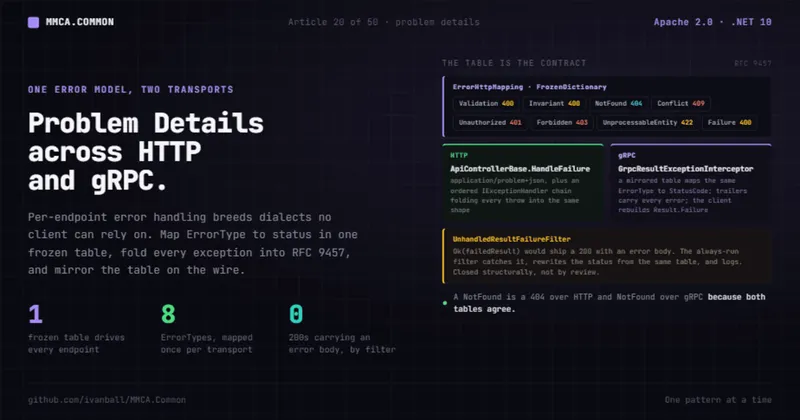
One error model, two transports. How a Result failure becomes the same RFC 9457 shape
whether the caller reached you over HTTP or gRPC, and the honest gaps that still cost the category points.
Here is an error contract that looks fine until you have more than one client:
[HttpGet("{id}")]
public async Task<IActionResult> Get(int id)
{
    var session = await _service.GetByIdAsync(id);
    if (session is null) return NotFound();          // 404, empty body
    if (!_user.CanView(session)) return Forbid();    // 403, no body
    return Ok(session);                              // 200
}
Multiply that across a few hundred actions written by a few different people and you get a few
different error dialects. One endpoint returns 404 with an empty body, another returns 200 with
{ "error": "not found" }, a third throws and the framework's default handler emits a stack trace in
development. A client integrating against you cannot write one error handler. It writes one per
endpoint, defensively, and still gets surprised.
Now add a second transport. The day a module is extracted and called over gRPC instead of HTTP, the
caller is reading RpcException status codes and trailing metadata, not HTTP status and bodies. If the
error mapping was hand-written per endpoint, none of it carries over. You re-derive the whole contract
on the wire.
Why it matters
A consistent error contract is not cosmetic. It is the difference between a client that can branch on
"was this a validation problem, a not-found, or a conflict?" mechanically, and a client that has to
pattern-match on prose. RFC 9457 (Problem Details for HTTP APIs, the successor to RFC 7807) exists
precisely so that "machine-readable error" is a settled, standard shape: a type, title, status,
detail, and extension members, served as application/problem+json.
In a framework whose thesis is "monolith now, services later, no rewrite," the error contract has an extra requirement: it has to be transport-agnostic. The same logical failure (a not-found, a forbidden, a conflict) has to look the same to a caller whether the answer came from an in-process object, an HTTP hop, or a gRPC hop. If it does not, extraction is a breaking change for every consumer.
The MMCA answer: one mapping table, reused on both transports
MMCA.Common's whole error story starts from one decision recorded across the codebase: expected
failures are values, not exceptions. Handlers return Result<T> carrying an Error list, each error
typed by an ErrorType. The edge's only job is to translate that value into the right wire shape.
On the HTTP side, every controller derives from ApiControllerBase, whose single job is
HandleFailure(IEnumerable<Error>). It produces an ObjectResult whose status belongs to the most
severe ErrorType present, deliberately not the first error's, so an aggregate built by
Result.Combine cannot be downgraded by error ordering: a 403 or a 500 travelling alongside a
validation error still answers 403 or 500, and equal ranks keep the earliest error. Every error still
travels in the Problem Details errors array; only the status is ranked. The actual
ErrorType -> status table does not live in the controller. It lives once in ErrorHttpMapping, a
FrozenDictionary keyed by error type:
// ErrorHttpMapping - the single ErrorType -> HTTP status table (FrozenDictionary):
//   Validation         -> 400
//   Invariant          -> 400
//   NotFound           -> 404
//   Conflict           -> 409
//   Unauthorized       -> 401
//   Forbidden          -> 403
//   UnprocessableEntity-> 422
//   Failure            -> 400
//   Unexpected         -> 500
//
// A multi-error failure is ranked, not indexed: GetStatusCode(errors) asks
// ErrorTypeSeverity.MostSevere which type wins, most to least severe:
//   Unexpected > Unauthorized > Forbidden > Conflict > NotFound
//              > UnprocessableEntity > Invariant / Validation / Failure
//
// Centralizing the map is what keeps every endpoint's error shape identical.
Thrown exceptions get folded into the same Problem Details shape by an ordered, most-specific-first
chain of IExceptionHandlers: OperationCanceledExceptionHandler (client disconnect -> 499, so
monitoring can tell an abandoned request from a server error), DomainExceptionHandler (business-rule
violation -> 400), DbUpdateExceptionHandler (concurrency or constraint -> 409, with a deliberately
generic message so schema names do not leak), ValidationExceptionHandler (FluentValidation -> 400
with a per-property errors dictionary), and GlobalExceptionHandler as the catch-all 500. Together
they guarantee one invariant: every error leaving the API, thrown or returned, is an RFC 9457 Problem
Details with a sensible status.
There is also a guard against the most insidious bug in this space: a controller that calls
Ok(result) on a failed Result. Without a guard that serializes as a misleading 200 OK carrying
an error body. UnhandledResultFailureFilter is an always-run result filter, registered globally, that
catches exactly that programmer mistake, rewrites the response to the correct error status using the
same ErrorHttpMapping table, and logs a warning. The 200-with-an-error-body trap is closed
structurally, not by code review.
On the gRPC side, the same Result model crosses the wire unchanged. A gRPC service implementation
calls the inner C# service, gets a Result, and calls result.ThrowIfFailure(). That throws a
ResultFailureException carrying the Error list. GrpcResultExceptionInterceptor, registered by
AddGrpcServiceDefaults(), catches it for all four call shapes (unary and the three streaming kinds),
logs it, and rethrows errors.ToRpcException(): an RpcException whose StatusCode comes from a
FrozenDictionary<ErrorType, StatusCode> that mirrors the HTTP table, picked from the most severe
error by the same ErrorTypeSeverity ranking the HTTP edge uses, and whose trailing metadata carries
every error as error-{i}-code/-message/-type/-source/-target entries.
Both halves of that round trip ship in the framework, in the same file. errors.ToRpcException() lives
in MMCA.Common's gRPC package (ResultGrpcExtensions), so every extracted service emits the same
structured trailers for free, and Metadata.ToErrors() is the exact inverse: it walks the
error-{i}-* entries back into an Error list, omitting an absent source or target exactly as the
encoder omitted it, and falling back to ErrorType.Failure on a type name it does not recognize so a
newer peer cannot break an older client. RpcException.ToResult() and ToResult<T>() sit on top of it
and rebuild Result.Failure(errors), degrading a transport fault that carries no trailers (a reset
connection, an exceeded deadline) to a single Failure error coded Grpc.{StatusCode} rather than
letting an exception escape. A consumer's client adapter is then a two-line catch: ADC's
SessionBookmarkValidationServiceGrpcAdapter and EventLiveValidationServiceGrpcAdapter catch
RpcException and return ex.ToResult<T>(), and the caller sees the same Result it would have seen
in-process.
That status-mapping symmetry is the point. The ErrorType -> status decision is made once per transport in a frozen
table, the translation is a pipeline concern written once in an interceptor, and a NotFound is a 404
over HTTP and a NotFound RpcException over gRPC because both tables agree.
The rest of the §9 contract
The same edge standardizes the things that drift if left to each endpoint:
- Pagination and filtering. The generic read controllers expose
GET /pagedwith filter, sort, and page parameters, and emit pagination metadata in anX-Paginationresponse header. A structured?filters[Name].operator=contains&filters[Name].value=shirtquery syntax is parsed by a model binder into the dynamic filter the query service applies server-side. Every list endpoint speaks the same query and pagination dialect because it inherits it. - Header-based API versioning. Versioning is configured at the host edge as a header concern, not baked into route strings per controller.
- Disabled features speak the same dialect. A
[FeatureGate]on an off flag returns an RFC 9457 404 (viaDisabledFeatureHandler), not a bespoke 403, so a disabled feature is indistinguishable from a route that does not exist and still matches the API's error shape.
Trade-offs, honestly
The scorecard scores §9 (API and Contract Design) at Maturity 4 of 4 and Implementation 9 of 10 (weighted 8/18). The category sits at the maturity ceiling: the contract is defined once and checked by a build, not by review. What is left is the last implementation point, and two honest notes say where it lives.
- The contract snapshot is guarded at two levels, on purpose. The framework generates an OpenAPI
document:
AddCommonOpenApi()calls ASP.NET Core's built-inAddOpenApi(),MapCommonOpenApi()serves/openapi/v1.jsonoutside Production, and an opt-inMapCommonScalarUi()renders the Scalar reference UI from that document.OpenApiBaselineTestscloses the loop in the framework's own CI: it boots an in-memory host over that exact registration path (AddCommonApiVersioning()+AddCommonOpenApi()+MapCommonOpenApi()), fetches/openapi/v1.json, normalizes it (the host-assignedserversblock is dropped, object properties are ordered ordinally so generator ordering is not mistaken for drift, array order is preserved because it is contractual), and diffs the result against a committedopenapi-baseline.v1.json. A change to the generated surface fails the build; an intended change is regenerated deliberately, by settingMMCA_UPDATE_OPENAPI_BASELINE=1and committing the new baseline in the same pull request. What that gate covers is the framework-owned surface: the probe controllers stand in for a consumer's real controllers precisely so the test guards document generation rather than any concrete API. The concrete surface stays guarded by the consumer hosts' own contract-snapshot tests, where the endpoints actually live. Two levels, one boundary, nothing duplicated. [ServiceContract]has a dedicated rule that guards more than it currently catches. The Shared-layer[ServiceContract]attribute tags the wire surface of an extracted service (the interfaces, event records, and boundary DTOs).ServiceContractsDoNotDependOnServiceInternalsscans every assembly the architecture map registers for types carrying that marker and fails the build, naming the offending type, when one reaches into the producing service's Domain, Application, or Infrastructure. It is attribute-driven rather than layer-driven for a specific reason: no repo registers a Contracts layer in its map today, so a layer-iterating rule would pass vacuously forever, while an attribute-driven one starts biting the moment a repo marks its first contract type. The honest part is that MMCA.Common marks no type with the attribute, so the framework's own run of the rule asserts nothing. The attribute is an adoptable marker, and the rule standing behind it is a ratchet rather than a check that catches violations daily.
So the enforcement story reads cleanly in three parts. The error mapping is enforced where it is defined (a frozen table reused on both transports, plus the 200-with-error-body filter). The contract shape is enforced by a baseline a build diffs. The contract purity invariant is enforced by a dedicated fitness rule, alongside the layer and transport rules (ADR-015) that guard the same boundary from the layer side. The remaining implementation point is exactly the honesty above: a purity rule no framework type exercises yet, and half of the snapshot gate that by design can only run in the repos that own the concrete API surface.
Apply this even without MMCA
The pattern ports to any stack with more than one client or more than one transport:
- Model expected failures as typed values, not exceptions or ad-hoc status codes. A small
ErrorTypeenum is enough. - Map that enum to wire status in one table, per transport. A
FrozenDictionary(or any single lookup) reused by every endpoint beats areturn NotFound()scattered across actions. - Make every exit produce the standard shape. Fold thrown exceptions into the same Problem Details via an ordered handler chain, and add a guard that catches the "success status on a failed result" mistake before it ships.
- If you might extract a module, mirror the table on the other transport. The gRPC status mapping should be the same decision as the HTTP status mapping, written once, so a caller sees one error model across the hop.
- Put the contract under a check. A versioned OpenAPI snapshot diffed by CI, or an architecture test on the contract types, is the difference between a contract and a hope. The framework above does both: it diffs its generated document against a committed baseline and asserts contract purity with a dedicated fitness rule, while the concrete API surface is snapshotted in the hosts that own it. Wherever a given check lives, make sure it actually runs on every build.
What we covered: why per-endpoint error handling produces inconsistent contracts that do not
survive a transport change, how MMCA.Common maps ErrorType to status through a single frozen table
reused by ApiControllerBase.HandleFailure over HTTP and GrpcResultExceptionInterceptor over gRPC,
how a guard closes the 200-with-error-body trap, and how §9 keeps that contract honest (a committed
OpenAPI baseline the framework's own build diffs, consumer hosts snapshotting their concrete surface,
and a dedicated [ServiceContract] purity rule waiting on the first marked type).
Next in the series: notifications as a vertical slice, the one concrete bounded context the framework ships, across push, in-app inbox, and email.
MMCA.Common is Apache-2.0 licensed and open source. Star the repo, read the §9 scorecard entry (gaps
included), or dotnet add package MMCA.Common.API and try it.
- Repo: https://github.com/ivanball/MMCA.Common
- The full 34-category scorecard, §9 included, lives in MMCA.Common: Architecture Scorecard in the docs site.
Tags: .NET, C Sharp, Software Architecture, gRPC, API Design