Data & persistence · No. 14
Self-ordering modules: discovered, Kahn-ordered, and extractable
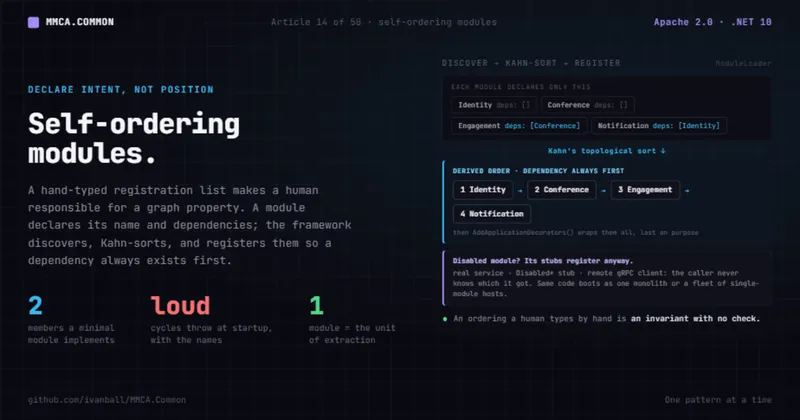
A module declares its name and its dependencies. The framework discovers every module, sorts them with Kahn's algorithm, and registers them in an order where a dependency always exists before the code that wraps it. The same code boots as a monolith or as a fleet of services.
Most "modular" .NET codebases have a Program.cs that looks like this:
services.AddIdentityModule();
services.AddConferenceModule();   // no dependencies
services.AddEngagementModule();   // needs Conference
services.AddNotificationModule(); // needs Identity
It works until someone reorders two lines, or adds a module that depends on a module registered later, or disables one module in one environment and forgets that three other registrations assumed it was there. The dependency order between modules is real, it matters for correctness, and it is encoded nowhere except the sequence of lines a human typed. That is a fragile place to keep an invariant.
Why ordering is a correctness concern, not a style one
In MMCA.Common the registration order is not cosmetic. The CQRS pipeline wraps command and query
handlers with decorators (logging, caching, validation, transactions) using Scrutor's TryDecorate,
which wraps registrations that already exist in the container. If a module's concrete handlers are
not registered before the decorators run, there is nothing to wrap and the cross-cutting behavior
silently does not apply. So "register A before B" is not a preference. It is the difference between a
handler that gets a transaction and one that does not.
The honest problem with the hand-ordered list is that it makes a human responsible for a graph property. Humans are bad at topological sorts done in their head, especially as the module count grows and dependencies become transitive. The fix is to let each module declare what it needs and let the framework compute the order.
A module declares intent, not position
A module in MMCA.Common is an IModule. The contract is deliberately small:
public interface IModule
{
    string Name { get; }
    IReadOnlyList<string> Dependencies => [];     // default-implemented
    bool RequiresDependencies => false;           // default-implemented
    void Register(IServiceCollection services, IConfigurationBuilder configuration,
                  ApplicationSettings applicationSettings);
    void RegisterDisabledStubs(IServiceCollection services) { } // default empty body
}
Three of the five members ship with default implementations, so a minimal module implements only
Name and Register. A real one is barely more than a dozen lines: ADC's ConferenceModule declares
its name, forwards Register to an AddConferenceModule(applicationSettings) extension method,
declares no dependencies (it is a foundational module the others build on), and (optionally) implements
RegisterDisabledStubs. A module that does depend on another, like EngagementModule, simply adds
Dependencies => ["Conference"] with RequiresDependencies => true. The module never says "register me
third." It says "my name is Engagement and I depend on Conference." Position is derived, not declared.
The engine: ModuleLoader and Kahn's algorithm
ModuleLoader is the piece that turns those declarations into an order. Its DiscoverAndRegister
method scans the assemblies the host names in a required moduleAssemblies parameter, instantiates
every concrete IModule (and every IModuleSeeder) it finds there, and then runs Kahn's topological
sort over the declared Dependencies. The host names those assemblies explicitly on purpose: an
AppDomain scan only sees assemblies that are already loaded, so a module assembly that is referenced
but never touched by a code path would be silently absent from discovery.
Kahn's algorithm is breadth-first search over a dependency graph:
- Compute each module's in-degree: the count of dependencies it is still waiting on.
- Seed a queue with every zero-in-degree module (the ones that depend on nothing).
- Emit a module from the queue, then decrement the in-degree of each module that depended on it. Any dependent that reaches zero gets enqueued.
- Repeat until the queue is empty.
The output is an ordering where every module appears after all of its dependencies. Because the loader registers modules in that order, a dependency's DI registrations always exist before any dependent registers, which is exactly the precondition the decorator pipeline needs.
There is a built-in correctness check that the hand-ordered list could never give you: if fewer modules come out of the sort than went in, the leftovers form a dependency cycle, and the loader throws with the offending module names. A circular dependency between modules becomes a loud, named startup failure instead of a subtle runtime surprise.
The scan is also defensive. Each GetTypes() call sits inside a try/catch (a
ReflectionTypeLoadException raised by a missing transitive reference is the case it exists for), so a
broken assembly contributes no types and logs why instead of aborting discovery of the rest. And every
step emits a structured [LoggerMessage]-generated log line, so the startup log tells you precisely
which modules loaded, in what order, and how long each took. When something is wrong, you read it, you
do not guess it.
// In each host's Program.cs. AddModuleHost binds and validates ApplicationSettings and
// ModulesSettings, builds the ModuleLoader and registers it as a singleton. It deliberately does
// not run discovery itself.
using var loggerFactory = SerilogHostExtensions.CreateBootstrapLoggerFactory();
var moduleHost = builder.AddModuleHost(
    [typeof(ConferenceModule).Assembly],      // the module assemblies, named explicitly
    loggerFactory.CreateLogger<ModuleLoader>());

// Discovery is a step of the application pipeline, so every module handler lands in the container
// before the decorators close over it.
services.AddMmcaApplicationPipeline(pipeline => pipeline
    .Register(moduleHost.RegisterModules));
A subtlety worth stating because it is easy to assume otherwise: discovery is not something
AddApplication() does for you, and the host does not call DiscoverAndRegister by hand either.
AddModuleHost captures the configuration, the bound settings, the environment name and the module
assemblies, and hands back a ModuleHostContext whose RegisterModules method is the delegate that
calls DiscoverAndRegister with all six of them. Registering that delegate as a pipeline step is what
puts the modules in the right place in the sequence. The loader stays a singleton, which is how it also
drives startup seeding through SeedAllAsync (which invokes each enabled module's
IModuleSeeder.SeedAsync once a real IServiceProvider exists, for example to seed a default admin
user).
Disabling a module without breaking its consumers
Here is the part that turns this from a tidy registration trick into an extraction mechanism. A host can
disable a module through configuration. ModulesSettings binds the "Modules" config section (it is a
Dictionary<string, ModuleSettings>), and ModuleSettings carries a per-module Enabled flag
(default true) plus a RemoteDependencies list.
{
  "Modules": {
    "Conference":   { "Enabled": true },
    "Engagement":   { "Enabled": false, "RemoteDependencies": [] }
  }
}
When the loader reaches a disabled module it does not skip it. It calls that module's
RegisterDisabledStubs(services) and records the name in DisabledModuleNames. This is the crux. A
disabled Engagement module still contributes stub registrations for the cross-module interfaces other
modules depend on. So when Conference's GetSessionBookmarkCountHandler asks the container for
Engagement's IBookmarkCountService, resolution still succeeds, because the disabled module left a
Disabled* stub behind.
That is a clean strategy plus null-object pairing (real service, disabled stub, or remote client) rather
than if (moduleEnabled) checks scattered through the call sites. The handler does not know or care
which of the three it got.
Dependency validation is microservice-aware to match. A dependency that is disabled in-process but
listed in this host's ModuleSettings.RemoteDependencies is treated as satisfied remotely (the host
will wire a typed gRPC client to the extracted peer), and only a module with RequiresDependencies = true and a genuinely unsatisfied dependency throws at startup. The loader also loads per-module
configuration by convention: before calling module.Register(...) it adds modules.{name}.json (and
the environment-specific variant) to the configuration builder, so a module can ship its own config
file.
Convention scanning: what a module's Register actually wires
Modules do not hand-register every handler. ScanModuleApplicationServices<TAssemblyMarker>() is the
Scrutor-based convention scan that a module's Add{X}Module calls to register, by assembly, every kind
of application service a slice ships:
- Domain event handlers and integration event handlers as singletons.
- Command and query handlers as scoped services (one per request).
- DTO mappers, DTO projectors, and request mappers as scoped services (three separate scans,
not one). The projector scan is optional and opt-in: an entity that ships an
IEntityDTOProjectorgets server-side projection on its list reads, one that does not keeps materialize-then-map. - Update appliers as scoped services, in two flavors scanned side by side: the request-shaped
IEntityUpdateApplier<,,>and the command-awareIEntityUpdateCommandApplier<,,,>for an update that also depends on state the request body does not carry. They are the write-side twin of the request mappers, so the generic update handler never has to know a field name. - FluentValidation validators discovered from the same assembly, plus an auto-registered validator
for any command that embeds a request via
ICommandWithRequest<T>.
The full registration sequence the framework documents is a hard contract because of the decorator rule
described earlier, and AddMmcaApplicationPipeline is the call that composes it: it runs
AddApplication(), then your callback, then AddApplicationDecorators(), and then seals the
collection.
services.AddInfrastructure(configuration);    // repos, UoW, DbContexts, caching, outbox
services.AddAPI(moduleHost.ModulesSettings);  // controllers, idempotency, error mapping

// AddApplication() runs first, inside this call; AddApplicationDecorators() runs last, inside it.
services.AddMmcaApplicationPipeline(pipeline => pipeline
    .Register(moduleHost.RegisterModules)     // every discovered module, in Kahn order
    .ScanModule<ModuleBClassRef>());          // or a single module named by its marker type
AddApplicationDecorators() is last on purpose. The concrete handlers from every module must already be
in the container, or TryDecorate has nothing to wrap. Sealing is what makes that checkable instead of
hopeful: a ScanModuleApplicationServices (or AddEntityCrud, or AddEntityUpdate) call that arrives
after the decorators throws an InvalidOperationException naming the caller, rather than quietly
registering a handler nothing wraps, and VerifyDecoratorPipeline() hands a fitness test the same
assertion over a fully composed collection. Registrations that are not handlers, such as infrastructure,
API, telemetry and options, sit outside the call because their order relative to the decorators does not
matter. The Kahn ordering inside DiscoverAndRegister guarantees the modules themselves go in
dependency order; the pipeline guarantees the decorators go on top of all of them.
Each module is the unit of extraction
The reason all of this is worth the machinery is that the module is also the deploy and scale boundary,
and the same self-ordering ModuleLoader registration runs at both ends of it. As a monolith, one host
enables every module and cross-module calls are in-process method calls: MMCA.Helpdesk is the framework's
monolith-first reference app, a single Tickets module exercised end to end through all five layers to
demonstrate the "build the monolith now, extract a service later" path. As a fleet, each service host
runs the same ModuleLoader with only its own module enabled (Modules:{Module}:Enabled=true); the
disabled peers contribute their stubs, and the host then replaces a stub with a typed gRPC client pointed
at the real, extracted peer process. MMCA.ADC runs this way today: four single-module service hosts
(Identity, Conference, Engagement, Notification) behind a YARP gateway, with no combined monolith host at
all. The Domain, Application, and Shared code is identical in both topologies. The transport choice lives
entirely at the composition edge (ADR-008).
That is the payoff of declaring intent instead of position: the same self-ordering registration that
makes the monolith correct is what makes the split reversible. Nothing in Helpdesk's TicketsModule or
ADC's ConferenceModule changes when it moves from one host to its own process.
Trade-offs, honestly
- Reflection at startup. Discovery calls
GetTypes()on every assembly the host named. This is a startup cost, paid once, and the per-GetTypes()guard means a load-time exception in one assembly is tolerated rather than fatal. Naming the assemblies keeps the bill proportional to the module count instead of to everything the process happens to have loaded, but it is a list the host has to maintain: forget an assembly and its module is simply not there. - Implicit order can surprise. The convenience of "the framework figures out the order" is also a
cost: the order is not visible as a list of lines. The structured startup log is the mitigation, but a
developer used to reading the order off
Program.cshas to learn to read it off the log instead. - Stubs must be maintained.
RegisterDisabledStubsis a real obligation. Add a cross-module interface and forget to register a stub for it, and a host that disables that module fails to resolve. This is caught at startup rather than in production, but it is a discipline the contract assumes. - Cycles are rejected, not resolved. A dependency cycle is a hard startup failure by design. That is the correct behavior, but it means you cannot lean on lazy resolution to paper over a genuine circular design between modules.
None of these are reasons to keep the hand-ordered list. They are the cost of moving the invariant from a human's memory into the framework.
Apply this even without MMCA
The pattern ports cleanly to any DI container:
- Give each module a name and a declared dependency list, not a hard-coded registration position.
- Topologically sort before you register. Kahn's algorithm is about fifteen lines; the payoff is that a cycle becomes a named exception instead of a subtle bug.
- Register decorators or pipeline behaviors after the things they wrap, and make that ordering a consequence of the sort rather than a comment. Better still, make the sequence one call that closes itself, so a late registration throws instead of running unwrapped.
- For anything you might disable per-environment, register a null-object or stub for its public interfaces, so consumers resolve regardless. The branch lives at composition, not at every call site.
The takeaway: if the order between your modules matters for correctness, derive it from declared dependencies and verify it at startup. An ordering a human types by hand is an invariant with no check.
What we covered: why module registration order is a correctness concern (the decorator pipeline
wraps existing registrations), how IModule lets a module declare its name and dependencies instead of
its position, how ModuleLoader discovers modules in the assemblies the host names and Kahn-sorts them
(rejecting cycles by name), how disabled modules register stubs so cross-module interfaces stay
resolvable, what ScanModuleApplicationServices<T>() wires by convention, and why the module is also
the unit of service extraction.
Next in the series: event-schema versioning, so an independently deployed consumer never breaks on an event that was silently reshaped.
MMCA.Common is Apache-2.0 licensed and open source. Star the repo, read ADR-008 for the extraction topology,
or dotnet add package MMCA.Common.API and try it.
- ⭐ Repo: https://github.com/ivanball/MMCA.Common
- 📚 Full series index: https://ivanball.github.io/writing.html
- 📄 ADR-008 (service-extraction topology) and ADR-006 (database-per-service) in the docs site.
Tags: .NET, C Sharp, Software Architecture, Modular Monolith, Microservices