Core patterns · No. 7
The CQRS decorator pipeline: logging, caching, and transactions without touching a handler
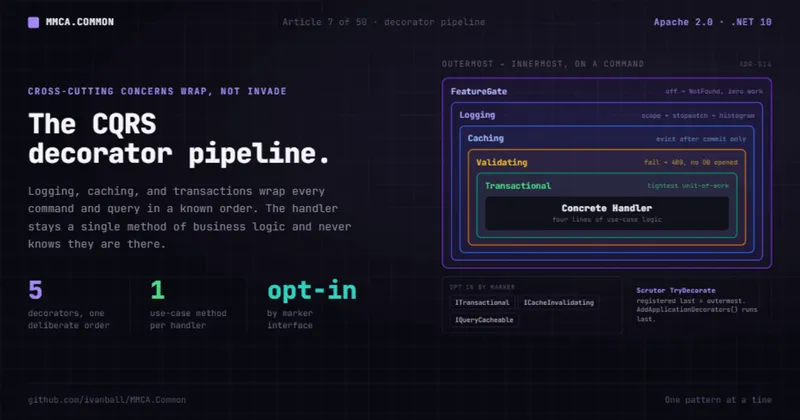
Cross-cutting concerns belong around a handler, not inside it. Here is a Scrutor-composed decorator pipeline where logging, caching, and transactions wrap every command and query, and a handler stays a single method of business logic.
Open a command handler in a typical .NET service and count how much of it is the actual use case.
You will find a transaction scope. A log line at the start and a stopwatch at the end. A cache eviction call after the save. Maybe a feature-flag check up top. Somewhere in the middle, four lines that are the thing the handler is actually for. The cross-cutting concerns outnumber the business logic, they are copy-pasted into every handler with subtle drift, and the order they run in is whatever order someone typed them.
That is the problem the CQRS decorator pipeline solves. A handler holds only its use-case logic. Logging, caching, validation, and transactions live in decorators that wrap the handler uniformly, in a known order, and the handler never knows they are there.
Why it matters
The scattered approach fails in two specific ways.
First, drift. When the transaction boilerplate lives in every handler, one handler eventually forgets it, or wraps the wrong span, or commits before it should. There is no single place to read "how do we do transactions here," so the answer is "differently in each file."
Second, implicit ordering. The order in which cross-cutting concerns run is load-bearing, and when it is emergent from hand-written code nobody can see it. Should validation run before or after the transaction opens? Should cache invalidation happen inside the transaction or after the commit? These are correctness questions, and scattered code answers them by accident.
The decorator pipeline makes both problems go away: each concern is written once, and the order is declared in one place on purpose.
The shape: thin handlers, fat pipeline
Every write and every read in MMCA.Common is a use case behind one of two interfaces:
public interface ICommandHandler<in TCommand, TResult>
{
    Task<TResult> HandleAsync(TCommand command, CancellationToken cancellationToken = default);
}

public interface IQueryHandler<in TQuery, TResult>
{
    Task<TResult> HandleAsync(TQuery query, CancellationToken cancellationToken = default);
}
One method each. TResult is almost always a Result or Result<T> (the railway error type from
ADR-013): a handler returns a failure value, it does not throw for expected error paths. Commands mutate
state, queries are side-effect-free reads, and splitting them into two interfaces is what lets the
container apply a different set of concerns to each. Writes get transactions and validation, reads get
result caching.
A decorator implements the same interface, takes the next handler in via its constructor, does its one
cross-cutting job, and delegates. Because each decorator is itself an ICommandHandler or
IQueryHandler, they nest arbitrarily, and the concrete handler at the bottom never knows it is wrapped.
That is the textbook Decorator pattern applied to the application boundary.
How the pipeline is assembled, and why order is the whole game
The wiring uses Scrutor's TryDecorate, and there is one rule you
have to internalize: TryDecorate applies decorators in reverse registration order. The last one
registered becomes the outermost wrapper.
So reading the registrations top to bottom lists innermost first. The resulting execution order for commands, outermost to innermost, is seven decorators deep:
FeatureGate -> Authorization -> Logging -> Caching ->
Validating -> Timeout -> Transactional -> Concrete Handler
And for queries, one decorator shorter: everything the command chain carries except the transaction.
FeatureGate -> Authorization -> Logging -> Caching ->
Validating -> Timeout -> Concrete Handler
(The framework also has an optional Profiling decorator layered on top when profiling is enabled, via a
separate AddApplicationProfiling() call.)
Each position is a deliberate cost-and-correctness argument:
- Feature-gating is outermost so a disabled feature is rejected with zero downstream work: no
permission lookup, no log scope, no cache touch, no validation, no transaction. It short-circuits with
a
NotFoundfailure when the flag is off. It also sits outside the permission check on purpose: a feature that is off must answer the same way for every caller rather than leaking which permission guards it. - Authorization sits directly inside the gate and outside caching. Both decorators delegate to one
shared
AuthorizationGate.Evaluate(...)helper that answers with a denialErroror withnull, and it applies two checks in order. First the capability check: a request declaringIRequiresPermissionis granted when the permission registry grants one of the caller's roles, or when the principal carries a matching permission claim, and is otherwise denied withError.Forbidden("Authorization.PermissionDenied", ...)without invoking the handler. Second the step-up check: a request markedIRequiresMfais denied withError.Forbidden("Authorization.MultiFactorRequired", ...)unless the principal presented a second factor, and absence denies, because there is no "this account has no second factor, let it through" branch. Capability first is deliberate, so a caller who does not hold the capability at all is answered by the capability gate and never learns which use cases additionally demand a step-up. The placement in the chain is the whole point: a cache lookup ahead of the permission check would serve another caller's rows to a principal not allowed to run the query, and a denied command never starts a transaction or runs validation either. - Logging sits inside the gate and the permission check so it measures only enabled, authorized
executions. It opens a structured log scope carrying the correlation id, times the whole inner pipeline
with
Stopwatch.GetTimestamp()(a timestamp rather than aStopwatchinstance, one fewer allocation per command), distinguishes success from business-failure from exception, and records the duration to an OpenTelemetry histogram on every path:completed,failed, andexception. - Caching sits outside validation so the cache is only touched after a valid, committed mutation. A validation failure or a rollback leaves the cache intact.
- Validation sits outside the transaction so a malformed command never opens a database transaction.
The validating decorator resolves the registered
IValidator<TCommand>and, on failure, returns aResultfailure taggedErrorType.Validation(which the API edge maps to HTTP 400) without ever calling the handler. Those validators are composed from reusable rule fragments rather than copy-pasted per command, a validation kit that gets its own deep-dive later in the series. On the query side the same concern sits one layer deeper, inside caching, for a deliberate reason: a cached entry can only exist because the same query already passed validation when that entry was produced, so re-validating on a cache hit spends work to reach a conclusion already reached. - The timeout budget sits inside validation and outside the transaction, so it covers the database work that actually hangs, never charges the caller for validation time, and cancels the transaction instead of leaving it open. On the query side it is innermost, so a cache hit is served without starting a budget at all.
- Transaction is innermost, closest to the handler, so the unit-of-work boundary is as tight as possible.
Place a decorator at the wrong depth and you silently change semantics: validate inside the transaction and you open a database transaction for a request you were going to reject anyway. Cache outside the permission check and you hand one caller's rows to another. That is exactly why the order is hard-coded and documented inline at the registration site, not config-driven, and why the registration method carries an ASCII nesting diagram of both chains in its own doc comment.
Transactional behavior, in detail
The transactional decorator wraps the handler in IUnitOfWork.ExecuteInTransactionAsync only when the
command implements ITransactional. Three outcomes, three behaviors:
- An exception rolls back. The transaction unwinds, nothing is persisted.
- A business failure (
Result.IsFailure, no exception) also rolls back. This is the subtle one. A failedResultmeans the handler decided "no" through a value rather than an exception, and the unit of work treats that decision exactly like a thrown fault:if (result is Result { IsFailure: true }) { RollbackTransaction(); return (result, null); }. Atomicity wins over partial persistence, so any writes the handler made before returning the failure are discarded, and the deferred domain events roll back with them. Cache invalidation is skipped as well, because nothing committed and there is nothing stale to evict. - A success commits and then invalidates the cache. Only a success reaches
CommitTransaction(). In-process domain events are flushed after the commit, so a handler never acts on state that could still roll back, and cache eviction runs outside the transaction boundary against committed state.
That "a business failure rolls back like an exception" rule is the kind of decision that, in scattered code, would be implemented three different ways in three handlers. Here it is one place, one behavior, every command.
Opt in by marker interface: pay only for what you use
The pipeline is registered for every handler, but most decorators are dormant unless the use case asks for them, through a set of tiny marker interfaces:
// Open a DB transaction around this command.
public sealed record PlaceOrderCommand(...) : ITransactional;

// Evict cached reads under "Catalog:Products" after this command succeeds.
public sealed record UpdateProductCommand(...) : ICacheInvalidating
{
    public string CachePrefix => "Catalog:Products";
}

// Read-through cache this query under a stable key.
public sealed record GetProductQuery(...) : IQueryCacheable
{
    public string CacheKey => $"Catalog:Products:{ProductId}";
    public TimeSpan CacheDuration => TimeSpan.FromMinutes(5);
}

// Deny this command with a Forbidden failure unless the caller holds the permission.
public sealed record DeleteProductCommand(...) : IRequiresPermission
{
    public string Permission => "catalog.products.delete";
}

// Give this query its own execution budget.
public sealed record GetSalesReportQuery(...) : IHasTimeout
{
    public TimeSpan Timeout => TimeSpan.FromSeconds(10);
}
Each decorator does an is-check (command is ITransactional, command is IRequiresPermission, and so
on) and passes straight through when the interface is absent. A read-only command pays nothing for
transactions. An un-cached query pays nothing for caching. A request that declares no permission is not
silently public, it just stays behind the endpoint's [Authorize] policy: the decorator is a defense in
depth layer that moves the capability check next to the use case, so a command reached through gRPC, a
scheduled job, or another module is checked the same way it is over HTTP. A timeout of TimeSpan.Zero or
less means "no budget" and passes the caller's token through untouched, because a misconfigured value must
not fail every request instantly. The capability is uniformly present for
every handler, but the cost is opt-in per handler. Leaving a marker off is a genuine decision too, not
just an oversight: a command whose writes already flush through a single atomic SaveChangesAsync gains
nothing from ITransactional except a wider lock window across whatever the handler runs first (a
cross-service price fetch, say), so it deliberately stays unmarked and lets optimistic concurrency guard
the read-then-write gap.
This is the Open/Closed Principle made literal. A new handler turns a concern on by implementing an interface. There is no decorator to write, no registration to add, no pipeline to touch. The pipeline is closed for modification and open for extension, and "extension" is one interface on a record.
The DI sequence that makes it work
Because TryDecorate can only wrap registrations that already exist, the decorators must be registered
after every module's concrete handlers. One step of this sequence is load-bearing, and only one:
services.AddApplication()                              // core services, event dispatcher
    .AddInfrastructure(configuration)
    .AddAPI(modulesSettings)
    .ScanModuleApplicationServices<ModuleAClassRef>()  // Module A handlers, validators, mappers
    .ScanModuleApplicationServices<ModuleBClassRef>()  // Module B handlers, validators, mappers
    .AddApplicationDecorators();                       // MUST be last: TryDecorate wraps existing handlers
ADR-014 is precise about the scope of the constraint: only the decorators-last ordering is
load-bearing, and the relative position of AddInfrastructure and AddAPI is not. Hosts are free to
arrange those two however they like.
AddApplicationDecorators() must be last among the application registrations. Call it before a
module's handler scan and TryDecorate finds nothing to wrap, so that module's handlers would run with
no logging, no caching, and no transactions.
Which is why the framework does not leave that to the host's memory. AddApplicationDecorators() seals
the pipeline on the service collection as its final act, and every registration method that could add
handlers afterwards (the module scan, the entity CRUD helpers) checks the seal first and throws an
InvalidOperationException naming the caller: "anything registered now would run completely
undecorated. Move this call before AddApplicationDecorators(), or compose the whole sequence with
AddMmcaApplicationPipeline(...)". The constraint is real either way; the difference is that violating
it stops the host at startup with the fix in the message, instead of booting a service that quietly
does less.
The suggestion in that message is the shorter road. AddMmcaApplicationPipeline(configure) composes the
whole sequence itself: it registers the application services, hands a builder to the delegate for the
module scans and anything else the host wants registered, and finishes with
AddApplicationDecorators(), so the ordering rule is executed by the framework rather than remembered
by the host:
services.AddMmcaApplicationPipeline(pipeline => pipeline
    .ScanModule<TicketsClassReference>()
    .Register(s => moduleLoader.DiscoverAndRegister(
        s, configuration, appSettings, moduleSettings, environmentName, moduleAssemblies)));
The same argument, one layer out: the HTTP pipeline
The decorator chain covers everything that happens once a command or query reaches a handler. But the request had to cross an edge to get there, and that edge is an ordered chain too: ASP.NET Core middleware. It has exactly the same failure mode. Put the rate limiter before authentication and it partitions every request as anonymous. Put a tenant resolver before authentication and it reads an empty principal. Redirect a gRPC call to HTTPS and the call breaks. Each of those compiles, passes every analyzer, and reads as correct.
So the framework treats the edge the way it treats the decorators: one fixed order, written down
once, called by every host. UseCommonMiddlewarePipeline() is a single extension method over
WebApplication that registers the whole edge and finishes by mapping controllers:
exception handler -> correlation id -> request localization -> pre-forwarded capture ->
forwarded headers -> HTTPS redirect (skipped for cleartext HTTP/2) -> response compression ->
routing -> CORS -> authentication -> tenant resolution -> rate limiter ->
soft-deleted-user check -> authorization -> output cache -> JWKS + OIDC discovery -> controllers
Four of those adjacencies are load-bearing, and the builder re-validates every one of them while it builds the step list, each with its reason carried in the exception it would throw:
- The pre-forwarded capture immediately before forwarded headers. The capture step stashes the real
transport scheme and host before
UseForwardedHeadersrewrites them from theX-Forwarded-*headers, which is what keeps the OIDC discovery document'sjwks_uripointing at an address the caller can actually reach. Those captured values are only faithful if nothing rewrites the request in between, so the two steps have to be adjacent, not merely ordered. - Forwarded headers before the HTTPS redirect. The redirect decision has to see the proxy-reported
scheme from
X-Forwarded-Protorather than the internal transport scheme. - Authentication immediately before tenant resolution. The claim-first tenant strategy reads the request principal, which carries the token's claims only once authentication has run.
- Authentication before the rate limiter. The global partition keys on the authenticated principal and routes anonymous traffic down a no-limiter branch, so an unpopulated user makes every request look anonymous and the per-user cap never engages.
The gRPC exemption on the HTTPS redirect is a step predicate rather than an adjacency, and it is keyed on the protocol Kestrel negotiated, not on the request's content type. The step runs ahead of routing, so no endpoint metadata exists yet; what does exist is the negotiated protocol, which no header can fake. Cleartext HTTP/2 is exactly the gRPC-over-plaintext case that a 307 would break, and every browser-reachable request is HTTP/1.1 or HTTP/2 over TLS, so it keeps being redirected instead of being served plaintext on the strength of a forged header.
The conditional pieces are registered unconditionally and made inert by configuration: tenant resolution and the soft-deleted-user check (which sits between the limiter and authorization so a revoked account is rejected before any endpoint gets to authorize it) are always in the chain, each gated by its own settings. That keeps the edge literally one shape on every host rather than a per-host permutation, so a diff between two hosts' pipelines is empty by construction. Every REST and gRPC service host in both production applications calls the method, and so does the reference app.
The edge carries the same two defenses as the decorator chain it mirrors. First, the order is frozen by a test, not by review. Every step is named and the defaults are seeded by a builder, so the order is data: a conformance test base mirroring the decorator one asserts the step sequence in the fast unit tier, and a reorder goes red before the semantics go quiet. Swapping two steps still compiles and still passes every analyzer, but it no longer passes the test pass. Second, the extension point is scoped. The method takes an optional configure delegate: a host can insert, replace, or remove steps by name, and the builder re-validates the load-bearing adjacencies at startup, so a customized edge fails while the host is starting instead of misordering silently. A host whose edge is genuinely different still composes its own, which is what the Blazor UI hosts and the YARP gateways do; the escape hatch comes in two sizes, not one.
Trade-offs, honestly
The pipeline is not free, and ADR-014 names the rough edges:
- Registration order is the reverse of execution order. This is a genuine Scrutor foot-gun. The framework mitigates it with inline ordering comments at the registration site, but you do have to keep "last registered is outermost" in your head when reading the code.
- Decorators must come after handlers. That one step of the DI sequence is a constraint, not a suggestion, and the guard that turns violating it into a startup exception is itself extra machinery: a seal on the service collection that every later registration method has to check.
- A new concern means a new decorator at the correct depth. Inserting it at the wrong position can silently change semantics, as with validating inside the transaction. Adding to the pipeline requires understanding the ordering argument, not just appending a class. That warning stopped being hypothetical the day authorization and timeout went in: both were inserted between existing neighbours, and getting either one wrong would have been a correctness bug rather than a style choice.
- The chain is deep. Every command walks seven decorators and every query six, even when it declares
none of the markers, because each one is registered unconditionally and decides at runtime whether it
has work to do. The pass-through cost of an
is-check is small, but it is not zero, and it grows every time a concern is added.
The response to the third one is the interesting part, because the order is defended by more than
comments and review. A reusable conformance test base resolves the
handlers from a real service collection, unwraps the constructed object graph by reflection, and asserts
both sequences outermost-first, including that the innermost element is not itself a decorator. Both
expected sequences are protected virtual, so a consumer whose chain differs can override them.
MMCA.Common subclasses it against its own registration sequence without overriding either list, so the
default order is pinned in the framework's own test pass. Move a TryDecorate line and the test goes
red before the semantics go quiet.
None of these are reasons to scatter the concerns back into the handlers. They are the reasons to keep the ordering documented in one place, pinned by a test, and to treat the DI sequence as load-bearing.
Apply this even without MMCA
The idea ports to any DI container that supports decoration (Scrutor for Microsoft.Extensions.DI, or the equivalent in your stack):
- Define a single handler interface per category (command, query) returning a result type, and keep handlers to one use case each.
- Write each cross-cutting concern as a decorator over that interface, not as code inside handlers.
- Declare the order explicitly in one place, and write down why each concern is at its depth (validation before the transaction, cache eviction after the commit).
- Make decoration opt-in by marker interface so handlers pay only for the concerns they declare.
The takeaway is the line ADR-014 is built around: if a concern is cross-cutting, it should wrap the handler, not live inside it. The order it wraps in is a design decision you write down once, not an accident you rediscover per file.
What we covered: why cross-cutting concerns scattered into handlers drift and hide their ordering, how
the MMCA.Common pipeline wraps every command with FeatureGate -> Authorization -> Logging -> Caching -> Validating -> Timeout -> Transactional decorators in a deliberate order (and every query with the same
chain minus the transaction), how ITransactional / ICacheInvalidating / IQueryCacheable /
IRequiresPermission / IRequiresMfa / IHasTimeout make each concern opt-in, why
AddApplicationDecorators() must be registered last and how sealing the pipeline turns forgetting that
into a startup exception, how a conformance test pins the order instead of leaving it to comments, and
how the same fixed-order argument runs one layer out at the HTTP edge through a single shared
middleware pipeline.
Next in the series: the reusable validation kit that plugs into this pipeline's Validating decorator, composed from shared rule fragments instead of copy-pasted per command.
MMCA.Common is Apache-2.0 licensed and open source. Star the repo, read the 2-minute ADR-014 behind this
pattern, or dotnet add package MMCA.Common.API and try it.
- Repo: https://github.com/ivanball/MMCA.Common
- ADR-014 (CQRS decorator pipeline): ADR-014: CQRS Handlers with a Decorator Pipeline in the docs site.
- ADR-079 (shared HTTP middleware pipeline): ADR-079: One Shared, Ordered HTTP Middleware Pipeline for Every Service Host in the docs site.
Tags: .NET, C Sharp, Software Architecture, CQRS, Design Patterns