Proof & getting started · No. 35
The test pyramid, not the ice-cream cone: 2,254 fast tests, zero Docker
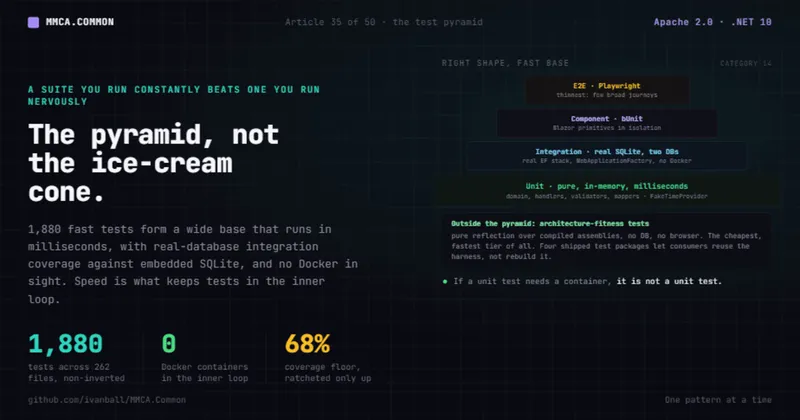
A suite you run constantly is worth more than a suite you run nervously. Here is how MMCA.Common keeps 2,254 tests fast enough to live in the inner loop, with real-database integration coverage and no Docker in sight.
There is a failure mode that almost every long-lived codebase drifts into, and it has a name: the ice-cream cone. The pyramid is inverted. A thin layer of unit tests sits at the bottom, and the bulk of the verification is a fat layer of slow, flaky, Docker-dependent end-to-end tests at the top. The suite takes twenty minutes, fails intermittently for reasons nobody can reproduce, and developers stop running it locally because the inner loop is too painful. The tests that were supposed to give you confidence instead give you a reason to avoid them.
MMCA.Common deliberately builds the right shape. About 2,254 [Fact]/[Theory], weighted to Core,
form a correct, non-inverted pyramid, with a wide base that runs in milliseconds and needs no database
and no Docker. That number, and the architecture behind it, is the single most-cited evidence in the
framework's testability score: category 14 stands at maturity 4 / implementation 9, carried by
the enforced coverage floor and the size of the suite behind it.
Why the shape matters more than the count
The test-count number is not the point. The shape is. The rubric (Architecture Evaluation Criteria, category 14) describes a healthy pyramid as "many fast unit tests on domain and application, fewer integration, few E2E," and names the inverted pyramid, "mostly slow E2E, flaky tests, tests disabled without tracking," as the headline red flag.
The reason is the inner loop. A wide base of fast tests is one you run after every change, which means defects surface in seconds, while you still have the context to fix them. A top-heavy suite is one you run at the end, in CI, after you have moved on, which means defects surface as a red build an hour later with no context. Speed is not a vanity metric. It is what determines whether the tests are part of how you write code or a tax you pay at the end.
The base: fast, pure, no infrastructure
The wide base of the MMCA.Common pyramid is pure unit tests with no I/O
(28. Testing & Quality Infrastructure): domain entity factories and invariants, value
objects, the Result/Error primitives, CQRS handlers with mocked repositories, FluentValidation
validators, and DTO and request mappers. These dominate the type count and run in-memory in
milliseconds. The whole reason this layer can be wide is the framework's design: Clean Architecture
keeps the Domain framework-pure and the Application layer testable without infrastructure, so the
logic worth testing is reachable without booting a host or touching a database.
Two design choices keep this layer honest. First, time is injected: tests use FakeTimeProvider rather
than DateTime.Now, so time-dependent logic (audit stamping, outbox eligibility delays) is
deterministic instead of flaky. Second, there is no shared mutable infrastructure to coordinate, so the
tests are isolated and parallelizable by construction.
The middle: real SQLite, two real databases, still no Docker
Above the base sit the persistence and EF-configuration tests, and this is where the "no Docker" claim gets interesting. Rather than mock the ORM (which proves nothing about whether your EF model actually builds) or spin up a SQL Server container (which is slow and adds a runtime dependency to the inner loop), the framework exercises a real EF Core stack against embedded SQLite. That means real model building: entity configurations, the outbox, repositories, and the multi-data-source resolver are verified against a real database engine, just a fast embedded one.
The standout here is MultiSourceSqliteIntegrationTests, which validates the database-per-service
routing over two real SQLite databases, a throwaway GUID-named file per logical source under the
temp directory. It proves the framework's hardest data-architecture claims against actual databases
rather than a stub: entity routing through the unit of work, per-source outbox capture, the collapse of
two logical source names sharing one connection onto a single context, and cross-source navigation
population through NavigationLoader. The Data Architecture category, whose evidence list names the same
cross-source degrade convention, scores maturity 4 in the evaluation, and this tier does it all without a
container.
Above that tier, integration tests boot a whole service host through WebApplicationFactory<Program>
and hit it over HTTP with a real, resettable database. This is also where the framework's
ship-the-test-base-as-a-package decision pays off, which I will come back to.
The cap, and an orthogonal tier
At the top of the pyramid are the component tests (bUnit, rendering Blazor components in isolation) and the end-to-end tests (Playwright, driving a real browser). These are deliberately the thinnest layer, the few broad journeys that justify their cost.
Sitting outside the pyramid entirely is a fourth, orthogonal tier: the architecture-fitness tests. They assert structural rules over compiled assemblies (the layer-dependency, domain-purity, and microservice-extraction rules) and need neither a database nor a browser. They are the cheapest, fastest tier of all, pure reflection, and they catch a class of regression that no functional test would.
Shipped test packages: consumers do not re-invent the harness
Five of the framework's nineteen published NuGet packages are test infrastructure, not test code, and this is how the pyramid stays consistent across three codebases instead of being rebuilt three times:
MMCA.Common.Testing, the integration base:IntegrationTestBase<TFixture>supplies a configuredHttpClient, bearer-token management, typedGetAsync<T>/PostAsync<T>/PutAsync<T>/DeleteAsynchelpers, per-test database reset, and a thread-safe ID counter.JwtTokenGeneratorsigns RS256 tokens with an embedded dev keypair so tests exercise the same JWKS validation path production runs.MMCA.Common.Testing.E2E, the Playwright base: browser fixtures, Blazor-aware navigation helpers that handle the InteractiveAuto hydration race, Identity page objects, and abstract workflow bases for the Login, Register, Profile, Logout, password-reset and authorization journeys, four of which close with an axe-core WCAG 2.1 AA assertion.MMCA.Common.Testing.UI, the bUnit base:BunitComponentTestBaseregisters MudBlazor's services, configures loose JSInterop, and wires real auth doubles so component tests resolve<AuthorizeView>cascades.MMCA.Common.Testing.Aspire, the AppHost base:AppHostFixtureBaseboots a real AppHost once per test collection and waits on each resource's own readiness signal, whileAppHostTestBase<TFixture>hands a test a client bound to a named resource plus typed health, readiness and JWKS assertions.MMCA.Common.Testing.Architecture, the fitness-rule library: the architecture rules defined once and consumed by each repo's thin test suite.
// A downstream integration test: a few lines of fixture glue, then real HTTP calls.
public sealed class CatalogTests : IntegrationTestBase<CatalogFixture>
{
    public CatalogTests(CatalogFixture fixture) : base(fixture) { }

    [Fact]
    public async Task Get_returns_seeded_product()
    {
        var product = await GetAsync<ProductDto>("/api/products/1");
        product.Name.Should().Be("Widget");
    }
    // HttpClient, auth token, typed helpers, and per-test DB reset all come from the base.
}
The rubric calls this out explicitly under category 14: "Shared test infrastructure (page objects, fixtures, base classes) reused across consumers, not duplicated." ADC and Store write integration tests with a few lines of fixture glue instead of re-deriving the HTTP, auth, and reset plumbing. One base evolves, all consumers inherit the fix.
That first package carries more than an integration base, though. MMCA.Common.Testing also ships the
framework's runtime conformance suites (ADR-058): seven abstract contract bases, one per runtime
contract, that a consuming host subclasses to prove it wired the framework correctly.
ProblemDetailsContractTestsBase<TFixture>asserts both error-shaping paths, ASP.NET Core model validation (400,application/problem+jsoncarryingtype,traceId, anderrors) and the framework'sHandleFailureResult mapping (404), against one sharedAssertProblemDetailsShapeAsynccheck.OpenApiContractTestsBase<TFixture>asserts the served/openapi/v1.jsonis OpenAPI 3.x and still describes every public resource the host pinned.ServiceInfoVersioningContractTestsBase<TFixture>drives/ServiceInfoatapi-version: 1.0and then2.0and checks the deprecated and supported reporting headers.SecurityHeadersTestsBaseprobes/aliveand pins six response headers, includingContent-Security-Policy: frame-ancestors 'none'and an HSTSmax-age.GracefulShutdownTestsBase<TEntryPoint>calls a realIHost.StopAsyncunder a bounded token and assertsApplicationStoppingthenApplicationStoppedfired.MmcaGatewayHardeningTestsBase<TEntryPoint>drives a booted gateway through eight edge gates: the per-client-IP rate limiter and its bypass list, the tighter named policy on the credential route, a correlation id generated when the caller supplies none and echoed when it does, one readiness check per downstream service, an active health probe on every cluster, and partitioning by the forwarded client IP rather than the proxy IP.DecoratorPipelineOrderTestsBase<TCommand, TCommandResult, TQuery, TQueryResult>resolves the decorated handler out of a built provider and walks the constructed object graph, asserting the documented nesting order.
This is the boundary against the architecture-fitness tier from the section above. Those rules assert
structure and registration, and their ADR draws that line itself in its trade-offs: "The tests assert
structure / registration, not runtime behavior." Fitness functions check shape. These check
behavior, and nothing here is inferred from a registration list. Service hosts boot through
SqlServerIntegrationTestFixtureBase<TEntryPoint>, which creates a GUID-named throwaway SQL Server
database, lets the host's own migrate-on-start strategy apply the schema, resets data between tests
with Respawn, and drops the database on disposal. Database-free hosts (the two YARP gateways) boot
through ProductionHostApplicationFactory<TEntryPoint>, which pins UseEnvironment("Production") so
the production-only branches (restrictive CORS, HSTS emission) are the ones actually under test, and
captures the started IHost, because StopAsync is not reachable through the WebApplicationFactory
surface at all.
The cost of adopting one stays small, which is the point of writing the body once: a subclass supplies two probe requests, or a path-count floor plus a pinned resource list, or a client factory, and the two gateway shutdown subclasses are single-line declarations with no body. There are no committed snapshots either. The OpenAPI guard asserts against the live document rather than a checked-in file, so a new controller can never leave a stale snapshot behind.
Adoption is partial, and that is worth reporting as an inventory rather than a clean sweep. The OpenAPI
guard and the problem-details guard both run on every extracted REST host: four ADC services and three
Store services. Versioning is subclassed once per repo (ADC Conference and Store Catalog), enough to keep
the machinery exercised and no more; Article 44 takes that one apart in detail. Security headers run on
four hosts, the two Gateways plus both web heads, while graceful shutdown stays on the two Gateways
only, so no service host asserts that contract. And MMCA.Helpdesk, the minimal reference app, takes the
two bases that need no booted service: it subclasses DecoratorPipelineOrderTestsBase and the
MiddlewarePipelineOrderTestsBase that ships beside the conformance suites, and leaves the HTTP contracts
to the two larger apps. Shipping a base is not the same as gating a host, and the inventory, not the
package list, is the honest answer to "is this contract actually guarded here."
The AppHost tier: a compiled claim about the composition
There is one file the tiers above never execute: the AppHost. It is the only place that states how a
whole stack fits together, which project resources exist, which database each one owns, which broker they
share, where JWKS discovery points, and the WaitFor graph that orders the startup. A solution build
type-checks that file and never runs it, so a resource renamed on one side of a WithReference still
compiles. The in-process integration tier boots hosts directly through WebApplicationFactory, which is
the point of that tier and also means it never sees the orchestration. The E2E tier runs against a
deployed environment, by which time a composition mistake is an incident rather than a test failure.
ADR-117 closes that gap as a package rather than a per-repo copy, and both consumer smoke tiers subclass
it.
AppHostFixtureBase is a collection fixture: it boots the real AppHost once through an
IDistributedApplicationTestingBuilder, starts it, waits for the resources to report ready, and hands the
running DistributedApplication to every test in the collection. The wait is the design point. "The
application started" only means the orchestrator launched the processes, so the fixture awaits each
resource's own health signal instead: resources that carry a health check are awaited healthy, resources
that carry none can only be awaited Running, and the fixture says which happened rather than pretending
the two are the same. Teardown stops and disposes the application and restores every environment variable
the fixture pushed, so one collection cannot leak key material into the next.
A missing precondition is a skip, not a failure, and that is what keeps the tier honest on a laptop.
AppHostEnvironmentGate reads the opt-in variable MMCA_APPHOST_TESTS and the default requirement is
that variable plus a container runtime, so the tier is off unless you ask for it; when something is
missing, SkipReason carries a sentence a human can act on and nothing is started. The fixture also mints
an ephemeral RS256 keypair into E2E_JWT_* when the environment has none, because an Identity resource
without key material answers every request including its liveness probe with a 500, never turns healthy,
and takes every WaitFor edge behind it down with it. That failure mode is in the record because it cost
an eight-day red nightly to diagnose.
AppHostTestBase<TFixture> then gives a test the two things only a running stack can hand it, an
HttpClient bound to a named resource and a resolved connection string, plus typed assertions over the
wiring contracts: AssertHealthyAsync, AssertAliveAsync, AssertReadyAsync, AssertJwksAsync and
AssertH2cAsync. The probe paths are constants (/health, /alive, /health/ready,
/.well-known/jwks.json) mirrored from the framework's own, with a unit test cross-asserting each pair so
a rename cannot silently orphan a probe. One rule is written into the constant's own documentation: a
startup gate probes liveness, never readiness, because a readiness endpoint aggregates downstream checks
and gating startup on it can deadlock the dependency graph.
// Illustrative: the consumer names the AppHost, the base owns boot, readiness, skip, and teardown.
public sealed class MyAppHostFixture : AppHostFixtureBase<Projects.MyApp_AppHost>
{
    protected override AppHostEnvironmentRequirement RequiredEnvironment =>
        AppHostEnvironmentRequirement.OptIn | AppHostEnvironmentRequirement.Docker;
}

public sealed class StackSmokeTests(MyAppHostFixture fixture) : AppHostTestBase<MyAppHostFixture>(fixture)
{
    [Fact]
    public async Task Identity_publishes_its_key_set()
    {
        Assert.SkipWhen(!Fixture.IsAvailable, Fixture.SkipReason!);
        await AssertJwksAsync("identity");
    }
}
Accessibility as a shipped test contract
The E2E package carries one more contract, and it is the tier where a published standard turns into a
build failure instead of a review comment. ADR-063 records it: WCAG 2.1 AA ships as a named constant in
MMCA.Common.Testing.E2E rather than as a setting each repo retypes.
AxeOptions.Wcag21Aa pins every axe scan to exactly four tags, wcag2a, wcag2aa, wcag21a, and
wcag21aa: levels A and AA across WCAG 2.0 and 2.1. What is left out is the load-bearing part. axe's
"best-practice" rules are deliberately outside the target, and that exclusion is what makes the check
blockable rather than advisory. Best-practice findings are opinions, A and AA findings are a standard,
and a gate that can go red on an opinion gets demoted to a suggestion within a month.
A violation is a thrown failure, not a report. AssertNoAccessibilityViolationsAsync runs axe and
throws AccessibilityViolationException carrying each rule's impact, id, help text, and the offending
markup compacted to one line per node, so a red gate points at the element. The package's Identity
workflow bases call it themselves: UserLoginTestsBase, UserRegistrationTestsBase,
ProfileManagementTestsBase, and PasswordResetTestsBase each end their journey by asserting against
AxeOptions.Wcag21Aa, so an app that subclasses them inherits the scan without writing one. For its own
pages a consumer picks between two helpers on E2ETestBase, and the pick is the declaration of which rule
set applies: ScanAsync waits for any loading bar to clear and asserts the strict options, ScanGridAsync
waits for a seeded data row and asserts with the one recorded exception.
There is exactly one exception, and it exists as a second option value rather than a suppression flag.
Wcag21AaExceptMudPagerCombobox carries the same four tags and disables a single rule,
aria-input-field-name, for pages whose only combobox is MudBlazor's own MudTablePager "rows per
page" select, which gets no accessible name and exposes no Label parameter to fix it from app markup.
Every other WCAG 2.1 AA rule still runs on those pages. One named, scoped, recorded exception is the
honest shape here: the caller has to say which contract it is scanning under, and the cost is written
down rather than buried, because the rule is off for the whole page scan and not just for the pager
node.
Enforcement then differs per repo, and precision matters more than a slogan. MMCA.Common scans its own backend-less gallery across chromium, firefox, and webkit, and all three are required merge checks. ADC and Store run a chromium-only leg against the full Aspire stack as a deploy gate, and that gate is scoped to UI changes, so a backend-only or infra-only deploy legitimately skips it: "deployed" does not always mean "axe ran on this commit". MMCA.Helpdesk adopts none of it. It pins the package version, references it from no project, and has no E2E test project at all, so the seed demonstrates the layers and not this contract.
Runner and gate: xUnit v3, MTP, and a coverage floor
A detail that trips up people coming from older .NET projects: the suite runs on the Microsoft Testing
Platform (MTP), not VSTest, configured in global.json, with xUnit v3, AwesomeAssertions, and
Moq. To run one class or method you target the project and pass an MTP filter after --
(-- --filter-class "*FooTests*" or -- --filter-method "*Pattern*"). One sharp edge worth knowing: every test
project must contain at least one test or MTP exits with code 8, so the unit run floors at
--minimum-expected-tests 2000 (the suite is about 2,254): a discovery or filter regression that
silently drops thousands of tests fails the job instead of passing green with a handful discovered.
And the suite is a real gate, not a suggestion. CI collects coverage via dotnet-coverage (which wraps
the MTP run and returns its exit code, so a test failure still fails the build) and enforces a
coverage floor: the unit tier must stay at or above 68.3% line coverage (measured about 70.3%) as
a regression backstop, gated on the unit tier alone rather than a gallery-diluted merged report, and
the floor only ever moves upward.
Trade-offs, honestly
The shape is right, but the scorecard names real gaps and one is squarely in the testing story.
- The UI tier's visual check is markup-deep, not pixel-deep. The framework ships roughly a dozen
reusable Blazor primitives in
MMCA.Common.UI, some with real branching logic (MobileCardList,MobileInfiniteScrollList), and the pyramid carries a fast base layer for the UI under them: theMMCA.Common.Testing.UIbUnit base backs their component tests, a real-browser render-smoke gate runs in CI, and a render-snapshot regression tier diffs their markup against committed baselines. Category 28 (Front-End Testing) scores maturity 4 / implementation 9 on that evidence. The limit is what a snapshot compares: markup structure, not rendered pixels. - SQLite is not SQL Server. The middle tier is fast precisely because it uses SQLite, which means SQL-Server-specific behavior (certain query translations, concurrency-token semantics) is validated against an approximation. The scorecard's Data Architecture row is candid about the surrounding shape: it holds maturity at 4 with implementation at 9, and ADR-018 records the non-SQL engines as deliberately latent, with no production entity on them. The trade buys a fast, Docker-free inner loop at the cost of needing the consumer apps and CI to cover the SQL-Server-specific paths.
- The honest limit is mutation testing, not coverage. The unit tier holds a 68.3% line-coverage floor (measured about 70.3%), enforced in CI and ratcheted up as the suite grows rather than left as an aspiration. What holds category 14 below the top band is a single Exemplary gap: there is no mutation testing on the Core tier, so a green suite proves the lines run, not that every assertion would catch a mutant. That is a real limit, stated plainly.
None of these argue against the pyramid. They are the cost of keeping the base fast and honest about what each tier actually proves.
Apply this even without MMCA
The shape ports to any stack:
- Make the base fast enough to run on every save. No Docker, no network, no shared database in the layer you run constantly. If your unit tests need a container, they are not unit tests.
- Use a real but embedded database for persistence tests. A throwaway SQLite file (or your stack's equivalent) proves the ORM mapping actually builds without the cost of a container. Mocking the ORM proves nothing.
- Inject time and other ambient state. A
FakeTimeProvider-style swap point turns flaky time-dependent tests into deterministic ones. - Ship your test harness, do not copy it. If you have more than one service, put the fixtures, page objects, and base classes in a shared package so every consumer reuses one evolving harness.
- Gate it, then ratchet. A modest coverage floor that only goes up beats an aspirational target nobody enforces.
The rule of thumb is the title: build the pyramid, not the ice-cream cone. A suite you run constantly, because it is fast and green, is worth more than a comprehensive suite you run nervously, because it is slow and flaky.
What we covered: why the pyramid's shape matters more than its count, the fast no-Docker base
(pure unit tests plus FakeTimeProvider), the real-SQLite middle tier with two databases in
MultiSourceSqliteIntegrationTests, the thin bUnit/Playwright cap and the orthogonal fitness-test tier,
the five shipped test packages that let consumers reuse the harness, the seven runtime conformance bases
that prove a really-booted host wired the framework's contracts (ADR-058) and their partial adoption, the
AppHost tier that compiles a claim about the composition itself (ADR-117), WCAG 2.1 AA shipped as a named
axe target with one recorded exception (ADR-063), the xUnit v3 / MTP runner and the CI coverage floor, and
the UI tier's honest limit: markup-deep snapshots rather than pixel-deep rendering.
Next in the series: soft-delete vs the right to erasure, the GDPR conflict that was this framework's lowest-scoring category, and the boundary that resolved it.
MMCA.Common is Apache-2.0 licensed and open source. Star the repo, read the Testing section of the
contributor guide, or dotnet add package MMCA.Common.Testing and reuse the integration base in your
own app.
- ⭐ Repo: https://github.com/ivanball/MMCA.Common
- 📄 The Testing and Build & Test Commands sections (
CLAUDE.md) are in the repo; the testability score (§14/§28) is the current number in MMCA.Common: Architecture Scorecard.
Tags: .NET, Testing, C Sharp, Software Architecture, Test Automation