Core patterns · No. 5
Kill the anemic domain model: rich aggregates with factory methods that return Result
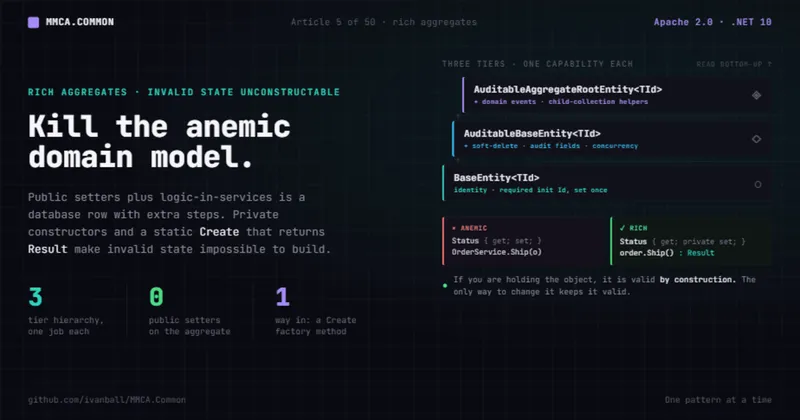
Public setters plus logic-in-services is not a domain model, it is a database row with extra steps. Here is the three-rung entity hierarchy in MMCA.Common that makes invalid state unconstructable.
You have seen this class. You have probably written it. Maybe this week:
public class Order
{
    public int Id { get; set; }
    public OrderStatus Status { get; set; }
    public decimal Total { get; set; }
    public List<OrderLine> Lines { get; set; } = new();
}

public class OrderService
{
    public void Ship(Order order)
    {
        if (order.Status != OrderStatus.Paid)
            throw new InvalidOperationException("Cannot ship an unpaid order");
        order.Status = OrderStatus.Shipped;
    }
}
The Order is a bag of public setters. It knows nothing and protects nothing. Anyone can set
Status = Shipped directly and skip the check. Anyone can set Total to a negative number. The rule
about not shipping an unpaid order lives in a service, off to the side, where it is one of many such
services that all reach into the order and mutate it from outside.
Martin Fowler named this the anemic domain model, and the name is precise: the objects have data but no behavior. The behavior has been drained out into a procedural layer. You get all the ceremony of object orientation (classes, properties, a "domain" folder) with none of its protection. The invariants are not enforced by the type; they are enforced by everyone remembering to call the right service in the right order.
Why it matters
The cost is not theoretical. When the rules live outside the object:
- Invalid state is representable. You can construct an
Orderwith a negative total and no lines, because the only thing standing between you and that object is a property setter. Bugs become "how did this row get into this state" tickets that nobody can reproduce. - The rules drift. The shipping check lives in
OrderService.Ship. Six months later someone addsBulkOrderService.ShipAlland forgets the check, because nothing tied the rule to the object. - You cannot trust the object you are holding. Every method that receives an
Orderhas to re-validate, because the type guarantees nothing.
A rich domain model inverts this. The object owns its rules. The only way to get an Order is through
a path that has already validated it, and the only way to change it is through a method that enforces
the invariant. If you are holding an Order, it is valid, by construction.
The MMCA answer: a three-rung hierarchy, one capability per rung
MMCA.Common builds every entity on a three-class inheritance chain. Read it bottom-up; each rung adds exactly one capability.
BaseEntity<TId>                    // identity
   -> AuditableBaseEntity<TId>     // + soft-delete, audit fields, optimistic concurrency
      -> AuditableAggregateRootEntity<TId>   // + domain events, child-collection helpers
BaseEntity<TId> is almost nothing: a single required init TId Id with a where TId : notnull
constraint. The required init is the load-bearing choice. A factory method sets Id once at
construction, and init makes it immutable thereafter, while EF Core still materializes existing rows
through the parameterless constructor and assigns Id via the same init accessor. One identity, set
once, never reassigned, on both the application path and the persistence path.
AuditableBaseEntity<TId> adds the cross-cutting facts every persisted row needs. Soft-delete
(IsDeleted, plus a Delete() / Undelete() pair that return Result and refuse to double-delete),
audit fields (CreatedOn/By, LastModifiedOn/By) with private setters, and a RowVersion
optimistic-concurrency token. The domain never writes the audit fields; they are stamped centrally
by the AuditSaveChangesInterceptor that EF Core runs inside SaveChangesAsync. Three concerns
that would otherwise be copy-pasted into every entity are inherited once and enforced in one place.
AuditableAggregateRootEntity<TId> is the top rung, the one that earns the DDD name "aggregate
root." It owns a private domain-event list (AddDomainEvent / ClearDomainEvents / a read-only
DomainEvents view, plus RemoveDomainEvents), and it adds six protected helpers that let a root
police its own consistency boundary: SetItems (replace a child collection, routed through an
overridable ValidateSetItems hook so a root can veto removing, say, a shipped order line),
GetChildOrNotFound<TChild, TChildId> (find an active child by id or return an Error.NotFound
failure), and the rest of the child lifecycle in RemoveChildOrNotFound, RestoreChild and
DeleteChildren. Only aggregate roots raise domain events, which is how the persistence layer knows
where to look.
The factory method that returns Result
Here is the heart of it. The constructor is private. The only public way in is a static Create that
returns Result<T>:
public sealed class Order : AuditableAggregateRootEntity<OrderIdentifierType>
{
    private readonly List<OrderLine> _lines = [];
    public OrderStatus Status { get; private set; }
    public Money Total { get; private set; }

    private Order() { }   // EF materialization only

    public static Result<Order> Create(CustomerIdentifierType customerId, Money total)
    {
        var validation = Result.Combine(
            CommonInvariants.EnsureIdIsNotDefault(
                customerId,
                "Order.CustomerId.Invalid",
                "An order needs a customer.",
                nameof(Create),
                nameof(customerId)),
            EnsureTotalIsNonNegative(total));

        if (validation.IsFailure)
        {
            return Result.Failure<Order>(validation.Errors);
        }

        return Result.Success(new Order { Id = default, Total = total, Status = OrderStatus.Pending });
    }

    public Result Ship()
    {
        if (Status != OrderStatus.Paid)
        {
            return Error.Invariant("Order.NotPaid", "Cannot ship an unpaid order");
        }

        Status = OrderStatus.Shipped;
        AddDomainEvent(new OrderShipped(Id));
        return Result.Success();
    }
}
Compare this to the anemic version. There are no public setters: Status and Total have
private set. There is no service holding the shipping rule; Ship() is the rule, and it lives on
the object. You cannot new Order(...) from outside, so an invalid order cannot exist. The
Result.Combine reports every broken invariant at once (covered in the Result railway article), and
Ship() raises an OrderShipped domain event as a first-class outcome rather than a side effect the
caller might forget. Invalid state is, quite literally, unconstructable.
Value objects: the same trick, one level down
The aggregate is built from value objects that play by the same rules. ValueObject is the cheapest
possible base, public abstract record ValueObject;, so every value object inherits structural
equality and immutability from record for free. Two Money(10, USD) are equal because their values
match, not because they are the same row.
Each concrete value object (Email, Money, Address, DateRange) uses the same private-constructor
plus static Create returning Result<T> idiom, so an invalid Email simply cannot be constructed.
The validation lives in static invariants classes (EmailInvariants, AddressInvariants). Only
AddressInvariants's MaxLength constants are actually reused elsewhere, and both reuse sites sit
inside MMCA.Common: AddressValidationRules reads them for FluentValidation, and the OwnsAddress
mapping extension reads the same six constants for HasMaxLength on the owned Address columns, so a
consuming app (Store's CustomerConfiguration) gets the field-length rule from one source of truth
through a single builder.OwnsAddress(p => p.Address); call. EmailInvariants.MaxLength does not get
the same treatment: each consumer declares its own, separate email length limit instead (Store's
CustomerInvariants.EmailMaxLength is 100, ADC's UserInvariants.EmailMaxLength is 100, and ADC's
SpeakerInvariants.EmailMaxLength aliases the 255 its own DTO declares), none derived from the 256
EmailInvariants itself declares.
Identifier aliases: the war on primitive obsession
There is one more piece that is easy to miss but does heavy lifting against bugs. Look back at the
factory signature: Create(CustomerIdentifierType customerId, Money total), not
Create(int customerId, decimal total).
MMCA.Common defines per-entity identifier aliases, for example a solution-wide
global using UserIdentifierType = int; linked into every project via Directory.Build.props. The
underlying type is still int, but the name carries meaning. A method that takes a
UserIdentifierType and an OrderIdentifierType reads unambiguously at every call site, the way two
bare ints never do. The id is also strongly named at the entity level (BaseEntity<TId> is generic
over the alias), and Money instead of decimal means the currency travels with the amount. This is
primitive obsession addressed at the type level rather than in code review.
The opt-in alternative: a wrapper struct the compiler enforces
The alias is the default, and it stays the default: every entity, DTO and consumer in this workspace
identifies itself through a primitive alias. An alias is a name for a primitive, though, so it buys
readability rather than enforcement. UserIdentifierType and OrderIdentifierType are both int, and
a call that transposes them compiles. For the case where you want that to be a compile error,
MMCA.Common ships the wrapper struct as an opt-in capability (ADR-115).
The contract is one interface with two members. IStronglyTypedId<TSelf, TValue> is self-referencing
(where TSelf : struct, IStronglyTypedId<TSelf, TValue>) and declares a TValue Value getter and a
static abstract TSelf From(TValue value) factory. It also derives from IParsable<TSelf> and
supplies both parse legs as default implementations, so a wrapper writes neither. Declaring one is two
lines:
public readonly record struct OrderId(int Value) : IStronglyTypedId<OrderId, int>
{
    public static OrderId From(int value) => new(value);
}
The positional record struct supplies Value, structural equality and ToString; the interface
supplies the rest. Because BaseEntity<TId> constrains its identifier to notnull and a
readonly record struct satisfies that, an entity keyed by OrderId needs no change anywhere in the
hierarchy.
One registration call is the whole opt-in. services.AddStronglyTypedIds(typeof(OrderId).Assembly)
scans the named assemblies, registers a StronglyTypedIdRegistry singleton, and registers a
StronglyTypedIdTypeConverter<TSelf, TValue> for each wrapper it finds through
StronglyTypedIdTypeConverters.Register. The TypeConverter is the load-bearing piece for MVC: a
minimal API binds a route segment through IParsable<T>, but an MVC [FromRoute] scalar binds through
TypeDescriptor.GetConverter, so GET /orders/42 does not bind without one. JSON goes through
StronglyTypedIdJsonConverterFactory, which writes the bare primitive and covers dictionary keys, so
the wire shape of OrderId is the wire shape of int.
Persistence decides whether adopting this is cheap, and it is. ApplicationDbContext asks the
container for the registry inside ConfigureConventions and, when it finds one, hands it to
StronglyTypedIdModelConfiguration.Apply, which declares a pre-convention type mapping per identifier
built from StronglyTypedIdValueConverter<TSelf, TValue> and StronglyTypedIdValueComparer<TSelf>
(NullableStronglyTypedIdValueConverter<TSelf, TValue> is the optional-property form). Two
consequences follow: the column stays the primitive, so wrapping an identifier is a code change rather
than a schema migration, and because the mapping lives on the one base context every engine context
inherits, every database engine gets it with no engine branch. A host that never calls
AddStronglyTypedIds resolves no registry, and the entire path is a no-op.
For a contract that deliberately keeps primitives on the wire, StronglyTypedIdMappings<TSelf, TValue>
exposes ToValue and ToIdentifier as plain static methods that a Mapperly-generated mapper discovers
by signature. The posture the framework takes is worth stating plainly: the aliases are the identifier
model for everything shipped here, nothing pushes a consumer toward a wrapper, and the capability
exists so that a team that does want transposition caught by the compiler gets JSON, EF Core, MVC
binding, filtering and OpenAPI answered in one place instead of hand-rolling a variant at six
boundaries.
Soft-delete, not destruction
Entities are never hard-deleted. Delete() flips IsDeleted to true and an EF global query filter
hides the row; the data and its foreign-key relationships stay intact. Delete() returns Result and
guards against double-deletion (returning Error.AlreadyDeleted), so even "remove this" flows through
the same error railway as everything else.
Trade-offs, honestly
Rich aggregates are the right default, but they are not free, and the scorecard's §4 review names the gaps:
- More boilerplate per entity. A private constructor, a static factory, private setters, and invariant checks are more code than four public auto-properties. The protection is worth it, but the first entity feels heavier than the anemic version.
- EF Core needs the parameterless constructor. The materialization path is a real constraint: EF
builds the object through
private Order()and setsIdviainit, which is why the constructor exists at all. You are designing around two construction paths, the factory and the ORM, and that costs a little ceremony. - Strategic DDD is downstream work, not framework work. The tactical conventions are
machine-enforced: an
AggregateConventionTestsfitness function, merge-gated, pins that every aggregate root exposes a staticCreatereturningResult<T>and has no public constructors, so "private constructor plus aCreatefactory" is an executable check, not a convention held by review. What no base class can give you is the strategic half of DDD: bounded contexts and a ubiquitous language are realized in the apps that build modules on these classes, not in the framework itself, and the scorecard's §4 names that as the remaining gap. - Aggregate boundaries are a judgment call. Deciding what belongs inside a root and what is its own aggregate is genuine modeling work that no base class makes for you.
Apply this even without MMCA
You do not need this framework to drop the anemic model. The moves are portable:
- Make constructors private and add a static factory that validates and returns a result type. If the only public way to build an object runs through validation, an invalid object cannot exist.
- Replace public setters with behavior methods.
order.Ship(), notorder.Status = Shipped. The rule lives on the object that owns the data. - Use strong identifier types, even if they are thin wrappers over
intorGuid. Transposed-id bugs are silent and expensive; the type system can catch them for free. - Push validation into value objects. An
Emailthat cannot be constructed invalid means every method downstream can stop re-checking it.
The rule of thumb: if you are holding the object, it should be valid, by construction, and the only way to change it should be a method that keeps it valid.
What we covered: why the anemic model drains protection out of your types, the
BaseEntity to AuditableBaseEntity to AuditableAggregateRootEntity hierarchy (identity, then
audit/soft-delete, then domain events), the private-constructor-plus-Create-returning-Result idiom
that makes invalidity unconstructable, value objects and identifier aliases against primitive
obsession (with the strongly typed identifier struct as the opt-in alternative), and domain events
raised on the aggregate root.
Next in the series: specifications over LINQ spaghetti, the composable, reusable query intent that keeps read logic out of your controllers.
MMCA.Common is Apache-2.0 licensed and open source. Star the repo, skim the domain building-blocks chapter,
or dotnet add package MMCA.Common.API and try it.
- Repo: https://github.com/ivanball/MMCA.Common
- Onboarding chapter: 2. Domain Building Blocks (Entities, Value Objects, Aggregates).
Tags: .NET, C Sharp, Software Architecture, Programming, Domain-Driven Design