Data & persistence · No. 15
Event-schema versioning: never silently reshape an event
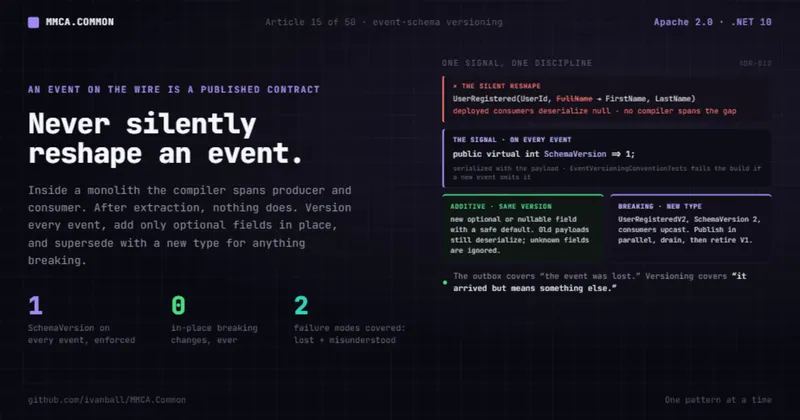
An integration event is a wire contract the moment it crosses a service boundary. Reshape it in place and you break consumers that are already deployed. Here is the policy that prevents it.
You shipped this event a year ago, and three services consume it:
public sealed record UserRegistered(int UserId, string FullName) : BaseIntegrationEvent;Today a product requirement says you need first and last name separately. The obvious edit:
// Looks harmless. It is not.
public sealed record UserRegistered(int UserId, string FirstName, string LastName)
    : BaseIntegrationEvent;
You deploy the producer. The event serializes with the new shape. Every consumer that still expects
FullName deserializes it, finds no FullName, and either gets a null where it never expected one or
throws on a missing required member. Nothing on the wire told them the shape changed. They were already
deployed and running, and you reshaped the contract under them.
This is not a hypothetical. With database-per-service and async integration over the outbox, consumers
resolve an event solely by its type string: the outbox serializes the event to JSON keyed by
EventType, and the broker path binds by .NET message type. There is no schema registry in the middle
saying "this is a different shape than you expect." A producer that reshapes a payload silently breaks
every consumer, and it does it in production, asynchronously, where it is hardest to trace.
Why it matters
In a monolith, an event handler and the code that raises the event compile together. Reshape the event and the consumer fails to compile; you fix it in the same commit. The type system is your schema check.
The moment a module is extracted into its own service, that safety net is gone. Producer and consumer are independently deployed. They are different processes, possibly different repos, definitely different deploy cadences. There is now a window where the producer speaks the new shape and the consumer still expects the old one, and no compiler spans that window. The events that were "just an internal contract" inside the monolith are now a wire contract, and wire contracts have exactly one rule: you do not break them out from under a deployed reader.
An event that carries only MessageId (idempotency) and DateOccurred (when the business action
happened) has no version signal at all, and a consumer meeting an unfamiliar payload has nothing to
branch on: it cannot tell a producer that has moved ahead of it from a shape it should refuse, and it
certainly cannot upcast. That is the one substantive CQRS and event-driven gap the scorecard names
under §6, and ADR-010 is the answer.
The MMCA answer: a version on every event, and a rule for changing it
The decision has two halves: a signal that is enforced, and a discipline for breaking changes.
Half one: every integration event carries an explicit SchemaVersion. The base record exposes it
as a virtual default:
// MMCA.Common.Domain - BaseIntegrationEvent
public virtual int SchemaVersion => 1;

// A concrete event overrides only when it bumps:
public sealed record UserRegisteredV2(int UserId, string FirstName, string LastName)
    : BaseIntegrationEvent
{
    public override int SchemaVersion => 2;
}
It is serialized with the payload (System.Text.Json on the outbox path, MassTransit on the broker
path), so a consumer always sees the producer's declared version and has an explicit value to branch or
upcast on. And it is not just a convention you have to remember: a fitness function,
EventVersioningConventionTests, asserts that every concrete integration event declares an int SchemaVersion, so a new event cannot ship without one. The same invariant-over-discipline approach as
the layer rules and the MassTransit-v8 pin: a thing that matters is a check, not a comment.
Half two: the rule for changing a shape.
- Additive, optional changes keep the same version. Adding a nullable or optional field, or one with a safe default, is backward-compatible. Consumers ignore unknown fields (System.Text.Json's default), and old payloads deserialize with the default. No version bump.
- Breaking changes require a NEW type plus an upcaster, never a silent reshape. Renaming, removing,
or retyping a field is breaking. The producer introduces a new event type (
UserRegisteredV2,SchemaVersion => 2) and publishes it. Consumers register an upcaster that maps the old type/version to the new shape before their handler runs. The old type is retired only after every consumer has drained it.
That last point is forced by the transport, not chosen for taste. The broker binds by type, so a rename is a parallel-publish-and-drain migration with a real compatibility window, not an in-place edit. An in-place reshape has no compatibility window: the instant the producer deploys, the old shape is gone, and any consumer mid-deploy or slow to upgrade is reading a contract that no longer exists. New-type-for-breaking-change is the only safe option when transport binds by type and consumers deploy independently.
Since 2026-08-21 the framework ships the wiring for that migration, not only the rule (ADR-090). An
upcaster is one typed class, IEventUpcaster<TOld, TNew>, registered by the module that owns the
contract:
// Module DI: one line per retired contract.
services.AddEventUpcaster<ProductVariantChanged, ProductVariantChangedV2, ProductVariantChangedUpcaster>();

// Broker hosts also bind the retired queue, inside AddBrokerMessaging's consumer callback:
x.RegisterIntegrationEventConsumer<ProductVariantChangedV2>();       // the current contract
x.RegisterUpcastedIntegrationEventConsumer<ProductVariantChanged>(); // the old one, draining
The registry chains registrations to the terminal contract (register V1 to V2 and V2 to V3, and a V1
message reaches the V3 handler), and after every hop it stamps MessageId and DateOccurred from the
pre-hop instance, so inbox deduplication keys survive the transform and an upcaster author maps payload
fields only. Both delivery paths honor it, the in-process dispatcher and the broker consumer, so
handlers are written once against the newest contract. A duplicate source contract, a type mapped onto
itself, or a cycle fails host startup with the offenders named, rather than the first message. Retiring
the old type is deleting these lines.
SchemaVersion is non-breaking by construction. A virtual get-only default (=> 1) means no existing
event has to change and no outbox row has to be migrated: System.Text.Json tolerates the missing field
on old payloads and the type supplies the default; new rows simply gain "schemaVersion":1. It lives in
the framework, and a framework change reaches every consumer in one pass: the lockstep policy (ADR-016)
bumps every MMCA.Common.* pin in every consumer together, with no phased rollout, so no consumer sits
on a base record its producers have moved past.
How it complements the outbox
This sits directly on top of the transactional outbox (ADR-003). The outbox guarantees an event is delivered at least once: persisted atomically with the state change, then drained to consumers with retries. Schema versioning guarantees that when the event arrives, the consumer can understand it.
The two failure modes are different and both have to be covered. The outbox addresses "the event was lost." Versioning addresses "the event arrived but means something different than the reader thinks." At-least-once delivery already requires consumers to be idempotent (a duplicate can arrive); add to that contract that a consumer should also be tolerant of versions it knows and explicit about versions it does not. The version field is what lets a consumer make that decision instead of guessing from a shape that silently changed.
Trade-offs, honestly
ADR-010 is candid that the field is a signal, not a complete mechanism.
SchemaVersionby itself does not stop a consumer breaking on a real reshape. It is a value on the wire, and the load-bearing half is still the discipline: new type plus upcaster. That half is no longer only a discipline. The framework now ships the registration extension point (2026-08-21, ADR-090): a typedIEventUpcaster<TSource, TTarget>,AddEventUpcaster<...>(), a chaining registry that preserves the envelope, a draining broker consumer for the retired queue, and two fitness functions that reject two upcasters claiming one source contract or a target that does not raiseSchemaVersion. Two gaps stay open and are worth naming: the framework itself still ships no V2 event of its own (its one concrete integration event stays at version 1, so the first real consumer migration will be the pipeline's first production use), and outbox type-name aliasing for a type deleted ahead of policy is deliberately out of scope, because the policy keeps the old type alive until every consumer has drained it.- The convention test covers a real event in MMCA.Common, but the framework's own coverage is one
event wide. Common ships exactly one concrete integration event, the sealed record
OutputCacheEvictionRequested, andCommonArchitectureMapregisters the Domain assembly it lives in, soEventVersioningConventionTestsruns against a real event in Common's own build. Enforcement runs at five points: the framework itself plus four consumer trees (ADC, Store, Helpdesk, and a local-only two-module sample), each subclassing the same base and running the identical rules against its own event assemblies. One caveat rides along: Common's map declares no modules, so the Shared-layer half of the namespace rule is relaxed for the framework's own event, while every module-bearing consumer is still held to it. The framework supplies the rule; the consumers still supply the bulk of the events that exercise it. SchemaVersionis informational on the wire (it round-trips out, not back in). A get-only virtual property means you read the version off the concrete type or the JSON, you do not mutate it per instance. That is intentional (a version is a property of the type, not of an individual message), but it means the upcaster reads the declared type, not a settable field. That is literally how the shipped registry works: it indexes upcasters and walks chains by the declared .NET type, which is what both transport bindings already key on.
None of these are reasons to skip the field. They are the reasons the field is necessary but not sufficient, and the discipline is the rest of the answer.
Apply this even without MMCA
The policy ports to any event-driven system with independently deployed consumers:
- Put an explicit version on every event, and make it un-skippable. A test that fails the build when a new event omits a version is worth more than a wiki page that says to add one.
- Treat additive-and-optional as the only in-place change you are allowed to make. New nullable field with a default: fine. Anything else is breaking.
- For breaking changes, publish a new type and upcast, then drain and retire the old one. Never edit a shape that a deployed reader still expects. The broker binds by type; use that to get a compatibility window instead of a cliff.
- Pair it with at-least-once delivery and idempotent consumers. Versioning answers "can I understand this?"; the outbox and idempotency answer "did I get it, exactly once in effect?" You need both.
The rule of thumb: the instant an event crosses a service boundary it is a published contract. You can add to it, you can supersede it, but you can never quietly change it.
What we covered: why silently reshaping an integration event breaks already-deployed consumers
(especially after extraction, when the compiler no longer spans producer and consumer), how
MMCA.Common puts an enforced SchemaVersion on every event and answers a breaking change with a new
type plus a registered upcaster that the framework chains and applies on both delivery paths, and how
that complements the outbox's at-least-once delivery.
Next in the series: cross-service auth without a shared secret, JWKS dual-fetch and RS256 so an extracted service validates tokens with no shared key.
MMCA.Common is Apache-2.0 licensed and open source. Star the repo, read the 2-minute ADR-010 behind this
policy, or dotnet add package MMCA.Common.API and try it.
- Repo: https://github.com/ivanball/MMCA.Common
- ADR-010 (event-schema versioning and upcaster policy): ADR-010: Integration-Event Schema Versioning & Upcaster Policy in the docs site.
- ADR-090 (the upcaster registration extension point): ADR-090: Event Upcaster Registration Extension Point in the docs site.
Tags: .NET, C Sharp, Software Architecture, Event-Driven Architecture, Microservices