Core patterns · No. 6
Specifications over LINQ spaghetti: composable, reusable query intent
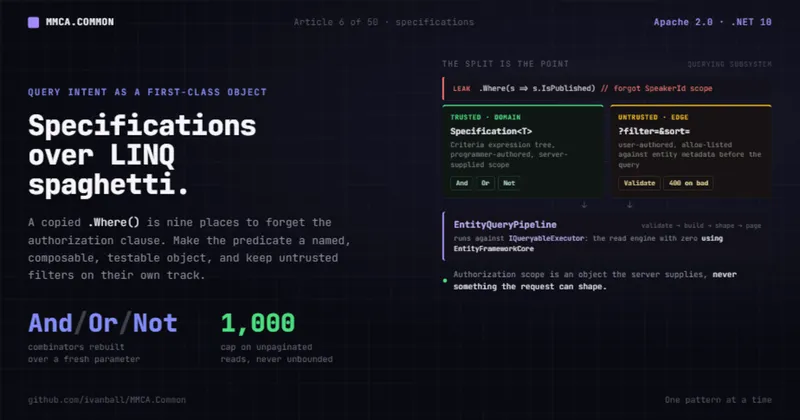
A .Where(s => s.SpeakerId == id && !s.IsDeleted && s.IsPublished) copied into nine
controllers is nine places to forget the authorization clause. Here is the Specification pattern that
makes query intent a first-class, composable, testable object, and a generic pipeline that keeps the
Application layer from ever touching EF Core.
Find the bug:
// SessionsController.GetMine
var sessions = _db.Sessions
    .Where(s => s.SpeakerId == currentUserId && !s.IsDeleted)
    .ToList();

// SessionsController.GetMinePublished  (added three months later, different dev)
var sessions = _db.Sessions
    .Where(s => s.IsPublished && !s.IsDeleted)   // forgot the SpeakerId scope
    .ToList();
The second query leaked. It returns every published session in the system, not just the current
speaker's, because the SpeakerId authorization clause lived as a loose lambda that someone had to
remember to copy. The predicate that matters most (the one that scopes data to the caller who is
allowed to see it) is the one most easily dropped, because it is just text in a .Where() that gets
re-typed at every call site.
This is LINQ spaghetti: query intent scattered across controllers as ad-hoc lambdas, with no name, no reuse, and no way to test "does the own-sessions rule actually restrict to the owner" in isolation. The Specification pattern fixes it by turning a predicate into an object.
Why it matters
Query predicates are not throwaway plumbing. Some of them encode business rules ("a published event is one whose status is Published and whose start date has not passed") and some encode authorization ("only the questions this attendee asked"). When those live as inline lambdas:
- They cannot be named or reused. "Published event" is a concept;
.Where(e => e.Status == Published && e.StartsAt > now)is a spell you recite from memory. - They cannot be composed reliably. Combining two inline predicates with
&&works until one of them has to be applied conditionally, at which point you get branchingIQueryableplumbing in the controller. - They cannot be tested in isolation. You can only test the controller action that uses them, so the rule and the HTTP plumbing are tangled in every test.
- The security-critical ones get dropped, exactly as above.
A specification gives the predicate a type and a name, makes it composable with And/Or/Not, and
lets the framework apply it server-side so the filter runs in the database, not in memory after a
full-table load.
The MMCA answer: trusted specifications, untrusted filters, one pipeline
MMCA.Common splits the read side into three cooperating sub-systems, and the split is the point.
1. The Specification pattern (the trusted predicate)
ISpecification<TEntity, TIdentifierType> exposes two faces of the same rule:
- a
Criteriaexpression tree (Expression<Func<TEntity, bool>>) that EF Core translates to SQL, so the filter runs in the database, and - an
IsSatisfiedBy(entity)predicate for in-memory evaluation.
The abstract base Specification<TEntity, TIdentifierType> lazy-compiles the expression once and caches
the delegate, so repeated in-memory checks do not recompile the tree. Three combinators,
AndSpecification, OrSpecification, and NotSpecification, compose specifications into a new one,
and they do it by parameter substitution: an ExpressionVisitor rebinds the right-hand operand's
parameter onto the left-hand lambda's own parameter, and the two bodies are joined with
Expression.AndAlso / OrElse / Not, so the result is again a single
Expression<Func<TEntity, bool>>, indistinguishable from a hand-written predicate. The obvious
alternative, Expression.Invoke(spec.Criteria, parameter), is deliberately avoided, and the source
says so in as many words: an InvocationExpression survives into the query tree, and while EF Core's
relational providers can usually unwrap it, others (Cosmos in particular) throw at translation time, so
an ANDed specification failed on exactly the engines the framework is meant to be portable across.
Substitution translates everywhere. Each combinator also builds its composed expression once per
instance and caches it in a lazy field, because the query pipeline reads Criteria at least once per
request. That is how both the source XML docs and the onboarding chapter describe it. There is a fluent
face as well: And, Or, and Not ship as extension members on ISpecification, so
spec.And(other).Not() reads left to right instead of inside out while the abstract base stays
untouched. Composition is live in production
today, in five consumer read paths across two applications. Three are in ADC: the paged sessions read
ANDs the public-session filter with the speaker-scoped one rather than substituting, because dropping
the public filter for a speaker-scoped request would leak non-accepted sessions to non-privileged
callers; the paged speakers read ANDs the public-speaker filter with an event-scoped one for the same
reason; and a shared visibility helper ANDs the public-session status rule with an inline event-scope
predicate before projecting session ids. Two are in MMCA.Store, where the public product-reviews
endpoint and the domain-event handler that recomputes a product's rating both AND a by-product review
specification with a published-reviews one. Each composed Criteria reaches the database as a single
server-side WHERE. All five call the fluent .And(), and the hand-built
new AndSpecification<...>(a, b) form appears nowhere in the three consumer repositories. Five call
sites in two applications is still a narrow sample, though (MMCA.Helpdesk composes nothing), and Or
and Not ship without a caller.
// A named, reusable, server-authored visibility rule (ADC, BR-49): a session is publicly
// visible when it is Accepted, or carries no status (organizer-created sessions never get one).
public sealed class PublicSessionStatusSpecification : Specification<Session, SessionIdentifierType>
{
    // Exposed on its own because other public read paths compose this predicate into larger expressions.
    public static readonly Expression<Func<Session, bool>> StatusCriteria =
        s => s.Status == null || s.Status == SessionStatuses.Accepted;

    // Criteria is an abstract get-only property on the base; override it with an expression body.
    public override Expression<Func<Session, bool>> Criteria => StatusCriteria;
}

// The paged sessions read: the speaker scope (itself a specification, a Session.Id IN (...) filter
// over the SessionSpeaker join) is ANDed with the public rule, never substituted for it.
return publicSpecification is null
    ? speakerResult.Value
    : publicSpecification.And(speakerResult.Value!);
The leaked-query bug from the opening cannot happen here. Both halves of the composed query are named objects, not text someone retypes at every call site: the speaker scope arrives as a specification built by a query handler, and the public visibility rule is a type the controller always ANDs in, because substituting one for the other would leak non-accepted sessions to non-privileged callers (the composing method's own doc comment says exactly that). The criteria are server-authored, so the client cannot tamper with them, and each rule is reusable and testable in isolation. This is a textbook Specification with security overtones: the authorization predicate is not something the request can override.
Scoping a query to the caller's own rows is common enough that the framework ships it: OwnedByUserSpecification<TEntity, TIdentifierType> filters on the CreatedBy audit field once, in the Domain layer, and is closed over
the entity type at the call site. Its generic constraint is deliberately the concrete
AuditableBaseEntity<TIdentifierType> rather than an interface, because a member access declared on an
interface is not guaranteed to map to the entity's audit column and the criteria has to stay
EF-translatable. ADC's question-answer controllers show the intended shape: an organizer gets null
(no scoping at all), and everyone else gets that specification bound to their own user id.
2. Dynamic filtering (the untrusted input)
The other half of any list endpoint is user-driven shaping: the ?filter=...&sort=...&fields=...
querystring. This is untrusted and is handled completely separately. Each CLR type gets an
IFilterStrategy (StringFilterStrategy, IntFilterStrategy, DateTimeFilterStrategy, and so on)
that knows which operators it supports, and a QueryFilterService registry dispatches by type. It runs
in two phases: ValidateFilters checks that the property exists on the entity and the operator is
legal for its type before the query (so a bad filter is a 400, not a SQL exception), and
ApplyFilters builds the .Where() chain. Untrusted input is allow-listed against real entity
metadata, never concatenated blindly.
The separation is deliberate and worth stating plainly: specifications are trusted and live with the domain; dynamic filters are untrusted and are validated, capped, and reflection-cached at the application boundary. Conflating the two is how authorization clauses end up overridable by a query string.
3. The pipeline and EntityQueryService (the orchestrator)
IEntityQueryPipeline (implemented by EntityQueryPipeline) executes against an IQueryable<TEntity>
and an immutable EntityQueryParameters<TEntity> bundle carrying the specification's Criteria, the
dynamic filters, sort, fields, paging, and include flags. The pipeline applies the criteria plus the
user filters as translated SQL WHERE clauses, sorts, counts before paging, applies Skip/Take,
projects the requested columns, and materializes. An unpaginated query is capped at
MaxUnboundedResultLimit (1000) so a caller who forgets paging can never trigger an unbounded
full-table load.
EntityQueryService<TEntity, TEntityDTO, TIdentifierType> is the public face that controllers inject.
Its GetAllAsync is a three-step orchestration, and the source labels the steps: validate all
parameters up front via Result.Combine (a bad fields is a 400 before any DB hit), execute the
query pipeline (includes, criteria, filters, sort, pagination, field selection), and shape the
output to the requested fields before wrapping the result in PaginationMetadata. Add a new entity and
it inherits filtering, sorting, paging, sparse
fieldsets, and eager-loading for free. The methods are virtual, so a module subclass can override one
behavior without reimplementing the engine.
The Application-purity payoff: IQueryableExecutor
Here is the subtle part that makes the whole pipeline architecturally honest. The Application layer
runs queries, but it must never reference EF Core directly (that is an Infrastructure concern, and the
inward-dependency rule forbids it). The pipeline therefore works against an IQueryable<TEntity>
abstraction, and the actual EF materialization (ToListAsync, CountAsync, and friends) sits behind an
IQueryableExecutor abstraction implemented in Infrastructure (the interface lives in
MMCA.Common.Application, exposing Include / AsSplitQuery / ToListAsync / CountAsync).
Application code asks the abstraction to run the query; Infrastructure supplies the EF Core
implementation. The result: the entire read engine lives in the Application layer with zero
using Microsoft.EntityFrameworkCore, and the layer-dependency fitness functions stay green. The
generic query pipeline is, in effect, EF Core used correctly from a layer that is not allowed to know
EF Core exists.
The contract underneath: repository plus specification
A specification is only half of the data-access contract. The other half is what a handler is allowed to
ask the repository for, and the framework splits that read surface by responsibility rather than
shipping one fat interface. IEntityReader<TEntity, TIdentifierType> carries single-entity work
(GetByIdAsync, GetByIdsAsync, and the two ExistsAsync overloads).
IEntityQuerier<TEntity, TIdentifierType> carries collection work, and its shape is emphatically
specification-first: alongside the parameter-driven GetAllAsync, GetProjectedAsync,
GetAllForLookupAsync, and CountAsync, it declares reads that take an ISpecification outright
(CountAsync(specification), ListAsync(specification), a projecting
ListAsync<TResult>(specification, select), AnyAsync(specification), and
FirstOrDefaultAsync(specification)), a keyset-paged GetPageByCursorAsync whose optional
specification scopes the page, and expression-predicate aggregates that keep the arithmetic in the
database (CountByAsync, SumByAsync, and the soft-delete-aware FindIncludingDeletedAsync). The
premise of this whole article, that query intent belongs in an object, is what the read contract
itself assumes.
IReadRepository composes exactly those two, and it alone
exposes the raw queryables: Table, TableNoTracking, TableNoTrackingSingleQuery, and
TableNoTrackingSplitQuery. A handler that declares the narrow dependency cannot reach an IQueryable
at all, because the member is not on the interface it asked for.
Why ban the queryable from a use-case handler? Because a handler written against one is EF-coupled: its
query shape means something only to the provider that will translate it, so the same call cannot be
answered across a gRPC boundary, and the module quietly loses the monolith-to-microservice extraction
promise. GetByIdAsync, GetProjectedAsync, and CountAsync each map onto a request/response message;
a composed IQueryable does not. So the rule is not left to code review:
ApplicationLayer_DoesNotUseRawQueryableSurfaces is a fitness function that reads the .cs files of
each mapped module's Application project, flags .Table / .TableNoTracking* member access, and fails
the build on a hit. It is deliberately a textual line scan rather than IL analysis (the testing package
carries no Roslyn or IL dependency on purpose), and its limits are documented on the rule itself.
Existing violations go into an AllowedFiles list used as an adoption ratchet, so new code is clean
immediately while the list shrinks. The rule is opt-in per repository by subclassing the base:
MMCA.Common, MMCA.ADC, and MMCA.Store subclass it today (Store adopted with an empty AllowedFiles,
because its Application layer had zero raw-queryable uses at adoption), so only MMCA.Helpdesk's
Application code is not scanned yet.
Trade-offs, honestly
The pattern earns its keep, but a few real, specific gaps are worth stating plainly rather than glossing:
- Two query vocabularies coexist. Specifications (typed, programmer-authored) and dynamic filters (string, user-authored) are different mechanisms with different trust levels. That is the right design, but a newcomer has to learn which is which and resist the temptation to express an authorization rule as a dynamic filter.
- The generic pipeline trades some control for reuse. Free filtering/sorting/paging for every
entity is a large win, but a query with genuinely bespoke shape may fit the pipeline awkwardly and is
better written directly. The
virtualoverride points exist for exactly this, but knowing when to override versus when to bypass is judgment. - The queryable ban is a textual scan, and it is opt-in. It skips only whole-line
//comments, so a match inside a string literal or a trailing comment is a false positive, and it cannot see through variable indirection or an alias that re-exposes a queryable. Three of the four repositories subclass the rule today; only MMCA.Helpdesk relies on review. The allowlisted files are real coupling, not paperwork: each one would need rework if its module moved behind a transport boundary.
None of these argue against the pattern. They argue for testing your composed specifications and for keeping the trusted/untrusted boundary crisp.
Apply this even without MMCA
The core ideas port to any stack and any ORM:
- Give predicates a type and a name. A
PublishedEventspecification object beats a copied.Where()lambda. Named intent is reusable, testable, and hard to forget. - Keep authorization scopes server-authored. The clause that restricts data to the caller should be an object the server supplies, never something the request can shape. Conflating "what the user filtered for" with "what the user is allowed to see" is a security bug waiting to happen.
- Validate untrusted query input against real metadata. Allow-list filter properties and operators against the entity's actual type before they reach the database, so a bad filter is a 400, not a 500 or an injection.
- Cap unpaginated reads. A safety ceiling on result size turns "someone forgot
Take" from an outage into a clamped response. - Combine expression trees by substitution, not invocation.
Expression.Invokeis the tempting way to glue two lambdas together, and it leaves anInvocationExpressionin the tree that some providers refuse to translate. Rebinding one lambda's parameter onto the other with anExpressionVisitoryields a tree indistinguishable from hand-written code, so it translates everywhere. Then still write a test that asserts the combined query runs in the database rather than falling back to in-memory evaluation. - Do not hand a queryable to a use-case handler. Give it methods it can call (by id, projected,
counted) and predicates it can pass, not an
IQueryableit can compose. Method calls map onto messages; a composed query means something only to the provider that will translate it, which is the difference between a module you can move later and one you cannot.
The rule of thumb: query intent that matters (business rules and authorization scopes) deserves to be a named, composable, tested object, not a lambda you re-type at every call site.
What we covered: why inline LINQ predicates scatter and leak, the Specification pattern with its
Criteria expression tree and its And/Or/Not combinators that compose by parameter substitution
rather than Expression.Invoke, the separation of trusted specifications
from untrusted dynamic filters, the generic EntityQueryPipeline / EntityQueryService that gives
every entity filtering/sorting/paging/sparse-fieldsets for free, the IQueryableExecutor abstraction
that keeps the Application layer free of EF Core, the ISP-split read contract (IEntityReader and
IEntityQuerier under IReadRepository) with a build gate that bans raw queryables from Application
code.
Next in the series: the CQRS decorator pipeline, where logging, caching, validation, and transactions wrap every command and query without touching a handler.
MMCA.Common is Apache-2.0 licensed and open source. Star the repo, read the querying chapter, or
dotnet add package MMCA.Common.API and try it.
- Repo: https://github.com/ivanball/MMCA.Common
- Onboarding chapter: 3. Querying: Specifications, Filtering & the Entity Query Service.
Tags: .NET, C Sharp, Software Architecture, Programming, Entity Framework