Core patterns · No. 4
Stop throwing exceptions for control flow: the Result railway in C#
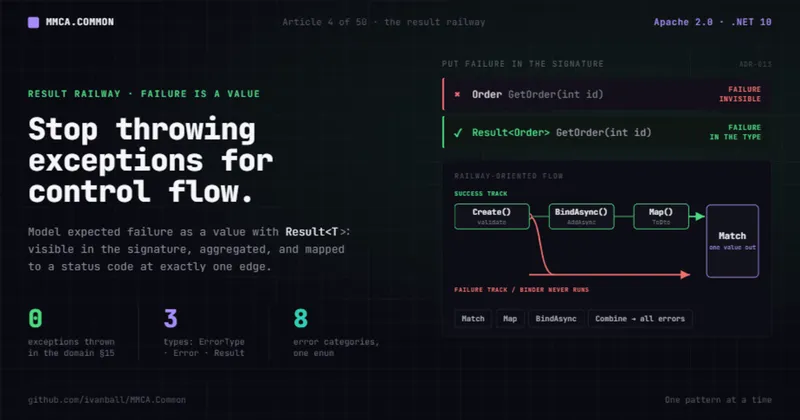
"This order ID does not exist" is not an exceptional event, it is a routine branch of
normal control flow. Here is the Result<T> railway that models it as a value, and why the domain in
MMCA.Common throws zero exceptions.
Here is a method signature you have written a hundred times:
public Order GetOrder(int id);Read it carefully. What does it tell you about failure? Nothing. It promises an Order. It does not
say it can fail when the id is missing, or that it might throw OrderNotFoundException, or that the
caller is supposed to wrap the call in a try/catch. The failure path is invisible. The compiler
cannot see it, the caller can forget it, and the only way to learn that the method throws is to read
its body or get paged at 3am.
Now compare:
public Result<Order> GetOrder(int id);The failure is in the signature. A caller cannot pretend it does not exist, because the return type is
not an Order, it is "an Order or an explanation of why not."
That swap is the single most pervasive idea in MMCA.Common. Practically every entity factory, every
CQRS command and query handler, every controller action, and every service method returns Result or
Result<T>. This article is about why, and about the small set of types that make it ergonomic enough
to use everywhere.
Why exceptions are not a control-flow mechanism
Exceptions are excellent at one job: aborting a computation that has gone genuinely wrong and unwinding the stack to someone who can recover. They are a poor fit for expected outcomes, for four concrete reasons that ADR-013 names directly:
- The failure is invisible in the method signature. Nothing forces a caller to handle it.
- It is easy to forget to catch. An uncaught exception escapes; an unread
Resultat least sits there as an unused value the analyzers can flag. - It is comparatively expensive on the throw path. Stack capture and unwinding cost real cycles for an outcome you expected.
- It conflates two different things: "the user asked for something we will not do" and "the
process is broken." Those deserve different handling, and a single
catchflattens them together.
"This email is already taken" and "this session does not exist" are not bugs. They are routine,
anticipated branches. Modeling them as data lets the compiler see them, lets them be collected into a
list, threaded through a pipeline, inspected, and mapped to an HTTP response with no try/catch
anywhere in the slice.
The MMCA answer: three small types and a railway
The pattern is factored into three dependency-free pieces, all living in MMCA.Common.Shared, the
innermost layer (the Blazor WebAssembly UI can reference it without dragging in EF Core or ASP.NET):
ErrorTypeis the classification axis: a nine-value enum.Validation,Invariant,NotFound,Conflict,Unauthorized,Forbidden,UnprocessableEntity,Failure, andUnexpectedfor a genuine server-side fault the caller cannot fix by changing the request. Critically, this is a pure enum with no reference to ASP.NET. The domain never names an HTTP status code.Erroris the carrier: an immutable positionalrecordwith a machine-readableCode(e.g."Order.NotFound", for programmatic branching), a human-readableMessage, anErrorType, and optionalSource/Targetcontext. Nine factory methods (one perErrorType) each hard-code the correct type, so a caller can never pairError.NotFoundError(...)with the wrong classification.Result(and the genericResult<T>) is the outcome envelope: either a success, or a failure carrying one or moreErrors.
You cannot new a Result<T>. Its constructors are internal; the only way in is through the static
factories (Result.Success, Result.Failure). That discipline guarantees the invariant the rest of
the codebase relies on: a result is always either a clean success or a non-empty failure, never a
half-built object.
The railway, in one picture
"Railway-oriented programming" is the mental model. Picture two parallel tracks, a success track and a
failure track. An operation takes the current result as input. If the result is already a failure, the
operation is skipped (the train stays on the failure track). If it is a success, the operation runs and
may stay on the success track or switch to failure. Control flows forward, with no nested
if (result.IsFailure) checks at every line.
Result<T> carries seven combinators, and three of them do most of the work:
Match(onSuccess, onFailure)terminates the railway by collapsing both tracks to a single value. Exactly one branch runs.MatchAsyncis the awaiting twin.Map(mapper)transforms the success value while propagating errors untouched.BindAsync(binder)is the monadic bind for async continuations: it short-circuits on failure (returning the original errors without callingbinder) and otherwise awaits the next operation, which itself returns aResult.Bindis the synchronous form of the same shape.
The other two are conveniences over the same short-circuit: Tap(action) runs a side effect on the
success value and hands back the same instance, and Ensure(predicate, error) fails the chain with a
supplied Error when the value does not satisfy a predicate. Every one of them skips the delegate it was
handed when the result is already a failure. A separate ResultExtensions class lifts BindAsync,
MapAsync, TapAsync and MatchAsync onto a pending Task<Result<T>>, so an asynchronous pipeline
composes end to end without an await and a temporary local between every step.
The non-generic base carries four members of its own, and Result.Combine(params ReadOnlySpan<Result>)
is the one that earns its keep: the aggregate-all-failures combinator. It runs several invariant checks and
returns all their errors at once rather than failing on the first. This is the workhorse of domain factory
methods. The ReadOnlySpan parameter avoids a heap allocation in the common case. Match, Bind and
OnFailure round out the base, so a valueless step composes the same way instead of forcing an
if (result.IsFailure) check.
// A domain factory: invalidity is unrepresentable, and every broken rule is reported at once.
public static Result<Speaker> Create(string name, Email email, DateOnly availableFrom)
{
    var validation = Result.Combine(
        CheckName(name),
        EmailInvariants.EnsureEmailIsValid(email, nameof(Create)),
        CheckAvailability(availableFrom));

    if (validation.IsFailure)
    {
        return Result.Failure<Speaker>(validation.Errors);
    }

    return Result.Success(new Speaker { Id = default, Name = name, Email = email });
}

// The shared create pipeline propagates the failure and stops; the success path continues.
protected async Task<Result<TEntityDTO>> CreateCoreAsync(
    IUnitOfWork attemptUnitOfWork,
    TCreateRequest command,
    CancellationToken cancellationToken)
{
    var prepared = await PrepareAsync(attemptUnitOfWork, command, cancellationToken).ConfigureAwait(false);
    if (prepared.IsFailure)
        return Result.Failure<TEntityDTO>(prepared.Errors);

    var result = await requestMapper.CreateEntityAsync(prepared.Value!, cancellationToken).ConfigureAwait(false);
    if (result.IsFailure)
        return Result.Failure<TEntityDTO>(result.Errors);

    var entity = result.Value!;
    var repository = attemptUnitOfWork.GetRepository<TEntity, TIdentifierType>();

    await PersistAsync(attemptUnitOfWork, repository, entity, cancellationToken).ConfigureAwait(false);

    return Result.Success(dtoMapper.MapToDTO(entity));
}
No try, no catch, no throw. The factory refuses to build an invalid Speaker, the handler
forwards the errors it cannot handle, and the failure path is carried along as data.
The transport mapping lives only at the edge
Because ErrorType is transport-agnostic, the translation to an HTTP status code is centralized in a
single shared internal class, ErrorHttpMapping. It owns the FrozenDictionary that maps each
ErrorType to a status (Validation, Invariant and Failure to 400, NotFound to 404, Conflict
to 409, Unauthorized to 401, Forbidden to 403, UnprocessableEntity to 422, Unexpected to 500,
anything unmapped falling back to 400) and the GetStatusCode lookups over it. Two consumers share the
status lookup. ApiControllerBase.HandleFailure() is the normal path: a controller action resolves the
status from the most severe error present through ErrorHttpMapping and renders an RFC 9457
ProblemDetails body carrying all the errors. UnhandledResultFailureFilter is the safety net: a global
filter that catches an action which accidentally returns a failed Result as a 200 body and rewrites it
into the identical ProblemDetails shape via the same mapping. A third caller, the If-Match concurrency
attribute, reuses the same class for the errors projection alone. Because the dictionary lives in one
place, the controller base and the filter can never drift apart.
The gRPC layer does the equivalent over the wire (GrpcResultExceptionInterceptor, ADR-007), so a remote
call looks like a local Result<T> to application code. One enum drives both transports, so every
endpoint and every extracted service produces the same error shape. There is one source of truth for
"what does a not-found look like."
The payoff at the framework level: the domain layer throws zero exceptions for business outcomes. The scorecard credits §15 for "consistent Result-based error handling"; the domain reserves exceptions for the genuinely exceptional (EF Core materialization), with no business-logic throws.
The read-side envelopes: collection and pagination results
Result<T> is what every write returns. Reads need a shape too, and returning a bare JSON array is a
trap: the moment you want to add pagination metadata, a top-level array forces a breaking change on every
client. So the read side has its own small envelopes, living in MMCA.Common.Shared right next to
Result:
CollectionResult<T>is a thin[DataContract]record with a singlerequired ICollection<T> Itemsproperty. Returning a named wrapper ({ "items": [...] }) instead of a raw array is a deliberate API-contract choice (Rubric §9): the wrapper leaves room to add metadata later without breaking the response shape, which a top-level array would force.PagedCollectionResult<T>extends it with one more required property,PaginationMetadata: the server-side paging state (TotalItemCount,PageSize,CurrentPage) plus computed, non-serialized derivations (TotalPageCount,FirstRowOnPage,LastRowOnPage).[DataMember(Order = ...)]annotations pin a deterministic wire order, and[IgnoreDataMember]keeps the derived values off the wire so the client recomputes them.
A paged query handler returns Result<PagedCollectionResult<T>>, composing the two ideas: the railway
carries success-or-failure, and the success payload is the canonical paged shape. One envelope for every
write, one for every read, and the response contract stays stable as the API grows.
Trade-offs, honestly
The Result pattern is not free, and ADR-013 names the rough edges rather than hiding them:
- More ceremony at the call site than letting an exception bubble.
Combineabsorbs most of it inside the factories, but a guard-and-propagate pair after every fallible call is wordier than a bare method call. That is the cost of making failure visible. - Two error channels coexist.
Resultis for expected failures; exceptions are reserved for the genuinely exceptional: programming errors (null-argument guards) and infrastructure faults (a dropped database connection) that should abort the request. The boundary is a judgment call: "could a well-behaved caller reasonably trigger this?" If yes, return aResult; if no, throw. MMCA.Common keeps a single concrete domain exception type (DomainInvariantViolationException) for the one structural gap whereResultcannot be returned: EF Core materialization, where the call stack is framework-owned. That is not the only exception the framework catches, though. An orderedIExceptionHandlerchain converges every escaped exception onto the same RFC 9457 ProblemDetails contract: a cancellation handler (499), a domain-exception handler (400), aDbUpdatehandler (409), a validation handler (400), and a catch-all (500), registered in that load-bearing order. So the failure shape stays identical whether it arrived as aResultor as a throw. - One status has to stand for a whole list of errors. Every error serializes into the
ProblemDetails body, but the status code can only be one number, so it is resolved by ranking: the
most severe
ErrorTypepresent wins (UnexpectedoverUnauthorizedoverForbiddenoverConflictoverNotFoundoverUnprocessableEntityover the shared bottom rank ofInvariant,ValidationandFailure), and equal ranks keep the earliest error. A result carrying both aValidationand aConflictanswers 409, and the validation detail is readable only in the body.
None of these are reasons to reach back for exceptions. They are the reasons to apply the pattern deliberately and to know where its one sanctioned exception lives.
Apply this even without MMCA
You do not need this framework to adopt the railway. The ideas port to any stack:
- Make failure visible in the signature. Return a result type (
Result<T>,OneOf,ErrorOr, your own) from any method that can fail in an expected way. If the failure is not in the signature, callers will forget it. - Classify errors as data, not as exception subtypes. An enum or sealed hierarchy of error categories keeps your core layer free of transport concerns and lets one mapping table translate to HTTP, gRPC, or a UI toast at the edge.
- Aggregate validation failures. Returning the first broken rule and stopping forces users through
a frustrating fix-one-retry loop. A
Combine-style combinator that returns all failures at once is a small change with a large UX payoff. - Keep exceptions for the exceptional. Null-argument guards and infrastructure faults still belong as exceptions. The rule of thumb: if a well-behaved caller could trigger it, return a value; if only a bug or a broken dependency could, throw.
The takeaway is one line: if a method can fail in a way a caller is expected to handle, put that failure in the return type, not on the stack.
What we covered: why exceptions are the wrong tool for expected outcomes, the three-type
ErrorType / Error / Result split, the Match / Map / BindAsync / Combine railway
combinators, factory methods that make invalidity unrepresentable, and the single shared
ErrorHttpMapping that maps ErrorType to HTTP via a FrozenDictionary for both the controller base
and the unhandled-failure filter.
Next in the series: killing the anemic domain model, where these factory methods that return
Result do their best work.
MMCA.Common is Apache-2.0 licensed and open source. Star the repo, read the 2-minute ADR-013 behind this
pattern, or dotnet add package MMCA.Common.API and try it.
- Repo: https://github.com/ivanball/MMCA.Common
- ADR-013 (Result pattern over exceptions): ADR-013: Result Pattern over Exceptions for Flow Control in the docs site.
Tags: .NET, C Sharp, Software Architecture, Programming, Error Handling