Auth & the edge · No. 47
Security Headers and CSP for Blazor: One Middleware, Every Host
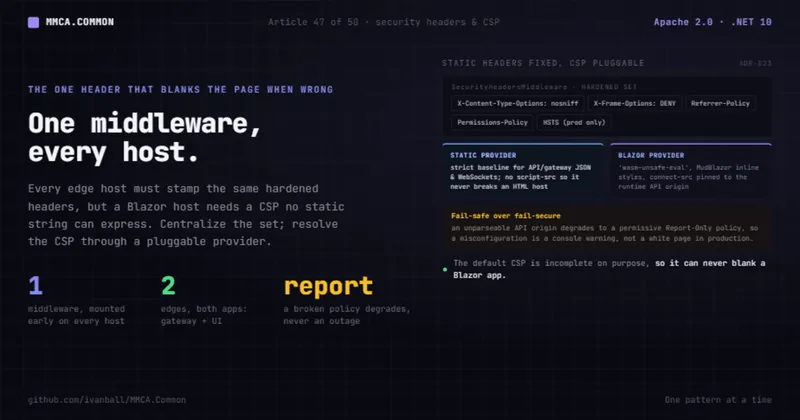
Every client-facing host must stamp the same hardened response headers, but a Blazor host needs a Content-Security-Policy no static string can express. Here is one middleware that centralizes the headers and resolves the CSP through a pluggable provider, applied at both edges of both apps, formalized in ADR-023.
You add X-Frame-Options: DENY, HSTS, and a strict Content-Security-Policy to your Blazor app. You deploy.
The page loads white. The browser console is a wall of red: Refused to evaluate a string as JavaScript because 'unsafe-eval' is not an allowed source of script. Blazor WebAssembly cannot boot, MudBlazor cannot
style a single component, and your "hardening" just took the whole front-end offline.
So you loosen the CSP until the app works again. Then you copy that policy into the second host, and the
gateway, and the next app. Six months later the Gateway sends frame-ancestors 'none' and the UI host sends
nothing, because someone edited one copy and forgot the others. A new edge host ships with no headers at all,
because adding them was a manual step nobody remembered. The headers that were supposed to be a baseline
became per-host folklore that drifts.
The two problems are linked. The header set wants to be defined once and inherited everywhere. But the CSP,
the one header that actually breaks the app when it is wrong, cannot be a single constant: an API or gateway
serving JSON and WebSockets wants a strict fixed policy, while a Blazor host needs script-src 'wasm-unsafe-eval', style-src 'unsafe-inline', and a connect-src pinned to an API origin it only learns
at runtime. One string cannot serve both, and a wrong string is an outage.
Why it matters
Security response headers are cheap defence-in-depth: X-Content-Type-Options: nosniff stops MIME
sniffing, X-Frame-Options and frame-ancestors stop clickjacking, HSTS forces HTTPS, and a
Content-Security-Policy shrinks the blast radius of an XSS bug by refusing to load script and connect to
origins you did not allow. None of them cost a request. All of them are worthless if a host forgets to send
them.
The failure mode is silence. A host that stamps no X-Frame-Options does not throw, does not log, and passes
every functional test. You find out it was frameable when someone clickjacks it. A CSP that drifted permissive
between two copies protects the strict copy and quietly stops protecting the other. Security headers are
exactly the kind of cross-cutting concern that rots when it lives as copied boilerplate in each host's
Program.cs, because the cost of getting one wrong is invisible until it is an incident.
And the CSP raises the stakes further, because it is the one header where the safe direction and the working direction point opposite ways. Tighten it and you protect the page; tighten it wrong and you blank the page. That tension is why the framework ships its static baseline at exactly the strength a Blazor page needs and still resolves the policy through an extension point instead of freezing all of it in one constant.
The MMCA answer: one middleware, a pluggable CSP
MMCA.Common ships a single SecurityHeadersMiddleware
(MMCA.Common.Aspire/Security/SecurityHeaders.cs:145) in the MMCA.Common.Aspire.Security layer, registered
with AddCommonSecurityHeaders(configuration?, configure?) (SecurityHeaders.cs:246) and mounted early with
UseCommonSecurityHeaders() (SecurityHeaders.cs:271). Every response gets the same hardened set, and the
CSP is resolved through an extension point rather than baked in as a constant.
The static part is the easy part. InvokeAsync (SecurityHeaders.cs:180) stamps
X-Content-Type-Options: nosniff (:185), X-Frame-Options (:186, default DENY), Referrer-Policy
(:187-189, default strict-origin-when-cross-origin), Permissions-Policy (:190, default
geolocation=(), microphone=(), camera=(), payment=()), and HSTS (:198-200, max-age=31536000; includeSubDomains). Every value lives on SecurityHeadersSettings (SecurityHeaders.cs:19) with those
hardened defaults, overridable via the "SecurityHeaders" configuration section (:22) or the configure
delegate. HSTS is emitted only when EnableHsts is set and the environment is not Development: the middleware
computes _enableHsts = options.Value.EnableHsts && !environment.IsDevelopment() once in its constructor
(:170), so localhost never gets pinned to HTTPS for a year.
Two of those headers are path-sensitive. CredentialPathPrefixes (:46, default ["/reset-password", "/auth/oauth-complete"]) names the paths a single-use secret arrives on, matched segment-based and
case-insensitively by IsCredentialPath (:174-177). On a hit the response answers Referrer-Policy: no-referrer instead of the site-wide value (:187-189) and adds Cache-Control: no-store, no-cache, must-revalidate, max-age=0 with Pragma: no-cache (:192-196), so a reset token or an OAuth authorization
code sitting in the URL never travels onward in a Referer header and the rendered page never lingers in a
browser or proxy cache (ADR-023:114-125).
The interesting part is the CSP. Instead of stamping a string, the middleware asks an ICspPolicyProvider
(SecurityHeaders.cs:84) for a CspPolicy(string Value, bool Enforce) (:76). When Enforce is true it
writes Content-Security-Policy (:219); when false it writes Content-Security-Policy-Report-Only
(:223); a null return emits no CSP at all (:203-204). The enforce-versus-report split is what lets a
host trial a tightened policy against real traffic and collect violations before anything blocks.
One substitution sits between the provider and the header write. A resolved policy carrying the literal token
{nonce} (NoncePlaceholder, :148) gets a fresh 128-bit value per request (NonceByteCount = 16, :151),
stashed raw in HttpContext.Items under CspNonce.ItemKey (:125) before the rest of the pipeline runs, and
spliced into the header as 'nonce-<value>' (:210-215). A page reads it back with
CspNonce.Get(HttpContext) (:122-137) and stamps it onto its own script and style tags, which is the
supported route off 'unsafe-inline' (documented on the setting, :62-63; ADR-023:42-45). A policy without
the token generates nothing and stores nothing.
// SecurityHeadersMiddleware.InvokeAsync, condensed from SecurityHeaders.cs:180-228
var headers = context.Response.Headers;
headers.XContentTypeOptions = "nosniff";
headers.XFrameOptions = _settings.FrameOptions;                      // "DENY"
headers["Referrer-Policy"] = IsCredentialPath(context.Request.Path)  // "/reset-password", "/auth/oauth-complete"
    ? "no-referrer"
    : _settings.ReferrerPolicy;                                      // "strict-origin-when-cross-origin"
headers["Permissions-Policy"] = _settings.PermissionsPolicy;

if (IsCredentialPath(context.Request.Path))
{
    headers.CacheControl = "no-store, no-cache, must-revalidate, max-age=0";
    headers.Pragma = "no-cache";
}

if (_enableHsts)                                                     // EnableHsts && !IsDevelopment()
{
    headers.StrictTransportSecurity = _settings.HstsValue;           // "max-age=31536000; includeSubDomains"
}

var csp = _cspPolicyProvider.GetPolicy(context);                     // the extension point
if (csp is not null)
{
    var value = csp.Value;
    if (value.Contains(NoncePlaceholder, StringComparison.Ordinal))  // the literal {nonce} token
    {
        var nonce = Convert.ToBase64String(RandomNumberGenerator.GetBytes(NonceByteCount));
        context.Items[CspNonce.ItemKey] = nonce;
        value = value.Replace(NoncePlaceholder, $"'nonce-{nonce}'", StringComparison.Ordinal);
    }

    if (csp.Enforce) headers.ContentSecurityPolicy = value;
    else             headers.ContentSecurityPolicyReportOnly = value;
}

await _next(context).ConfigureAwait(false);
The default provider is StaticCspPolicyProvider (SecurityHeaders.cs:91), registered with
TryAddSingleton (:263) so a host can override it. It computes its policy once in the constructor
(:95-102) and returns the cached value for every request (:104). The baseline itself lives on
SecurityHeadersSettings.ContentSecurityPolicy (:65-67): default-src 'self'; script-src 'self' 'wasm-unsafe-eval'; style-src 'self' 'unsafe-inline'; object-src 'none'; base-uri 'self'; form-action 'self'; frame-ancestors 'none'. Nothing is left out, including the two directives that blank a Blazor page when they
are wrong: the XML doc on the setting calls it a complete hardened baseline that ships script-src and
style-src at exactly the strength Blazor ('wasm-unsafe-eval') and MudBlazor ('unsafe-inline' styles)
require (:51-64). An HTML host that never registers a fuller provider gets a functional policy instead of
one silently missing both directives, and the JSON, WebSocket, and static-page responses an API or gateway
serves are unaffected either way (ADR-023:46-53).
The Blazor policy, built at runtime
An HTML host opts into the origin-pinned policy by registering its own provider before calling
AddCommonSecurityHeaders. Both apps register one shared BlazorCspPolicyProvider
(MMCA.Common.UI.Web/Security/BlazorCspPolicyProvider.cs:28) via AddCommonBlazorCsp()
(MMCA.Common.UI.Web/DependencyInjection.cs:52), which does three things: binds BlazorCspSettings from the
"BlazorCsp" configuration section with ValidateOnStart() (:54-56), registers
BlazorCspSettingsValidator through TryAddEnumerable so calling it twice validates once (:59-60), and
registers AddSingleton<ICspPolicyProvider, BlazorCspPolicyProvider> (:62). Because the static default is
registered with TryAdd, the first-registered provider wins, so the call order is load-bearing:
AddCommonBlazorCsp() must run before AddCommonSecurityHeaders(...).
The provider builds the full policy once, at construction (BlazorCspPolicyProvider.cs:33-42), and returns
the cached result for every request (:45). BuildPolicy (:103-113) assembles what a Blazor + MudBlazor
page actually needs: default-src 'self', script-src 'self' 'wasm-unsafe-eval' (the WASM runtime),
style-src 'self' 'unsafe-inline' (MudBlazor), img-src 'self' data: https: (profile pictures and CDN
images are low XSS-risk, so images stay open while the directives that matter for exfiltration stay locked),
font-src 'self', plus base-uri, form-action, and frame-ancestors 'none'.
One directive in that list is opt-in. BuildFrameSrc (:85-97) emits frame-src 'self' <origins> only when
BlazorCspSettings.FrameSources lists at least one origin, canonicalized and de-duplicated before the splice
(:92-96, spliced into the policy at :110); with the default empty list there is no frame-src at all and
frames fall back to default-src 'self' (:82). Entries are validated at boot rather than trusted, so a
wildcard or a stray semicolon fails startup with a message naming it instead of landing verbatim in a security
response header (ADR-023:185-197). ADC's Blazor host configures it for the embedded Google Maps venue maps on
its public event page (MMCA.ADC.UI.Web/appsettings.json:47-52). frame-ancestors 'none' is never relaxed by
that path (:21-24).
The hard directive is connect-src, because it is per-deployment. BuildCsp (:49) reads the API origin
from ApiSettings (WasmApiEndpoint ?? ApiEndpoint, :51), and if it resolves to a real http(s) URL it pins
connect-src to 'self' plus that origin and its WebSocket form (wss://... for the SignalR notification
hub, :66-68), enforced (:79). Development loosens two directives, not one: connect-src gains
http://localhost:* and ws://localhost:* (:74-77), and script-src gains 'unsafe-inline' (:105),
because Visual Studio's Browser Link and Hot Reload inject an inline bootstrap script as well as opening a
WebSocket on a port that changes every run (:70-73). Only the first of those is localhost-scoped, and
neither reaches a non-Development host, because the flag is IWebHostEnvironment.IsDevelopment() read once at
construction (:41; ADR-023:178-184).
The detail worth stealing is the failure path. If the origin cannot be parsed, or on Linux parses as a
file:// URI instead of http(s), the provider does not guess and it does not stop enforcing. It narrows
connect-src to 'self', the strictest value it can be sure of, leaves the rest of the policy exactly as it
was, and returns it with Enforce: true (:62). The policy fails closed. A deployment whose ApiSettings
endpoint is wrong still serves its pages, and every cross-origin API call and the SignalR hub are blocked
loudly in the browser console, because the alternative is a permissive Report-Only header that protects
nothing and that nobody notices (:16-20, :60-61; ADR-023:85-88). A security response header that quietly
stops being enforced is the worse failure mode.
font-src 'self' (:108) reads like the boring entry in that list, and it is the one that carries a real web
font. The shared MudBlazor theme names Inter first in its font stack, and the reflex way to supply it is a
Google Fonts link tag, with the reflex follow-on of widening font-src to that CDN's origin plus a
style-src allowance for its stylesheet: a third-party origin welded into the policy of every host,
permanently, because of a typography change. Instead the font ships from the framework. MMCA.Common.UI
vendors the Inter woff2 files (weights 400, 500, 600, 700, 800, latin subset, SIL OFL 1.1 notice alongside
them) under its own wwwroot/fonts/, and its app.css declares the five faces with font-display: swap
(MMCA.Common.UI/wwwroot/app.css:9-47).
Because a Razor class library's static assets are served from _content/MMCA.Common.UI/, the fonts are
same-origin, the existing font-src 'self' already permits them, and not one character of the CSP changed to
land the refresh.
That is the part worth generalizing. A CSP directive is only a real constraint if it is allowed to shape
decisions, because the moment a design choice arrives the path of least resistance is to widen the policy to
fit it. Here the policy shaped the implementation instead. The honest costs: the vendored subset is latin
only, so non-latin text still falls back to the platform font; the woff2 bytes ride inside the NuGet package,
so updating the font means a framework release and a lockstep consumer bump rather than swapping a CDN
version; and self-hosting forfeits any shared cross-site CDN cache, so each origin downloads its own copy.
font-display: swap trades a visible flash of the fallback face for not blocking first paint. All of that was
cheaper than an extra origin in the policy.
Adopted at both edges of both apps
This is not a library that exists and waits to be used. Store and ADC each wire it at both client-facing
edges. The Gateway hosts call AddCommonSecurityHeaders(builder.Configuration) and UseCommonSecurityHeaders()
with the strict static baseline, exactly right for a YARP proxy serving JSON, WebSockets, and a static privacy
page (ADC Gateway Program.cs:118,168; Store Gateway Program.cs:71,159). The Blazor UI hosts register
AddCommonBlazorCsp() first, then the same plain AddCommonSecurityHeaders(builder.Configuration) with no
configure delegate, then UseCommonSecurityHeaders() (ADC UI Program.cs:162,163,192; Store UI
Program.cs:191,192,215). Each UI origin emits its own HSTS on purpose, because an HSTS pin is per-origin and
the Gateway's header says nothing about the sibling hostname a user actually types (ADC UI
Program.cs:156-161; Store UI Program.cs:184-190). The built-in app.UseHsts() stays uncalled on both,
since it would run later in the pipeline and overwrite the shared one-year value with its own weaker default
(ADC UI Program.cs:188-191).
The cross-origin posture at that same edge is a separate decision with its own record: two policies, an
allow-listed one for service hosts and a deliberately broader one for gateways (ADR-082,
Website/docs-src/adr/082-two-tier-cors-posture.md:28-34), which names ADR-023 as its edge sibling (:19-25).
The middleware carries a unit test, SecurityHeadersMiddlewareTests in MMCA.Common.Aspire.Tests, and each
app's Gateway has its own SecurityHeadersTests asserting the headers are present.
Trade-offs, honestly
- The baseline is complete, not maximal. A default that works for a Blazor and MudBlazor host is a default
that carries
style-src 'unsafe-inline'(SecurityHeaders.cs:65-67), so inline styles are not blocked out of the box, and an API or gateway host that serves no HTML inherits a script and style allowance it does not need. Tightening past that is an explicit act: configure the"SecurityHeaders"section, register your own provider, or move to the{nonce}placeholder (ADR-023:91-96). - Registration order is a foot-gun. Because the provider uses
TryAddSingleton(SecurityHeaders.cs:263), a host that callsAddCommonSecurityHeadersbefore registering its customICspPolicyProvidersilently keeps the static default. The order is correct in both apps, but nothing forces it. - Failing closed moves the pain onto a running app. A Blazor host whose
ApiSettingsendpoint is wrong still serves pages, but the enforcedconnect-src 'self'blocks every cross-origin API call and the SignalR notification hub (BlazorCspPolicyProvider.cs:62). That loud signal is the point, and the cost is that the configuration mistake lands on the users of that deployment rather than in a passive report (ADR-023:105-109). - One shared Blazor provider constrains divergence.
BlazorCspPolicyProviderlives once inMMCA.Common.UI.Webover the sharedApiSettings, so a host that needs genuinely different CSP logic cannot tweak an app-local copy. It has to supply its ownICspPolicyProviderinstead, registered beforeAddCommonSecurityHeaders.
None of these argue against centralizing the headers. They argue for keeping the extension point visible and for treating the CSP as the one header you test in every host that renders HTML.
Apply this even without MMCA
The shape ports to any ASP.NET Core stack, and the idea ports to any web framework:
- Put the hardened header set in one middleware with strongly-typed, overridable settings, and mount it early so every response gets it. A new edge host inherits the baseline instead of remembering to copy it.
- Do not stamp the CSP as a constant. Resolve it through a provider abstraction that returns the policy string plus an enforce-or-report flag. Static hosts get a fixed strict policy; HTML hosts inject a dynamic one.
- For a Blazor or SPA host, build
connect-srcfrom the API origin at runtime, and put thescript-src/style-srcsources the framework actually requires ('wasm-unsafe-eval'for Blazor WASM) in the static default too, so a host that registers nothing still gets a policy it can run under. - Make the failure path fail closed, not permissive. If the dynamic part of the policy cannot be built, narrow that one directive to the strictest value you can be sure of and keep enforcing, so the mistake surfaces as blocked calls somebody chases instead of a header that is emitted and inert.
The takeaway: security headers want to be defined once and inherited everywhere, but the CSP is the one header that breaks the app when it is wrong. Centralize the headers in a middleware, resolve the CSP through a provider, and when the dynamic part cannot be built, narrow that directive and keep enforcing rather than emitting a policy that protects nothing.
What we covered: why per-host security headers drift and why a static CSP cannot serve both an API and a
Blazor host, how MMCA.Common's SecurityHeadersMiddleware stamps one hardened header set (with a stricter
referrer and cache posture on credential paths, and a per-request {nonce} substitution) while resolving the
CSP through a pluggable ICspPolicyProvider, how the default static provider ships a complete hardened
baseline a Blazor page can still run under, how BlazorCspPolicyProvider pins connect-src to the runtime API
origin and fails closed when it cannot, and how both apps adopt it at their Gateway and UI edges (ADR-023).
Next in the series: Article 48, "Observability by Default: OpenTelemetry and Azure Monitor in MMCA," on the tracing, metrics, and logging pipeline every host gets for free.
MMCA.Common is Apache-2.0 licensed and open source. Star the repo, read the 2-minute ADR-023 behind this
pattern, or dotnet add package MMCA.Common.Aspire and try the middleware.
- Repo: https://github.com/ivanball/MMCA.Common
- This pattern's decision record: ADR-023: Centralized Security-Response-Headers Middleware with a Pluggable CSP
- The full 34-category scorecard, §26 included, lives in MMCA.Common: Architecture Scorecard in the docs site.
Previous: Article 46, "Field-Level Encryption in EF Core: AES-GCM for PII Columns." Next: Article 48, "Observability by Default: OpenTelemetry and Azure Monitor in MMCA."
Tags: .NET, C Sharp, Blazor, Web Security, Content Security Policy