Auth & the edge · No. 17
Password hashing done right: PBKDF2-SHA512, 600k iterations, timing-safe
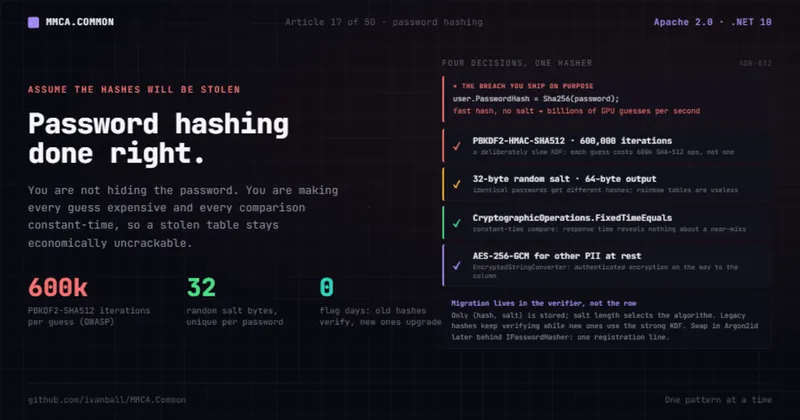
Storing a password is a solved problem, and almost every breach headline is someone who solved it the wrong way. Here are the four decisions that separate a hash you can defend from one that leaks every account the day your database does.
The single most damaging line of code in a lot of .NET apps is shorter than this sentence:
user.PasswordHash = Sha256(password); // looks responsible. is not.It looks responsible. It is not a plaintext password, after all. But SHA-256 is a fast hash, designed
to digest gigabytes per second, and that speed is exactly the problem. The day your Users table
leaks, an attacker with a commodity GPU runs billions of those hashes per second against a wordlist and
recovers most of your users' passwords before lunch. No salt means identical passwords share a hash, so
they only have to crack each distinct password once. You did not store plaintext, but you stored
something an attacker turns into plaintext at scale.
Password storage is a solved problem. The breach headlines are almost always someone who solved it the wrong way: a fast hash, no salt, a hand-rolled comparison, or a homegrown scheme that "looked secure."
Why it matters
A leaked password table is not just a breach of your app. People reuse passwords. The credentials you fail to protect become the keys an attacker tries against their bank, their email, their employer. The threat model for a password hash is not "keep it secret" (you cannot, your database will eventually be read by someone it should not be). The threat model is: assume the hashes are stolen, and make recovering the original passwords economically infeasible anyway.
That reframes the whole job. You are not hiding the password. You are making each guess expensive enough that brute force does not pay, and making the storage shape leak nothing extra (not which passwords are identical, not how many bytes of a guess were right).
The MMCA answer: a deliberately slow KDF, salted, compared in constant time
MMCA.Common ships one production password hasher, split the Clean-Architecture way: the
IPasswordHasher port sits in MMCA.Common.Application and its single PasswordHasher
implementation in MMCA.Common.Infrastructure. It makes the right call on every axis:
- PBKDF2-HMAC-SHA512 at 600,000 iterations (OWASP 2023 guidance). PBKDF2 is a key derivation function: a deliberately expensive hash. Six hundred thousand iterations means each guess costs the attacker 600,000 SHA-512 operations, not one. That turns "billions of guesses per second" into a rate where offline brute force against a strong password stops being worth the electricity.
- A 32-byte cryptographically random salt per password, with a 64-byte output. The salt means two users with the same password get different hashes, so an attacker cannot crack once and apply everywhere, and precomputed rainbow tables are useless.
- Constant-time comparison. Verification ends with
CryptographicOperations.FixedTimeEquals, which always compares the full length regardless of where the first mismatch is.
// HashPassword: 32-byte random salt, PBKDF2-HMAC-SHA512, 600,000 iterations, 64-byte output.
(byte[] Hash, byte[] Salt) HashPassword(string password);

// VerifyPassword ends with a timing-safe compare, never a == or SequenceEqual:
return CryptographicOperations.FixedTimeEquals(computedHash, hash);
(Source: PasswordHasher.cs and the password section of 8. Authentication & Authorization.)
Those parameters are not a convention held in place by code review. They are build-failing checks.
Known-answer tests recompute the digest independently with PBKDF2-HMAC-SHA512 at 600,000 iterations
and a 64-byte output, so a lowered work factor, a swapped algorithm or a truncated digest stops
matching. A negative known-answer test derives a digest at a fraction of that iteration count and
asserts verification rejects it, which proves the work factor really participates rather than sitting
in a comment. Reflection reads the three private constants straight off the type and pins them (the
iteration count, the 32-byte salt and the 64-byte digest), so lowering one fails the build instead of
silently shipping. And an architecture rule reads the compiled type and fails the build if the slow key
derivation function or the fixed-time comparison disappears from it, so a rewrite that swapped PBKDF2
for a raw SHA-512, or FixedTimeEquals for SequenceEqual, cannot merge even if it kept the same
output length.
Why constant-time matters more than it looks
The naive comparison computed == stored returns as soon as it finds the first differing byte. That
is a timing side channel: an attacker who can measure response time learns how many leading bytes
matched, and can recover a secret byte by byte, turning an astronomically large search into a linear
one. FixedTimeEquals always touches the full length, so the time it takes reveals nothing about how
close a guess was. You never write your own equality check on secret material. The BCL has the
timing-safe primitive precisely so you do not have to.
One algorithm, one read path, and a guard on the material
The hasher stores (byte[] Hash, byte[] Salt) and nothing else: the iteration count and the algorithm
live in the verifier, not in the stored record. PBKDF2-HMAC-SHA512 is the only supported algorithm, so
nothing about a stored row selects a primitive. Verification opens by rejecting any material that is
not exactly a 64-byte hash over a 32-byte salt, then recomputes to that constant length and compares.
That guard is the interesting part: a row holding an empty hash and an empty salt (the shape an
external-OAuth account carries, ADR-036) otherwise derives an empty output and compares two empty
spans, which a fixed-time comparison answers true for, so any password authenticates it. Material this
hasher never produced verifies nothing.
One primitive is a deliberate trade. A verifier that picks its algorithm from a data property (the
stored salt length, say) can carry two credential formats at once, which is what an installed base of
old hashes needs. It also means the credential table decides which primitive runs, with no version
marker and no way to assert from configuration which path a given login took, and the weaker format
stays reachable for as long as the branch exists. MMCA.Common takes the other side: one path, and a
credential in any other shape fails rather than authenticating through a fast hash. Changing the
algorithm itself stays cheap because it sits behind IPasswordHasher: swapping PBKDF2 for Argon2id is
an Infrastructure registration change, and the application handlers never name a hashing primitive.
Defense in depth: PII at rest, not just passwords
Passwords are the famous case, but they are not the only personal data sitting in your database.
MMCA.Common ships field-level PII encryption as a separate control, now recorded in its own decision
record (ADR-037): EncryptedStringConverter is an EF Core value converter that encrypts a column with
AES-256-GCM transparently on the way to the database and decrypts on the way out. GCM is
authenticated encryption, so it protects confidentiality and detects tampering. It is the framework
capability the erasure design (ADR-005) provides for fields a service chooses to keep retrievable for
legitimate use after anonymization, encrypted at rest rather than overwritten. (Today it is a shipped,
unit-tested converter that no entity configuration in any of the four repositories wires yet, so zero
production columns are encrypted; the consumer apps still overwrite every PII field on anonymization.
ADR-037 records the extension point and is explicit about that latent posture.)
The whole pipeline is held to the same enforcement bar as the rest of the framework: all five
analyzers run at error severity with TreatWarningsAsErrors globally, and a couple of them
(SonarAnalyzer and Meziantou) carry security-relevant rules. The security category (§11) scored
Maturity 4 / Implementation 8 on the framework's two-axis rubric (Maturity 0-4, Implementation
0-10), on the strength of JWT algorithm pinning, this hashing scheme (recorded in ADR-102),
AES-256-GCM field encryption, server-side authorization, and rate limiting (brute-force protection
applies exponential-backoff lockouts and clears the counter on success).
Trade-offs, honestly
A credible security post owns its rough edges, and a few sit around this hash rather than in it.
- Plain-HTTP metadata discovery is an opt-out, not a default.
AddForwardedJwtBearerresolvesRequireHttpsMetadatafrom an explicit argument, then anAuthentication:JwtBearer:RequireHttpsMetadataconfig key, thentrueeverywhere except Development, and logs one startup warning when a deployment opts back out (both production apps do, because their authority is an internal-ingress cleartext URL, and their deployment templates say so beside the setting). Permissive dev CORS is a development affordance in the code, not a recommendation for what you run in production. - Iteration counts are a moving target. 600,000 PBKDF2-SHA512 iterations matches 2023 OWASP guidance; that number ratchets up with hardware. Treat the iteration count as a config decision you revisit, and prefer a memory-hard KDF (Argon2id) when you can, which is exactly why the algorithm lives behind an interface here.
The current §11 entry itself names two limitations, both upstream of the hash: vault/managed-identity secret binding is delegated to the deployer (correct for a library), and authorization is RBAC with a capability layer rather than a full resource- or attribute-based policy engine. None of these undermine the storage scheme. They are the operational and governance work that surrounds a correct hash.
Apply this even without MMCA
The rules port to any stack, and they are short enough to memorize:
- Never store plaintext, and never use a fast hash (MD5, SHA-1, plain SHA-256/512) for passwords. Use a purpose-built KDF: Argon2id if available, otherwise PBKDF2-HMAC-SHA512 or bcrypt/scrypt.
- Tune the work factor to current guidance (600k+ PBKDF2-SHA512 iterations at the time of writing) and revisit it as hardware improves.
- Salt every password with a per-user cryptographically random value. The salt does not need to be secret; it needs to be unique.
- Compare in constant time. Use your platform's timing-safe primitive
(
CryptographicOperations.FixedTimeEqualsin .NET), never==or a default sequence equality on secret bytes. - Never roll your own crypto. Lean on the BCL/library primitives, and put the algorithm behind an interface so you can migrate without a flag day.
- Encrypt other PII at rest with authenticated encryption (AES-256-GCM), and keep your analyzers
at error severity so a careless
==on a secret never merges.
The takeaway: assume the hashes will be stolen, and make every guess expensive and every comparison constant-time anyway. Everything else is detail.
What we covered: why a fast unsalted hash is the breach you ship on purpose, how PBKDF2-SHA512 at
600,000 iterations with a per-password salt and a FixedTimeEquals compare makes stolen hashes
uneconomical to crack, how known-answer tests and an architecture rule keep those parameters
build-failing invariants, why a single PBKDF2 path plus a canonical-material guard means a credential
row in any other shape authenticates nobody, how AES-256-GCM field encryption via
EncryptedStringConverter extends the same care to other PII, and the honest trade-offs (the
HTTPS-metadata opt-out, an iteration count that ratchets with hardware).
Next in the series: idempotency in one attribute, so a client that retries a write gets the first response replayed instead of a duplicate.
MMCA.Common is Apache-2.0 licensed and open source. Star the repo, read the §11 scorecard entry, or
dotnet add package MMCA.Common.Infrastructure and try it.
- ⭐ Repo: https://github.com/ivanball/MMCA.Common
- 📄 The §11 security entry lives in MMCA.Common: Architecture Scorecard in the docs site.
Tags: .NET, C Sharp, Software Architecture, Security, Cryptography