Orientation · No. 2
Modular monolith to microservices, without the rewrite
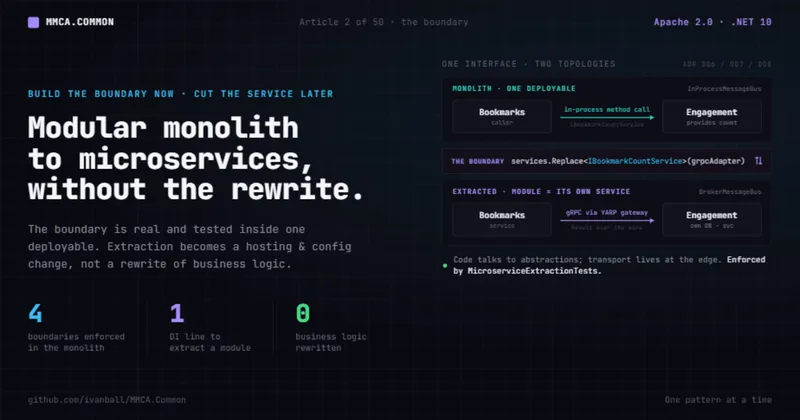
"Monolith or microservices" is the wrong question. Build the extraction point now, keep it tested, and cut the service later, on a boundary you have already proven.
There is a decision a lot of teams make far too early, and then spend two years paying for.
Day one, someone asks "monolith or microservices?" and the room splits. One camp wants a single deployable so they can ship. The other wants service boundaries so they never have to do the "big migration" later. Both are right, and the argument is a false binary. The thing that actually hurts is not which one you pick. It is that whichever you pick, the boundary you draw on a whiteboard in week one is almost never the boundary the system needs in year two. A premature service split calcifies the wrong join point in a network you cannot refactor across. A monolith with no internal boundaries calcifies no join point at all, and the eventual extraction is a rewrite.
MMCA.Common takes a third position. Build the boundary now, inside one deployable, and make it real and tested rather than aspirational. The day a module genuinely needs to be its own service, extraction is a hosting and configuration change, not a rewrite of business logic.
Why it matters
The reason the "we will split it later" plan usually fails is that the monolith quietly grows couplings that the eventual split has to unwind. Two modules share a database, so a foreign key spans them. One module calls another's class directly, so the call assumes in-process semantics (synchronous, transactional, never fails for network reasons). Events are dispatched by a direct method call, so nobody ever wrote the durable handoff a broker needs. None of these are visible in a demo. All of them are load-bearing the day you try to pull a module out, and that is exactly when you discover the boundary was a fiction.
So the boundary has to be enforced while it is cheap to enforce: while everything still runs in one process and a violation is a one-line fix instead of a distributed-systems incident. That is the whole design center of this framework. The invariant, stated once: application and domain code talks to abstractions; transport choices live at the edges.
The MMCA answer: four extraction points, all enforced in the monolith
There are four places a "split it later" plan leaks, and the framework closes each one with a real mechanism, not a guideline.
1. Database-per-service, even inside the monolith (ADR-006)
The first leak is the shared database. In MMCA.Common, every entity resolves to a physical data
source: a DataSourceKey(Engine, Name) pair. DataSourceResolver maps logical names (a module's name)
onto physical connection strings, and EntityDataSourceRegistry maps every entity to its source at
startup. The clever part is collapse: a host with no DataSources configuration collapses every
logical name onto a single Default source, so it behaves exactly like a single-database
monolith (one context, one change tracker, foreign keys intact). Point one config entry at a separate
database and that module's data is now physically isolated, with no code change. This is the deep-dive
of its own article; the point here is that the data boundary exists from day one and costs nothing
until you use it.
2. A transport-agnostic message bus
The second leak is event delivery. There is one abstraction, IMessageBus, defined in the
Application layer, with two implementations in Infrastructure: InProcessMessageBus (delivery is a
method call, used in the monolith) and BrokerMessageBus (delivery is over a MassTransit broker,
RabbitMQ locally and Azure Service Bus in production, used once a module is its own service).
MessageBusSettings selects the mode. Your handler code does not change when you flip it.
The rule that keeps this honest is that Application, Domain, and Shared must never reference
MassTransit directly. That is not a code-review comment. It is a fitness test,
MicroserviceExtractionTests, that fails the build if a transport type leaks into the core. The
transactional outbox (its own article in this series) is what makes the flip safe: the same durable
event record drains to an in-process handler today and to a broker tomorrow.
3. gRPC contracts for synchronous calls (ADR-007)
The third leak is the synchronous call between modules: "how many bookmarks does this session have?"
needs an answer, not a fire-and-forget event. In the monolith that is a direct interface call. Across
a process boundary it is gRPC, exposed through MMCA.Common.Grpc.
The convention is what makes extraction a registration change. Any project whose name ends in
.Contracts auto-compiles its Protos/**/*.proto with both server and client stubs. Each
.Contracts project ships a hand-written adapter that implements the same C# interface the modules
already used in-process. Concretely, a BookmarkCountServiceGrpcAdapter implements
IBookmarkCountService, holds a generated gRPC client, and translates the interface call into a wire
call. Because the in-process service and the adapter satisfy the identical interface, the composition
root just does services.Replace(...) to swap one for the other. The calling code never learns which
it got.
The error model survives the hop too. On the server, GrpcResultExceptionInterceptor turns a failed
Result (raised as a ResultFailureException) into an RpcException carrying the errors, and the typed
client adapter reconstructs Result.Failure(errors) from the trailers, so callers keep
programming against Result<T> whether the answer came from an object or a network round-trip. This
is "Result over the wire," and it is why the wire hop does not poison your error handling.
4. Federated auth, a gateway, and Aspire hosting (ADR-008)
The last leak is everything around the services. Cross-service auth uses JWKS, not a shared secret:
IJwksProvider (RsaJwksProvider) exposes signing keys, and JwksEndpointExtensions serves
/.well-known/jwks.json, so an extracted service validates a forwarded token against the issuer's
public keys, discovered through the gateway. A single YARP reverse-proxy gateway is the only client
entry point, owning the route-to-service map; clients never address a service directly.
MMCA.Common.Aspire.Hosting wires the broker, JWKS discovery, and the per-service data sources for
the extracted topology.
ADR-008 names the payoff precisely: each extracted service is just the monolith with one module
enabled. The ModuleLoader still runs, only with one module's Enabled=true; disabled peers are
satisfied by Disabled* stubs, which the host then replaces with gRPC clients. The Domain,
Application, and Shared code is byte-for-byte identical whether it runs in-process or extracted.
What the boundary looks like in code
The whole thesis fits in one DI swap. The same handler depends on the same interface; only the registration line differs between the two topologies.
// Application/Domain code depends ONLY on the interface. It never sees the transport.
public sealed class GetSessionBookmarkCountHandler(IBookmarkCountService counts)
{
    // ... calls counts.GetBookmarkCountForSessionAsync(sessionId), which returns a plain int (Task<int>);
    // the handler wraps that count as Result.Success(count) and returns Result<int>.
}

// MONOLITH host: the real in-process implementation is registered (peer module enabled).
//   -> IBookmarkCountService = the concrete Engagement service. Delivery is a method call.

// EXTRACTED host: after ModuleLoader runs, the peer is disabled (a Disabled* stub holds the slot),
// then the .Contracts DI helper overwrites it with the gRPC adapter:
services.Replace(ServiceDescriptor.Scoped<IBookmarkCountService, BookmarkCountServiceGrpcAdapter>());
//   -> same interface, now a gRPC call. GetSessionBookmarkCountHandler does not change.
The transport choice is one line at the composition edge. Everything above it is untouched.
Trade-offs, honestly
Reversibility is not free, and the ADRs are candid about the bill.
- Distributed-systems semantics arrive the moment you split. Cross-service consistency is eventual (outbox plus integration events), not transactional. There are no cross-service transactions and no cross-database foreign keys (ADR-006). Referential integrity across services becomes the application's responsibility; a compensating index survives, the FK constraint does not.
- Operational surface grows. A split means multiple deployables, a gateway, service discovery, a broker, and per-service databases to provision, migrate, and back up, versus one process. Aspire orchestrates this locally and Bicep/Azure Container Apps in production, but the complexity is real.
- Bidirectional gRPC pairs need care. When two services call each other synchronously, the
AppHost deliberately omits a reciprocal
WaitForto avoid a startup deadlock; the transient "peer not ready" errors self-heal through the resilience pipeline. That is a known sharp edge, not a free lunch. - The boundary costs a little even when unused. Carrying
IMessageBus, the data-source resolver, and the.Contractsconvention in a monolith you may never split is overhead. The bet is that the overhead is small and the optionality is worth it. It is a bet, not a theorem.
The honest version of the thesis is not "microservices for free." It is "the boundary is cheap to keep and tested, so the decision to split stays open instead of being foreclosed by accreted coupling."
Apply this even without MMCA
You do not need this framework to keep the extraction point open. You need three habits.
- Give each module its own logical data ownership now, even in one database. No cross-module foreign keys, no joins across modules. If you cannot draw the data boundary today, you do not have a module, you have a tangle.
- Put one transport-agnostic interface between modules for both events and synchronous calls. Application code depends on the interface; the in-process implementation and the future remote implementation both satisfy it. Swapping them is a registration change.
- Make the boundary executable. A test that fails the build when transport types leak into your core is worth more than any architecture diagram, because the diagram does not run in CI and the test does.
The rule of thumb: a service boundary you have not enforced in the monolith is a boundary you have not actually built. You have drawn a picture of one.
What we covered: why monolith-versus-microservices is a false binary, the four extraction points MMCA.Common
enforces inside one deployable (database-per-service, the transport-agnostic IMessageBus, gRPC
.Contracts with Result-over-the-wire, and JWKS auth behind a YARP gateway with Aspire hosting), and
the one invariant that ties them together: application code talks to abstractions, transport lives at
the edge, enforced by MicroserviceExtractionTests.
Next in the series: what good architecture actually means, the 34-category rubric this framework grades itself against, and why enforced beats convention-only.
MMCA.Common is Apache-2.0 licensed and open source. Star the repo, read the three ADRs behind this boundary, or install it and try the split for yourself.
- ⭐ Repo: https://github.com/ivanball/MMCA.Common
- 📄 ADR-006 (database per service), ADR-007 (gRPC extraction), ADR-008 (service-extraction topology):
in
Website/docs-src/adr/in the docs site. dotnet add package MMCA.Common.API
Tags: .NET, C Sharp, Software Architecture, Microservices, Modular Monolith