Orientation · No. 1
I open-sourced the enterprise .NET plumbing I never want to rewrite, and graded it against 34 categories
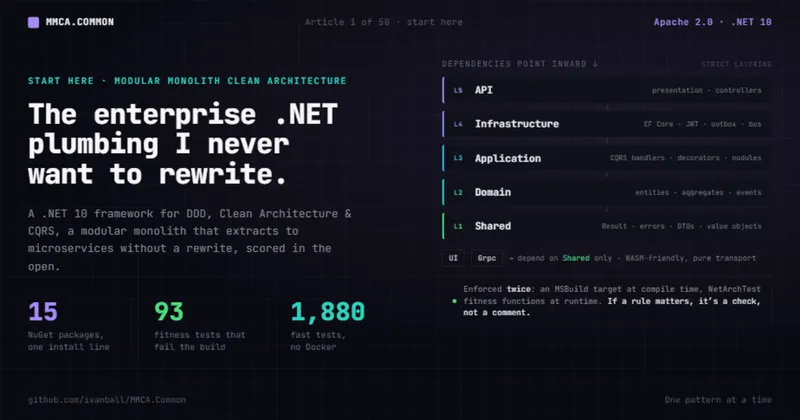
A .NET 10 framework for DDD, Clean Architecture, and CQRS, built as a modular monolith that extracts to microservices without a rewrite, and scored in the open against a 34-category rubric.
I have lost count of how many times I have rebuilt the same plumbing.
Error handling. The CQRS wiring. A transactional outbox. JWT and JWKS auth. Multi-database routing. Audit fields. The test harness. On every new enterprise .NET project, the same set of cross-cutting concerns gets rebuilt, usually from scratch, usually a little worse than last time because the deadline was closer.
So I did the obvious thing and extracted it once, properly, into a framework I could reuse. Then I did the less obvious thing: I open-sourced it under the Apache 2.0 license, and I graded it against a 34-category architecture rubric in public, gaps and all.
It is called MMCA.Common (Modular Monolith Clean Architecture), it targets .NET 10, and this article is the front door to a series that teaches it one pattern at a time.
What it is
MMCA.Common is a set of nineteen NuGet packages that give you a DDD + Clean Architecture + CQRS foundation as a modular monolith, plus the extraction boundaries to pull a module out into its own microservice later without rewriting application code.
The packages layer strictly, each one only depending on the layers below it:
API              (presentation / controllers)
     ↓
Infrastructure   (EF Core, caching, JWT, JWKS, outbox, message bus, SignalR)
     ↓
Application      (CQRS handlers, decorators, module system, IMessageBus)
     ↓
Domain           (entities, aggregates, domain events, specifications)
     ↓
Shared           (Result pattern, errors, DTOs, value objects)
A few packages sit off to the side of that stack rather than on top of it. UI and Grpc depend on
Shared only: the Blazor UI stays WebAssembly-friendly, and Grpc is pure transport that must not
couple to Domain, Application, or Infrastructure. The rest of the UI family builds on UI rather than
the layer stack: UI.Web is the web-host UI package, and UI.Maui (the one MAUI-target package)
depends on UI plus Shared only (ADR-042).
Two more packages sit outside the stack entirely. Gateway is the YARP edge that fronts the service
hosts once modules are extracted (ADR-008), and AI is a governed boundary for language-model calls,
isolated, versioned, evaluated, observed, and bounded in one package so a second AI feature inherits
the rules instead of copying them (ADR-120). The nineteenth package is MMCA.Common itself: a
metapackage that ships no assembly, one PackageReference in place of the six a standard application
host always takes (ADR-101).
Adding it to a solution you already have is one line, and each package transitively pulls the layers beneath it:
dotnet add package MMCA.Common.APIAPI brings Infrastructure, which brings Application, Domain, and Shared. The other packages
(Grpc, UI, UI.Web, UI.Maui, Aspire, Aspire.Hosting, Gateway, AI, and five Testing.*
packages) are opt-in for the surface you need.
Starting from nothing is a different command, because a package reference is not an application. A
solution on this framework is twelve projects and roughly 6,600 lines of plumbing before any business
logic, so the framework ships a dotnet new pack that writes all of it:
dotnet new install MMCA.Templates
dotnet new mmca-app -n Contoso.Support --module Orders --aggregate Order
That generates a warning-free build under five analyzers and a passing test run including the architecture-fitness rules, with no database needed. The template content is the framework's runnable reference app, staged at pack time rather than copied, so what you generate is the app whose CI keeps it green, under your own names.
The one thing that makes it different
Plenty of repositories will sell you Clean Architecture. The difference here is that the rules are not prose in a README. They are executable, and they fail the build.
The inward-pointing dependency rule (Domain must never reference EF Core or ASP.NET) is enforced twice, on purpose:
- At compile time, by an MSBuild target (
MMCA.Common.LayerEnforcement.targets) that inspects project references and fails the build with a descriptive error if a layer reaches into a layer it should not. - At runtime, by NetArchTest fitness functions that assert the same rules against the compiled assemblies.
Those fitness functions do not live as copy-pasted test code in three repos. They live once, in a
shipped package, MMCA.Common.Testing.Architecture, which exposes a reusable rule library and abstract
test bases (136 test methods across 53 base classes). MMCA.Common's own build runs
267 of them; the two consumer apps subclass the same bases and supply their own architecture map,
so the rules are literally identical across all three codebases.
This is the line I care about most: if a rule matters, it should be a check, not a comment.
Modular monolith now, microservices later, no rewrite
The other thesis baked into the framework is that "monolith vs microservices" is a false binary. You build the extraction point now and cut the service when (if) you actually need to.
The extraction boundaries are real and tested, not slideware:
- Database-per-service, even inside the monolith. Every entity resolves to a physical data source; a host with no extra configuration behaves exactly like a single-database monolith, and the same code runs against per-service databases once you split them (ADR-006).
- A transport-agnostic
IMessageBus. The same code dispatches events in-process today (InProcessMessageBus) and over a broker the day a module becomes its own service (BrokerMessageBus). Application, Domain, and Shared are forbidden from referencing the broker library directly, and a fitness test enforces it. - A transactional outbox so that split never loses an event (its own deep-dive later in the series).
- gRPC contracts, JWKS cross-service auth, and Aspire hosting extensions for the extracted topology (ADRs 004, 007, 008, 012).
The point is reversibility. Transport choices live at the edges; your business logic does not know or care whether the module next door is a method call or a network hop.
I scored it on two axes, then published every gap
Here is the part that usually gets left out of "look at my framework" posts.
I graded MMCA.Common against a 34-category architecture rubric (backend, front-end, and operational/governance categories), scoring each category on two axes: Maturity (how well-governed the process is) and Implementation (how much substance is actually executed). It sits at a maturity index of 97.0% and an implementation index of 86.0% across all 34 categories (internationalization ships in the framework as en-US plus Spanish under ADR-027, which supersedes the single-locale ADR-011, so it scores on both axes like every other category; nothing is excluded as N/A). Then I committed the full evaluation to the repo, with every category's two scores, the evidence, and the honest gaps.
The rubric itself is versioned. Version 2 (ADR-110) keeps all 34 categories and scores category 10 as Messaging & Integration Architecture (Maturity 4 / Implementation 9) and category 16 as AI-Native Application Architecture (Maturity 3 / Implementation 6), which is where the governed language-model boundary is graded.
The pattern in the scores is the same line from earlier: every category that earned top marks was backed by a fitness function or a compile-time guard. Every category capped lower either left the design to code review, or has its real proof living downstream in a consumer app. Clean Architecture, SOLID, microservices readiness, CQRS, and testability all sit at Maturity 4 / Implementation 9, and all of them are enforced automatically.
Implementation is the weaker axis on purpose. A framework ships mature, well-governed mechanisms whose full execution often completes in the apps that consume it. Deployment, resilience recovery, and data-migration gating all score higher on maturity than on implementation precisely because the substance they reward (infrastructure-as-code, a drilled restore, a CI migration step) lives in MMCA.ADC and MMCA.Store, not in a library.
The headline gap the rubric named was Compliance and Privacy: soft-delete everywhere and no right-to-erasure path, which is the exact GDPR conflict the rubric names. I wrote that down rather than hiding it, and it became ADR-005, a real anonymization extension point, and a PII fitness function that fails the build. That is the whole point of scoring yourself in public: the gaps turn into the roadmap.
It runs in production, on two real apps
MMCA.Common is not a toy. Two deployed apps consume the same nineteen packages:
- MMCA.ADC, the Atlanta Developers Conference app, deployed to Azure and used to run a live event.
- MMCA.Store, an e-commerce app with Catalog, Sales, and Identity modules and Stripe integration.
Both run on the same framework version, swept in lockstep when the framework releases. The test suite is roughly 2,254 fast tests in a correct pyramid with no Docker or database dependency, held above a 2,000-test zero-discovery floor by CI, so the inner loop stays quick and a filter regression that silently drops tests fails the build.
What this series will cover
Over the coming weeks I will take one pattern per article and go deep:
- The
Result<T>railway that retired exceptions-as-control-flow. - The transactional outbox, in full.
- Database-per-service inside a monolith.
- The CQRS decorator pipeline (logging, caching, transactions, without touching a handler).
- Navigation populators that replace EF
Includechains. - JWKS cross-service auth without a shared secret.
- Architecture fitness functions you can add to your own codebase this week.
Each article stands alone if you land on it from a search, and links into the rest if you want the whole curriculum.
Try it, or come argue with me
MMCA.Common is Apache-2.0 licensed and open source. The fastest way to form an opinion is to read the scorecard (the gaps are the honest part) and skim the ADRs (the "why" behind each decision).
- ⭐ Star the repo: https://github.com/ivanball/MMCA.Common
- Read the full 34-category scorecard in the repo, gaps included.
dotnet new install MMCA.Templatesthendotnet new mmca-app -n Your.App, and tell me what breaks.
Next up: how a modular monolith becomes microservices without a rewrite, and why that extraction point is something you build now, not a migration you survive later.
Tags: .NET, C Sharp, Software Architecture, Microservices, Open Source