Core patterns · No. 8
Compose validators, don't copy them: a reusable FluentValidation kit
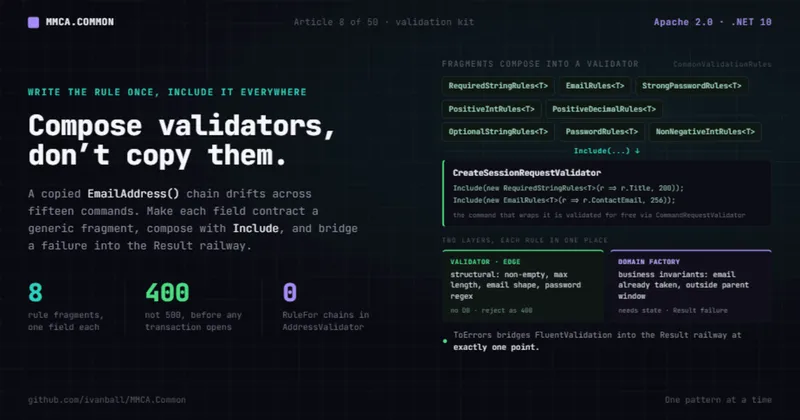
"Email must be valid, password must be strong, name is required." Every command re-declares
those rules, and then they drift. Here is a validation kit where the rules are written once, composed with
Include(...), and bridged into the Result railway so a bad request is a 400, not a 500.
Open any codebase with more than a dozen commands and grep for EmailAddress(). You will find it five
times. NotEmpty().MaximumLength(...) for a name field, fifteen times. A password regex chain, copied into
the register validator, the set-password validator, and the admin-reset validator, each subtly different
because someone tightened one and forgot the others. That is the anemic-validation smell: validation is
treated as boilerplate you retype per command instead of a building block you compose.
The pipeline question (where does validation run) is settled elsewhere: a ValidatingCommandDecorator
sits in the CQRS chain and gates every command before the handler, covered in the decorator-pipeline
deep-dive. This article is about the other half that no one writes well: the reusable building blocks
that make each validator a short list of includes rather than a copy-pasted RuleFor wall. MMCA.Common
ships that kit in MMCA.Common.Application, so ADC and Store both inherit identical email, password, and
address rules without duplicating a single line.
Reusable rule fragments, composed with Include
The core idea is a rule fragment: a tiny AbstractValidator<T> that owns exactly one field's contract,
generic over the parent type T and configured with a selector expression. CommonValidationRules.cs
declares eleven of them: RequiredStringRules<T>, OptionalStringRules<T>, EmailRules<T>,
AbsoluteUrlRules<T>, PositiveIntRules<T>, PositiveDecimalRules<T>, NonNegativeIntRules<T>,
RequiredIdRules<T, TId>, OptionalPositiveIdRules<T, TId>, PasswordRules<T>, and
StrongPasswordRules<T>. Each constructor is a single expression body. EmailRules<T>, for example,
chains NotEmpty() + EmailAddress() + MaximumLength(maxLength). StrongPasswordRules<T> repeats
PasswordRules<T>'s non-empty plus 8-to-128 length and adds four Matches(...) regexes for an uppercase
letter, a lowercase letter, a digit, and a special character.
Two design choices make a fragment reusable across unrelated types. First, it is generic over T, the
type that contains the field. Second, it takes a selector expression (Expression<Func<T, string>>)
rather than inheriting from the parent. So the same EmailRules<T> validates a RegisterRequest, a
LoginRequest, or a bare value object, with zero inheritance coupling. A concrete validator pulls a
fragment in with FluentValidation's Include(...):
public sealed class CreateSessionRequestValidator : AbstractValidator<CreateSessionRequest>
{
    public CreateSessionRequestValidator()
    {
        Include(new RequiredStringRules<CreateSessionRequest>(r => r.Title, "Title", 200));
        Include(new EmailRules<CreateSessionRequest>(r => r.ContactEmail, "Contact Email", 256));
    }
}
Read that and the contract is obvious at a glance: a required title capped at 200 characters, a valid
contact email capped at 256. No RuleFor chain to re-derive. The "non-empty plus valid format plus max
length" logic lives in one place, and a security tweak (tighten the password regex, raise an email length
cap) is a one-line edit that propagates to every consumer on the next package bump instead of being missed
in some forgotten validator.
The address family is the worked example of composition all the way up. AddressValidationRules.cs ships
six field fragments (AddressLine1Rules<T> through CountryRules<T>), and AddressValidator is a
composite AbstractValidator<Address> whose entire body is six Include(...) calls. It owns no
RuleFor chains of its own. The address fragments also pull their length limits from AddressInvariants
constants in MMCA.Common.Shared rather than baking numeric literals into the rule, so the domain
invariant and its validator agree by construction. The max length for a city lives in exactly one place
across the entire solution, and the validator references it.
One validator for the request, free for the command
Most commands in this codebase are thin wrappers that carry a request DTO, for example
CreateSessionCommand(CreateSessionRequest Request), and implement ICommandWithRequest<TRequest> (its
Request property is the bridge). The naive approach forces you to register a validator for both the
request and the command, which means restating the request's rules at the command level for every single
command. That is boilerplate begging to drift.
CommandRequestValidator<TCommand, TRequest> removes it by convention. It is an auto-registered
AbstractValidator<TCommand> whose constructor takes IEnumerable<IValidator<TRequest>> by DI and loops
over the whole collection, de-duplicated by runtime type with DistinctBy(v => v.GetType()), applying
RuleFor(c => c.Request).SetValidator(validator) for each one. Every registered validator for the request
type runs, not just the first, so a module that authors a validator beside a framework-supplied one gets
both sets of rules enforced instead of silently losing one. The generic constraint
where TCommand : ICommandWithRequest<TRequest> is what guarantees the c.Request selector compiles.
Write one validator for the request, and the command that wraps it is validated for free.
The wiring lives in the Application layer's module scan,
ScanModuleApplicationServices<TAssemblyMarker>(), which forwards to an Assembly-typed overload. That
overload calls AddValidatorsFromAssembly(moduleAssembly) to discover every hand-written validator by
convention, then reflects over the assembly for commands implementing ICommandWithRequest<>, builds the
closed CommandRequestValidator<TCommand, TRequest> type per command, and registers it with
TryAddTransient. That TryAdd is the load-bearing detail: it is a fallback, not an override. If a
module ships an explicit hand-written IValidator<TCommand>, that wins, and the generic bridge stays out
of the way. An empty validator collection is not an error either: it just means the request has no rules
and the generic validator is a no-op. Convention over configuration, with an escape hatch that never
blocks a bespoke case.
A validation failure is a Result, and the edge maps it to 400
A validator that runs is useless unless its output flows into the rest of the system cleanly.
FluentValidation speaks in ValidationResult and ValidationFailure. The rest of the codebase speaks in
the Result railway (covered in the Result-pattern article). One static class bridges them:
ValidationFailureExtensions, a C# extension(ValidationResult) block exposing a single method,
ToErrors(string source).
ToErrors projects each ValidationFailure into an Error.Validation(code, message, source, target),
tagged with the ErrorType.Validation kind. The mapping is exact: the failure's ErrorCode becomes the
error code, its ErrorMessage the message, the caller-supplied source the source, and its
PropertyName the target so the client learns which field failed. The ValidatingCommandDecorator
calls it with typeof(TCommand).Name as the source, so each error carries the name of the command that
produced it. On failure the decorator never calls the inner handler: it converts the failures to errors
and returns a Result failure immediately.
Two properties of that flow matter to a caller:
- Validation runs before the transaction opens. The
ValidatingCommandDecoratorsits before the transactional decorator in the pipeline. An invalid command short-circuits before any database transaction is opened. You never pay for a transaction on input that was never going to be persisted. - A validation failure is a 400, not a 500. The
ErrorType.Validationtag is what the API edge's failure mapper turns into400 Bad Requestwith per-property messages, identical at the boundary regardless of which validator raised it. A bad request is a client error, and the status code says so. Nothing in the domain or the handler ever references FluentValidation: the entire kit is an application-layer concern, consistent with the inward dependency rule of Clean Architecture.
That decoupling cuts both ways. FluentValidation never sees a domain Error, and the domain Error never
sees a ValidationFailure. ValidationFailureExtensions is the only join point where the two meet, so
neither library knows the other exists.
The two-altitude rule: validator versus domain factory
A reasonable objection: if the validator checks the input, why does the domain factory also return a
Result<T> and re-check things? Because they check at two different altitudes, and they complement rather
than duplicate.
The validator does cheap structural checks: is the string non-empty, is it under the max length, does it look like an email, does the password match the complexity regex. These are properties of the request shape alone. They need no database, no other entity, no business context, and they are exactly what you want to reject at the edge with a 400 before opening a transaction.
The domain factory enforces business invariants: rules that depend on state the validator cannot see.
"This email is already registered." "A session cannot be scheduled outside its parent event's window." "A
discount cannot exceed the order total." Those need other data, so they belong in the domain where that
data lives, returned as a Result failure from the factory method.
Put the structural check in the validator and the business invariant in the domain factory, and each lives in exactly one place. The anti-pattern is smearing one altitude across both layers: re-doing a regex check inside the factory, or trying to query the database from a validator. The kit's job is to make the cheap structural layer composable and consistent, so the domain factory is free to focus on the rules only it can enforce.
Trade-offs, honestly
- It is a FluentValidation dependency. The kit is a thin composition layer over FluentValidation 12,
not a hand-rolled engine. That is a deliberate trade (a mature, well-known library over reinventing
validation), but it is a dependency in the Application layer all the same, and your team has to know
FluentValidation's
Include,RuleFor, andSetValidatoridioms to read a validator fluently. - The generic-plus-selector indirection has a learning curve. A fragment like
RequiredStringRules<T>(selector, fieldName, maxLength)is more abstract than a literalRuleFor(x => x.Title).NotEmpty().MaximumLength(200). The payoff is reuse, but a newcomer meets a small generic puzzle (what isT, what does the selector bind) before the firstIncludereads naturally. - This layer is structural only. A fragment validates shape, never cross-entity or stateful rules. That is correct (those belong in the domain factory), but it means the validator is not the whole story, and a reviewer must check both altitudes to know a command is fully guarded.
- It overlaps the domain factory at the edges. "Required" and "max length" can be expressed both as a
validator fragment and as a domain invariant. The kit keeps the structural copy in the validator and
sources address limits from the same
AddressInvariantsconstants the domain uses, so the two agree by construction. Where a field has no shared constant, keeping the two in sync is a discipline, not a compiler guarantee.
None of these argue for copy-pasting RuleFor chains. They argue for knowing which altitude a rule lives
at and composing the structural ones deliberately.
Apply this even without MMCA
The pattern ports to any stack with a validation library that supports composition:
- Write each field contract once as a fragment: a small validator generic over the parent type, taking a selector, owning one field's rules (required, email, strong password).
- Compose, never copy. A real validator is a short list of includes, not a wall of inline rules.
- Source length limits and similar constants from the same place the domain uses, so the validator and the invariant cannot drift apart.
- Bridge validation output into your error type at one join point, tag it as a validation-class error, and map that class to HTTP 400 at the edge. Run it before you open a transaction.
- Keep structural checks in the validator and business invariants in the domain. Two altitudes, no smearing.
The takeaway: validation is a cross-cutting concern, so it deserves the same composition discipline as the rest of your architecture. A copy-pasted RuleFor chain is the anemic-validation smell. Write the rule once, include it everywhere, and let the edge turn a failure into a 400.
What we covered: why every command re-declaring "email valid, password strong, name required" drifts,
how MMCA.Common's reusable rule fragments (RequiredStringRules<T>, EmailRules<T>,
StrongPasswordRules<T>, the address fragments and AddressValidator) compose via Include(...) instead
of copy-paste, how CommandRequestValidator<TCommand, TRequest> plus ICommandWithRequest validate a
command for free from its request validator, and how ValidationFailureExtensions.ToErrors turns a
failure into an ErrorType.Validation Result that the API edge maps to 400 before any transaction opens.
Next in the series: the transactional outbox, the reliability backbone that persists a domain event and publishes it in the same transaction, never losing one.
MMCA.Common is Apache-2.0 licensed and open source. Star the repo, read the validation chapter of the onboarding
guide, or dotnet add package MMCA.Common.Application and try it.
Tags: .NET, C Sharp, Validation, Software Architecture, FluentValidation