Data & persistence · No. 11
One entity model, four databases: polyglot persistence behind a single attribute
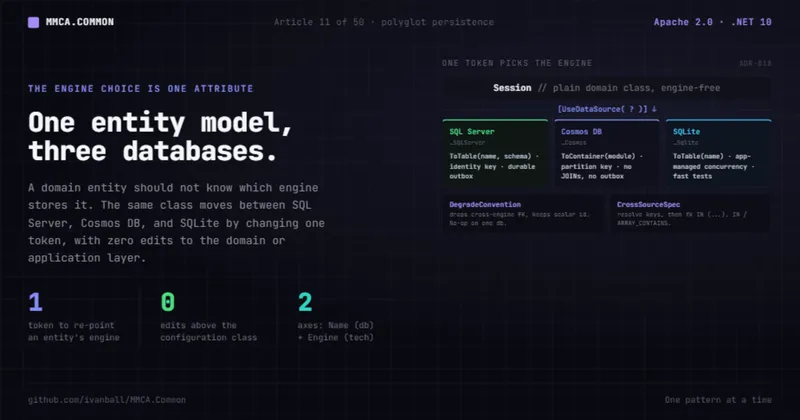
A domain entity should not know which database engine stores it. Here is a design where the same entity moves between SQL Server, PostgreSQL, Cosmos DB, and SQLite by changing one attribute, with zero edits to the domain or application layer, plus the honest note that the machinery is shipped and tested but not yet running in production.
Pick an entity. A Session, say. Where does it live? In almost every codebase the answer is welded
into the entity itself, or at least into its persistence configuration: a SQL table here, a Cosmos
container there, and switching between them means rewriting the mapping, the key strategy, the
queries, and usually a few handlers that quietly assumed a relational JOIN was available. The storage
engine becomes a load-bearing decision you made on day one with the least information you will ever
have.
That coupling is expensive in two directions. If you guessed SQL Server and later want a document store for a high-write, schema-loose entity, you are looking at a migration project, not a config change. And if you guessed Cosmos and later need a relational JOIN, you are stuck writing application side joins forever. The engine choice wants to be reversible. It almost never is.
MMCA.Common makes it reversible. A domain entity carries no persistence-engine choice at all. It is a
plain class. What decides whether it is stored in SQL Server, PostgreSQL, Cosmos DB, or SQLite is a
single [UseDataSource(<engine>)] attribute on its EntityConfiguration, carried for you by one of four
thin base classes. Moving an entity between engines is a one-token change, and nothing above the
configuration class has to know it happened.
Two axes, not one
This is the companion to the database-per-service article (Article 10), and the two are deliberately orthogonal. It helps to name the axes.
Database-per-service (ADR-006) is the Name axis: which physical database owns an entity, so that the Conference module's data and the Engagement module's data sit in separate databases that can be deployed and scaled independently. Article 10 covers that axis in full.
Polyglot persistence (ADR-018, extended to a fourth engine by ADR-113) is the Engine axis: which storage technology backs an entity, SQL Server vs PostgreSQL vs Cosmos DB vs SQLite, independent of which logical database it belongs to. The two compose. An entity has a Name (its database) and an Engine (its technology), and you can change one without touching the other. This article is about the Engine axis.
The configuration hierarchy: where the engine lives
Every entity in the framework gets an EntityConfiguration class. The relevant inheritance chain is short and worth holding in your head.
At the bottom is EntityTypeConfigurationBase<TEntity, TIdentifierType>. It does exactly one
cross-cutting thing: if the entity is an aggregate root, it tells EF to ignore the in-memory
DomainEvents collection so EF never tries to persist it. That is all. It knows nothing about
engines.
Above it sits the piece that ADR-018 added: a single, engine-aware
EntityTypeConfiguration<TEntity, TIdentifierType> base. This one class carries all the
table-versus-container, schema, and key-mapping logic for every engine. Its Configure method reads
the [UseDataSource(...)] attribute off the concrete configuration, and if the attribute is absent it
throws InvalidOperationException at startup. A configuration with no declared engine is a hard error,
not a silent default. Then it dispatches to a protected static ApplyEngineConventions helper that is
a switch over the engine, four cases in three branches:
- SQL Server and PostgreSQL, one shared branch deliberately:
ToTable(Name, schema)where the schema is the module name derived from the entity's namespace (the segment before "Domain"),HasKey(Id), and identity-column key generation. PostgreSQL takes the SQL Server mapping unchanged, module schema and PascalCase identifiers included, so an entity moves between the two engines by changing its configuration base class and nothing else (ADR-113). PostgreSQL house style (snake_case, the public schema) is a consumer's naming-convention plugin, not a framework decision. - SQLite:
ToTable(Name)with no schema,HasKey(Id), and SQLite identity columns. - Cosmos DB:
ToContainer(moduleName).HasPartitionKey(Id), one container per module so a module's entities and their relationships co-locate,HasKey(Id), and a client-sideCosmosIntIdValueGeneratorfor keys (Cosmos has no server-sideIDENTITY). - Anything else: a
defaultbranch that throwsInvalidOperationException. An engine with no mapping fails loudly instead of falling through to a relational guess.
Key generation is conditional in every branch: the engine's generator applies only when the entity's
identifier is store-generated (typeof(TEntity).IsIdValueGenerated), and otherwise the key is
ValueGeneratedNever(), so an entity that supplies its own ids keeps them on every engine.
On top of that single base sit four thin shims: EntityTypeConfigurationSQLServer,
EntityTypeConfigurationPostgreSQL, EntityTypeConfigurationCosmos, and
EntityTypeConfigurationSqlite. Each one is a one-line class. Its entire body is the attribute plus an
empty derivation. Here is the SQL Server shim, near enough verbatim:
[UseDataSource(DataSource.SQLServer)]
public abstract class EntityTypeConfigurationSQLServer<TEntity, TIdentifierType>
    : EntityTypeConfiguration<TEntity, TIdentifierType>
    where TEntity : AuditableBaseEntity<TIdentifierType>
    where TIdentifierType : notnull
{
    // no Configure override; all mapping lives in the engine-aware base
}
The PostgreSQL, Cosmos, and SQLite shims are identical except for the attribute value
(DataSource.PostgreSQL, DataSource.CosmosDB, DataSource.Sqlite). They exist purely so that a
consumer can express the engine choice by which base class they derive from, without ever typing the
attribute themselves.
The entity move is one token
So what does it take to move Session from SQL Server to Cosmos? You change its configuration's base
class from EntityTypeConfigurationSQLServer<Session, ...> to
EntityTypeConfigurationCosmos<Session, ...>. Or, equivalently, you derive from the engine-aware base
directly and put [UseDataSource(DataSource.CosmosDB)] on the class. That is the change.
// Before: relational
public sealed class SessionConfiguration
    : EntityTypeConfigurationSQLServer<Session, SessionIdentifierType>
{
    public override void Configure(EntityTypeBuilder<Session> builder)
    {
        base.Configure(builder);
        // relationships, column lengths, indexes...
    }
}

// After: document store. Same body. One base class changed.
public sealed class SessionConfiguration
    : EntityTypeConfigurationCosmos<Session, SessionIdentifierType>
{
    public override void Configure(EntityTypeBuilder<Session> builder)
    {
        base.Configure(builder);
        // relationships, column lengths, indexes...
    }
}
The Session entity class does not change. The command handlers do not change. The query handlers do
not change. The DTOs and mappers do not change. The engine is resolved once at startup by the
EntityDataSourceRegistry, which reflects over the configuration assemblies, reads each config's
[UseDataSource] attribute, and records the engine in a frozen lookup. The right DbContext
(SQLServerDbContext, PostgreSQLDbContext, CosmosDbContext, or SqliteDbContext, all sealed
subclasses of the abstract ApplicationDbContext, one class per engine) is then built per data source,
and the whole save and query pipeline routes through it without any caller knowing which engine
answered.
When a relationship crosses an engine boundary
A document store cannot enforce a foreign key into a SQL table. So the moment Session moves to
Cosmos while the Event it references stays in SQL Server, the relationship between them spans two
physical sources, and EF cannot model it the usual way. Two mechanisms catch this, and both run
without you writing a line of code.
The first is CrossDataSourceDegradeConvention, an EF model-finalizing convention. For each model it
builds, it finds relationships whose two ends resolve to different physical databases and degrades
them: it removes the foreign-key constraint, keeps the scalar FK column (plus a compensating index
so the value stays queryable), ignores the CLR navigation members that point at the foreign entity,
and removes the foreign entity type from this model entirely. The scalar FK survives, so a logical
join is still possible through a batch loader; what disappears is the impossible cross-database
constraint. The compensating index is deliberately skipped on Cosmos, because Cosmos auto-indexes
every property and rejects explicit index definitions (adding one would fail model validation). That
Cosmos-index skip was added with ADR-018 precisely so the same configuration body stays portable to
Cosmos with no edits.
The most important property of this convention: when every entity collapses onto one database (the monolith case), nothing is foreign and the convention is a structural no-op. The degraded model is byte-for-byte the single-database model. The boundary exists and is tested, but it costs nothing when unused.
Keeping a cross-source predicate translatable
Degrading the relationship solves the schema. It does not solve the query. Suppose you want all sessions whose event is published. Written the obvious way, that is a navigation:
// Not translatable once Session and Event live in different engines.
s => s.Event.IsPublished
Once Session is in Cosmos and Event is in SQL Server, EF cannot translate that. The navigation has
been degraded out of the Cosmos model entirely. You cannot JOIN across physical sources, full stop.
The engine-portable answer is resolve-then-filter-by-FK, and the framework packages it in
CrossSourceSpecification. Its single BuildAsync method does two things. First it resolves the
matching principal keys: it runs a scalar query against the principal's own data source (here, "give
me the ids of all published events") and materializes them into a list. Then it returns an
InlineSpecification whose criteria is the engine-portable expression
localPredicate AND principalKeys.Contains(dependent.ForeignKey). Every provider translates that:
SQL Server emits an IN clause, Cosmos emits ARRAY_CONTAINS.
// Engine-portable. Works whether Session is on SQL Server, PostgreSQL, SQLite, or Cosmos.
var spec = await CrossSourceSpecification.BuildAsync<Session, SessionIdentifierType,
                                                     Event, EventIdentifierType>(
    unitOfWork,
    principalPredicate: e => e.IsPublished,        // run against Event's source
    dependentForeignKey: s => s.EventId,           // the surviving scalar FK on Session
    localPredicate: s => !s.IsCancelled);          // optional local filter
Two details make this honest rather than magic. The predicate is combined with Expression.AndAlso,
not Expression.Invoke, so the resulting tree stays translatable on every provider (an
ExpressionVisitor rebinds the local predicate onto the FK selector's parameter so the two trees
share one lambda parameter). And the returned InlineSpecification drops straight into the existing
IEntityQueryService / read-repository specification argument, so the rest of the read pipeline does
not know anything unusual happened. ADC Conference's public-session filter
(GetPublicSessionFilterHandler, built on CrossSourceSpecification.BuildAsync) is written this way:
it resolves published Event ids and filters Session.EventId IN (...), which is portable across all
four engines.
There is even a fitness rule that enforces this discipline: an opt-in
SpecificationsDoNotNavigateToOtherEntities test fails the build if a specification navigates across
an entity boundary the way the un-translatable version above does.
The honest adoption note
Here is the part most articles would quietly omit. All of the above is shipped and tested. None of it is running in production yet.
Today, every current production entity configuration uses the …SQLServer base. ADC runs SQL Server
only, across four databases (the Name axis), with no entity on PostgreSQL, Cosmos, or SQLite in
production. The SQLite base backs the fast test database in MMCA.Common's own infrastructure tests;
the Cosmos base is exercised by portability tests and a factory test. ADC Conference actually trialed the Session→Cosmos
and Room→SQLite move (the worked example throughout this article): it was built and locally tested,
then deliberately reverted to all-SQL-Server, with every framework extension point kept in place. The unified
base, the cross-source degrade convention, the Cosmos-index skip, the SQLite EnsureCreated path, the
cross-source specification, and the fitness rule are all in place and green.
So treat PostgreSQL, Cosmos, and SQLite as supported, exercised extension points rather than dormant ones, but do not read this as "ADC is polyglot in production." It is not. The capability is real and has been trialed end to end, but no production entity routes to a non-SQL engine today. Saying so is the point of the §8 evaluation: an extension point that is built and tested but not yet load-bearing is a different thing from one that is in daily production, and conflating them is how architecture diagrams start lying.
Trade-offs, honestly
- Cosmos has no JOINs, and the framework does not pretend otherwise. The whole resolve-then-filter-by-FK machinery exists because you cannot join across containers or across physical sources. Cross-source navigation goes through batch loaders, and cross-source consistency is the outbox's job (ADR-003), not a transaction's. There is no two-phase commit across engines.
CrossSourceSpecificationfits bounded principal sets. It materializes the matching principal keys and embeds them in the predicate. That is ideal for "published events" or "active tenants," but an unbounded principal set would inline a very largeINlist. The class documents this limit explicitly; it is a tool for the common bounded shape, not a general join replacement.- Concurrency tokens differ by engine. SQL Server maps
RowVersionto a server-generatedrowversion; SQLite has no server-generated equivalent, so the same token is application-managed there, and PostgreSQL takes that same application-managed token rather than its nativexmin, so it is not the one engine whose entity shape differs (ADR-113). The entity model is one, but the optimistic-concurrency mechanics underneath are not identical across engines, and you should know which you are getting. - Cosmos has no durable outbox.
CosmosDbContextoverridesSupportsOutboxtofalse. Domain events from a Cosmos-stored aggregate are dispatched in-process only, with no durable outbox row to replay from. That is a real reliability difference from the relational path, and it is a deliberate consequence of Cosmos having no relationalOutboxMessagestable. - Trialed, then reverted, not deployed. As above: the extension points are built and tested, ADC trialed the Cosmos/SQLite move and rolled it back to all-SQL-Server, and no production polyglot entity has shipped. Validate the engine behavior you depend on against your own data before you lean on it in production.
None of these are reasons to weld the engine choice back into the entity. They are the reasons to keep the engine choice in one attribute, where you can see it, test it, and change it.
Apply this even without MMCA
The pattern ports to any stack with EF Core or a comparable configuration-driven ORM:
- Keep the entity engine-free. The domain class is a plain object. The persistence engine is a property of the configuration, not the entity.
- Put the engine choice behind a single attribute or base class, and make a missing engine a startup error, never a silent default. Loud beats subtle.
- Centralize the per-engine mapping in one place (one
switchover the engine), so the four engine shims share identical logic and cannot drift. - Degrade cross-engine relationships automatically at model-build time: drop the impossible constraint, keep the scalar FK column, and make it a no-op when everything is on one engine.
- For cross-engine filters, resolve principal keys first, then filter by
foreignKey IN (keys). That predicate is translatable on every engine; a navigation is not. - Document the adoption state honestly. "Built and tested" and "running in production" are different claims. Say which one you mean.
The takeaway: an entity should not know what database it lives in. Move the engine choice into one attribute and the storage technology becomes a reversible decision instead of a permanent one, even if you do not flip it on day one.
What we covered: why welding an entity to a storage engine is an expensive, usually irreversible
decision, how MMCA.Common's engine-aware EntityTypeConfiguration base plus four thin
…SQLServer/PostgreSQL/Cosmos/Sqlite shims re-point the same entity to a different engine through one
[UseDataSource] attribute, how CrossDataSourceDegradeConvention and CrossSourceSpecification keep
cross-engine relationships and predicates working without rewrites, and the honest note that this is
shipped and tested but not yet running in ADC production.
Next in the series: navigation populators, the batch-loader that replaces EF Include chains once a relationship crosses a data-source boundary.
MMCA.Common is Apache-2.0 licensed and open source. Star the repo, read the persistence chapter of the
onboarding guide, or dotnet add package MMCA.Common.Infrastructure and try it.
Tags: .NET, C Sharp, Software Architecture, Databases, EF Core