Proof & getting started · No. 42
One Blazor UI, two hosts: a device-capability layer that stays resolvable everywhere
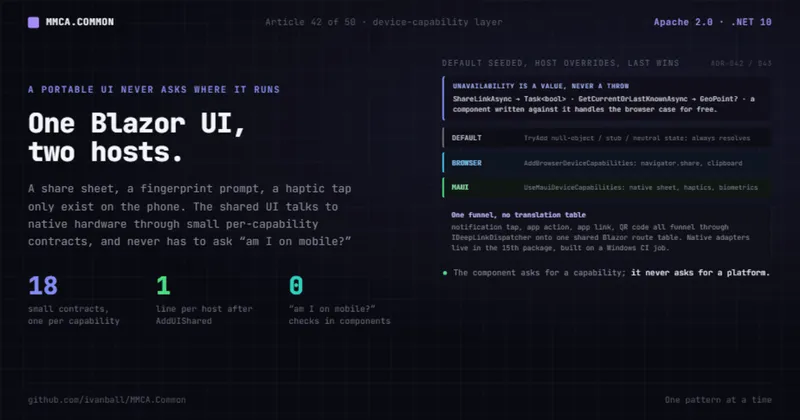
The same Blazor component set runs in a browser and inside a MAUI Blazor Hybrid app. But a share sheet, a fingerprint prompt, and a haptic tap only exist on the phone. Here is how one UI talks to native hardware through small per-capability contracts, and never has to ask "am I on mobile?"
Ship the same Blazor components through a browser and through a .NET MAUI Blazor Hybrid app and you hit a wall the first time a component wants to do something physical. Open the native share sheet. Copy to the clipboard. Buzz on a bookmark. Prompt for Face ID. Read a GPS fix. Speak a screen-reader announcement. None of those APIs exist in a browser, and half of them have a partial browser equivalent (navigator.share, navigator.clipboard, navigator.onLine) that behaves nothing like the native one.
The naive fix is a platform check. A component asks "am I running on MAUI?" and branches. That question metastasizes: it shows up in the share button, the offline banner, the avatar picker, the login page, and every one of them now has two code paths, one of which never runs in the environment you are testing in. The component library stops being portable the moment it knows what a phone is.
MMCA.Common.UI is a single-target net10.0 Razor class library that has to compile into a Blazor WebAssembly bundle, so it cannot reference a MAUI type without breaking the web heads at compile time. That hard constraint is the whole reason the design is clean: the shared UI is structurally forbidden from knowing about the phone, so it has to talk to native hardware through an abstraction, and the implementation gets chosen somewhere the shared library never sees. This is ADR-042, the Device Capability Abstraction, and it is a whole shipped functional group (G26 in the onboarding guide, roughly a hundred types once you count contracts, native adapters, browser adapters, and fallbacks).
The MMCA answer: one small contract per capability, chosen per host
There is no god IDeviceCapabilities interface. That was a deliberate rejection: an aggregate device service forces every head to implement everything, and every new capability becomes a breaking change to a type everyone depends on. Instead the framework defines one small interface per capability, all living under Source/Presentation/MMCA.Common.UI/Services/Capabilities/ (Website/docs-src/adr/042-device-capability-abstraction.md:33), 24 capability contracts in all.
Each contract is a few methods, shaped so failure is a value, not an exception:
IShareService(IShareService.cs:8):ShareLinkAsync/ShareFileAsync, both returningTask<bool>so a caller learns "no share UI was presented" and falls back to copy-link rather than catching.IHapticFeedbackService(IHapticFeedbackService.cs:8):Click,LongPress,Vibrate, plus anIsSupportedflag; the doc comment is blunt that "haptics are decoration, never behavior," so failures are swallowed.IBiometricAuthenticator(IBiometricAuthenticator.cs:9):IsAvailableAsyncandAuthenticateAsync(reason), where cancellation, lockout, and error all returnfalseso the caller falls back to the normal credential login, never to a weaker path.IGeolocationService(IGeolocationService.cs:8):GetCurrentOrLastKnownAsyncreturns a nullableGeoPoint, and denial or timeout yieldsnullso a proximity hint is simply omitted.ISpeechToTextService(ISpeechToTextService.cs:10),IConnectivityStatusService(IConnectivityStatusService.cs:10),IExternalLinkService(IExternalLinkService.cs:9),IMediaPickerService(IMediaPickerService.cs:9),IPushRegistrationService(IPushRegistrationService.cs:10), and the rest follow the same rule: a boolean or a nullable that means "unavailable," never a throw a component has to guard.
That last point is the load-bearing design choice. Because unavailability is a return value, a component written against the contract already handles the browser case for free. It calls ShareLinkAsync, gets false, and shows the copy-link path. It never asks what platform it is on.
Three flavors of "unavailable," all registered by default
Small contracts only help if every one of them always resolves. A component that injects IShareService must get something on every head, or the browser build throws at runtime the first time someone taps share. So AddUIShared (the shared UI registration every host already calls) TryAdd-registers a safe default for every contract, in AddDeviceCapabilityDefaults (Services/Capabilities/DependencyInjection.cs:37). The TryAdd matters: it seeds a default only if nothing else claimed the slot, which keeps repeated host calls idempotent and lets a later registration win.
There are three flavors of default for absent hardware, and picking the right one per capability is the subtle part:
- Null object.
NullShareService(Interop/NullShareService.cs:4) returnsTask.FromResult(false)from both methods.NullHapticFeedbackService(DeviceStatus/NullHapticFeedbackService.cs:4) andNullSpeechToTextService(Media/NullSpeechToTextService.cs:6) do the same and reportIsSupported => falseso components hide the affordance entirely. Each null default signals unavailability the way its own contract does:IBiometricAuthenticatorhas noIsSupportedflag at all, soNullBiometricAuthenticator(Auth/NullBiometricAuthenticator.cs:4) returnsfalsefromIsAvailableAsyncinstead. - Constant stub.
AlwaysOnlineConnectivityStatusService(DeviceStatus/AlwaysOnlineConnectivityStatusService.cs:7) hard-codesIsOnline => trueand never raises its event. That is not laziness: it is correct for Blazor Server, where a lost connection tears down the circuit itself, so the reconnect overlay already covers the offline case and a connectivity service would be redundant. - Neutral local state.
InMemoryDevicePreferences(DeviceStorage/InMemoryDevicePreferences.cs:10) is registered scoped, not singleton, so the Blazor Server fallback holds per-circuit (per-user) state and never leaks one user's preferences into another's.
A fourth kind is not a fallback at all. For two contracts the shared default is the real implementation, so no head replaces it: DeepLinkDispatcher (registered at Services/Capabilities/DependencyInjection.cs:78) and AppLifecycleNotifier (at :82), which the MAUI package feeds from the native window rather than overriding. That is why AddMauiDeviceCapabilities natively overrides 20 of the 24 contracts rather than all of them (Website/docs-src/adr/042-device-capability-abstraction.md:47-52).
The payoff: a head that knows nothing about capabilities keeps working. It gets share-returns-false, haptics-do-nothing, always-online, and every component degrades gracefully with zero host changes. That is the same inert-by-default posture the framework's notification layer takes.
Heads override after the defaults, last registration wins
A default that is always inert would be useless on the platforms that can do the real thing. So heads override, and the mechanism is deliberately boring: plain Add registrations, called after AddUIShared, exploiting the rule that the last registration wins for single-service resolution.
The browser heads (Blazor Server and WebAssembly) call AddBrowserDeviceCapabilities (Services/Capabilities/DependencyInjection.cs:95), which swaps in eight browser adapters over one shared JS module, CapabilitiesJsModule. BrowserShareService (Interop/BrowserShareService.cs:8) calls navigator.share and returns whether a share UI actually appeared; on desktop Firefox or an insecure context it reports false, and the copy-link fallback kicks in exactly as on the null default. Every browser adapter is prerender-safe: a JS-unavailable call degrades to the null behavior instead of throwing during the static SSR pass.
The MAUI head calls UseMauiDeviceCapabilities (MMCA.Common.UI.Maui/HostingDependencyInjection.cs:30), which wires the native Plugin.LocalNotification lifecycle, registers the notification-tap bridge, and calls AddMauiDeviceCapabilities (MMCA.Common.UI.Maui/DependencyInjection.cs:42) to replace the defaults with MauiShareService, MauiClipboardService, MauiHapticFeedbackService, MauiGeolocationService, and the rest. Permission flows live inside each MAUI adapter (check, show rationale, request, degrade, never throw); components never see permission state.
Here is the whole composition, illustrative of the documented shape:
// Every host, browser or native, calls the shared UI registration first.
// It TryAdd-seeds a safe default for every capability contract.
builder.Services.AddUIShared(builder.Configuration);   // -> AddDeviceCapabilityDefaults() inside

// Blazor Server / WebAssembly host: override with browser adapters AFTER AddUIShared.
builder.Services.AddBrowserDeviceCapabilities();       // navigator.share, clipboard, aria-live, onLine

// MAUI Blazor Hybrid host (in MauiProgram): override with native adapters AFTER AddUIShared.
builder.UseMauiDeviceCapabilities();                   // native share sheet, haptics, geolocation, biometrics
Three hosts, one shared component set, and the only difference is which one line ran after AddUIShared. A component that injects IShareService gets NullShareService on a forgetful host, BrowserShareService on the web, and MauiShareService on the phone, and it wrote none of that branching.
The ninth package, and why it lives outside the solution
The native adapters cannot ship in MMCA.Common.UI, because that package must stay WebAssembly-compatible. They ship in MMCA.Common.UI.Maui, the ninth of the framework's nineteen NuGet packages and its one MAUI-target exception. It multi-targets net10.0-android/ios/maccatalyst/windows, references MMCA.Common.UI plus Microsoft.Maui.Controls and Plugin.LocalNotification, and stays out of MMCA.Common.slnx (Website/docs-src/adr/042-device-capability-abstraction.md:81).
That exclusion is not cosmetic. MMCA.Common's CI and release pipelines run on ubuntu, which cannot build MAUI target frameworks at all, and the nineteen packages release in lockstep. So the MAUI package is built and packed by dedicated windows CI jobs (build-maui, a required gate, and publish-maui, under the same tag and SBOM discipline), the same mechanism that keeps the UI gallery and E2E projects out of the fast ubuntu unit run. Its layer rule is "UI plus Shared only," enforced at compile time; it is deliberately absent from the ubuntu runtime architecture map because its assemblies cannot even load there.
Deep links: one funnel, no translation table
The most elegant part is navigation. A notification tap, a home-screen app action, an app link, a scanned QR code: all four are native events that need to land on a Blazor route. They funnel through one singleton, IDeepLinkDispatcher (Services/Capabilities/Navigation/IDeepLinkDispatcher.cs:10), whose default DeepLinkDispatcher (Services/Capabilities/Navigation/DeepLinkDispatcher.cs:9) either raises RouteRequested live when a listener is attached, or buffers the most recent route (capacity one, guarded by a Lock) so a cold-start tap survives until the router renders. The DeepLinkListener.razor component in the shared layout drains that buffer after first render and navigates.
Why capacity one, and why a buffer at all? Because a tap can launch the app: native code publishes the route into the singleton before Blazor has rendered anything, so there is no listener yet. The single-entry buffer holds that route until first render, then the listener consumes it. Live taps, once the app is running, skip the buffer entirely.
The payoff of Blazor Hybrid is that web URLs and app routes are identical. All heads share one Blazor route table, so an incoming deep link is reduced to its path and query and published as-is. No translation table exists anywhere. This is also where ADR-043 (mobile deep links and app association) plugs in: incoming app-link and OAuth-callback URIs reuse this exact dispatcher, and each app's UI.Web host serves the platform association files (assetlinks.json, apple-app-site-association) that tell the OS to open shared https URLs in the installed app. The OAuth-callback angle is its own story; here the point is only that ADR-043 adds native entry points and reuses this one funnel rather than building a second.
One more component earns its place: ExternalLink.razor. A raw target="_blank" anchor silently dead-ends inside a BlazorWebView (WKWebView drops it), so shared components route external links through IExternalLinkService (Services/Capabilities/Interop/IExternalLinkService.cs:9). It renders a real new-tab anchor on web heads, and where InterceptsLinks is true it intercepts the click into the system browser. OfflineBanner.razor renders only when IConnectivityStatusService reports offline. The components adapt; they never branch on platform.
Trade-offs, honestly
- Null-object defaults can mask a missing registration. A MAUI head that forgets
UseMauiDeviceCapabilitiesdoes not fail fast: it silently resolves the null defaults and loses haptics, share, and biometrics with no error. That is accepted for decoration-grade capabilities, but a feature that genuinely depends on a capability has to assert availability in its own UI and surface the gap (IsSupportedwhere the contract exposes one,IsAvailableAsyncfor biometrics, the returnedfalsefor share), rather than trusting the registration happened. - The pattern relies on registration order. The whole "last registration wins" mechanism only works if
AddUIShared(and itsTryAdddefaults) runs before the head's plainAddoverrides. Both extension methods document the ordering, and the class doc comment aboveAddMauiDeviceCapabilities(MMCA.Common.UI.Maui/DependencyInjection.cs:28-30) restates it, but it is an ordering contract a host can still get wrong. - A separate MAUI package raises release surface. Two CI runners, ubuntu and windows, must both succeed for a whole release, because the MAUI package cannot build on ubuntu and the packages ship in lockstep. Accepted, and gated by the same tag and SBOM checks as the rest.
- Some contracts ship ahead of their native depth. The external-auth broker registers
MauiExternalAuthBrokerscoped but inert (IsAvailable == false) until the head configures its OAuth redirect scheme and platform callback (MMCA.Common.UI.Maui/DependencyInjection.cs:73-76); until then the shared login page stays on its anchor flow. Native push likewise stays wired-but-tokenless until real FCM/APNs credentials exist (MMCA.Common.UI.Maui/DependencyInjection.cs:64-67). Registered is not the same as fully live, and the article does not claim otherwise.
None of these argue for a platform check back in the components. They argue for asserting IsSupported where a feature truly needs the hardware, and for keeping the registration order honest.
Apply this even without MMCA
The pattern ports to any UI that runs on more than one host:
- Define one small interface per capability, not an aggregate device service. Each new capability is then additive, not a breaking change to a type everyone depends on.
- Shape each contract so unavailability is a return value (a
boolor a nullable), never an exception. A component written against it handles the missing-hardware case without a single guard. - Register a safe default for every contract at the composition root, with a conditional-add so it only seeds when nothing else claimed the slot. Then a host that knows nothing about capabilities still resolves everything and degrades gracefully.
- Let hosts override after the defaults, relying on last-registration-wins, so the per-host adapter is one line and the shared code never sees it.
- Keep the platform-specific package physically separate if its target frameworks cannot build where the rest of your CI runs, and gate it on its own runner under the same release tag.
The takeaway: a portable UI is one that is structurally forbidden from knowing where it runs. Put each device capability behind a small contract, give every contract an inert default so it always resolves, and choose the real implementation per host at the composition root. The component asks for a capability; it never asks for a platform.
What we covered: why a platform check inside a shared component set is a portability leak, how ADR-042 replaces it with one small contract per capability under MMCA.Common.UI/Services/Capabilities/, how AddDeviceCapabilityDefaults TryAdd-seeds a null-object, constant-stub, or neutral-state default for every contract so it always resolves, how browser and MAUI heads override those defaults after AddUIShared with last-registration-wins, why the native adapters live in the ninth package MMCA.Common.UI.Maui built by a windows CI job, and how IDeepLinkDispatcher funnels every native navigation source onto the one shared Blazor route table.
Previously in the series: Two real apps on one framework, a conference platform and a store, both running on MMCA.Common without a fork.
Next in the series: managed file storage, uploads you don't have to trust, with untrusted-image re-encoding and a storage abstraction that swaps an Azure Blob backend for a safe Null fallback.
MMCA.Common is Apache-2.0 licensed and open source. Star the repo, read the device-capability chapter of the onboarding guide, or dotnet add package MMCA.Common.UI.Maui and try it.
Tags: .NET, Blazor, MAUI, C Sharp, Software Architecture