Auth & the edge · No. 19
The self-invalidating cache that lives in the pipeline, not your handlers
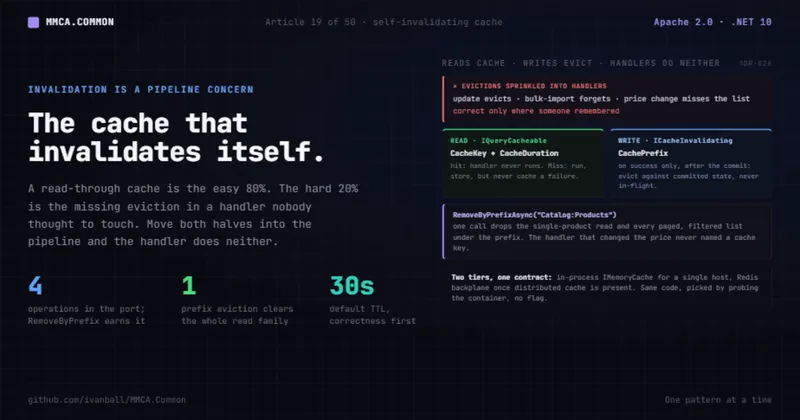
A read-through cache is easy. Keeping it correct is the hard part. Here is a cache where a write invalidates the reads it staled automatically, because invalidation lives in the pipeline instead of in every handler.
Adding a cache is the easy 80%. Here is the read path almost everyone writes first:
var cached = await _cache.GetAsync<ProductDto>(key);
if (cached is not null) { return cached; }
var product = await LoadProduct(id);
await _cache.SetAsync(key, product);
return product;
Reasonable. The hard 20% is the other side: the moment something changes the product, every cached read
of it is now a lie. So you start sprinkling RemoveAsync calls into your write handlers. The update
handler evicts one key. The bulk-import handler forgets. The price-change command evicts the product but
not the paged product list it appears in. Six months later you are debugging "the price updated in the
database but the API still shows the old one," and the cause is a missing eviction in a handler nobody
thought to touch.
Cache invalidation is famously one of the two hard problems in computer science. It gets harder when you scatter it across every command handler that might stale a read. So MMCA.Common does not put it there. It puts it in the pipeline.
Why invalidation belongs in the pipeline, not the handler
A handler's job is one use case. The fact that succeeding at that use case happens to stale some cached reads is a cross-cutting concern, not part of the use case. Tie the two together and you get the failure mode above: invalidation is correct only in the handlers where someone remembered it.
The fix is the same Decorator-pattern move the whole CQRS pipeline is built on (covered in the pipeline deep-dive). The cache logic lives in two decorators that wrap every command and query, and a handler opts into caching by implementing a marker interface, not by calling the cache. The read path caches. The write path invalidates. The handler does neither.
The cache abstraction
The whole subsystem is small and deliberate. The Application layer depends on one port:
public interface ICacheService
{
    Task<T?> GetAsync<T>(string key, CancellationToken ct);
    Task SetAsync<T>(string key, T value, TimeSpan? expiration = null, CancellationToken ct = default);
    Task RemoveAsync(string key, CancellationToken ct);
    Task RemoveByPrefixAsync(string prefix, CancellationToken ct);   // the load-bearing one
    Task<long> IncrementAsync(string key, TimeSpan expiration, CancellationToken ct);
    Task<T> GetOrCreateAsync<T>(string key, Func<CancellationToken, Task<T>> factory,
                                TimeSpan? expiration = null, CancellationToken ct = default);
}
Four cache operations, a counter primitive, and one composed read-through helper. RemoveByPrefixAsync is
the member that earns its keep. It is what lets a single write evict a whole family of cached reads
(every paged and filtered view under one prefix) in one call, without enumerating individual keys. It is
also why the backends had to be hand-built rather than pulled off the shelf: IMemoryCache has no key
enumeration, and IDistributedCache has no prefix delete. (IncrementAsync was the first late arrival, a
default interface member so no existing implementer broke, added as the single entry point for the
brute-force and rate-limit counters of ADR-029 instead of a read-then-write pair at each call site. The
distributed backend overrides it, but with the same read-modify-write shape rather than a Redis INCR,
because the counter lives in the adapter's own JSON layout: the override buys one call site, not
atomicity.)
GetOrCreateAsync is the second late arrival and the more interesting one, because of who does not use
it. It is also a default interface member: get, then take a per-key lock from a process-wide stripe,
double-check, run the factory, store the result. That is the read-through shape the query decorator below
implements, offered to the callers that are not queries. The decorators still do not route through it, and
the interface says so in its own remarks: GetOrCreateAsync caches whatever the factory returns,
unconditionally, including a failed Result. The decorator must not, so it keeps its own
read/execute/write sequence. A convenience helper that quietly relaxes a correctness rule is worth having
only if the code that depends on the rule stays off it.
ICacheService is defined in the Application layer; the concrete backend is chosen by DI at the
composition root. Handlers and decorators never see StackExchange.Redis or
Microsoft.Extensions.Caching directly. That is a textbook Clean Architecture port/adapter split: the
business code programs against the contract, the transport is a deployment concern.
One contract, three backends
AddCaching() picks a backend by probing the container. If a real distributed cache is registered (an
IDistributedCache that is not the default MemoryDistributedCache, typically Redis wired by Aspire), it
builds a DistributedCacheService. Otherwise it falls back to a MemoryCacheService over the in-process
IMemoryCache. No flag, no per-environment branch in application code:
MemoryCacheServiceis the single-instance fast path. BecauseIMemoryCachecannot enumerate its own keys, it maintains a sideConcurrentDictionarykey set so it can satisfyRemoveByPrefixAsync, and keeps that index honest with a post-eviction callback so expired entries prune themselves rather than leaking.DistributedCacheServiceis the out-of-process adapter, serializing values to UTF-8 JSON. When a RedisIConnectionMultiplexeris available, prefix eviction reaches pastIDistributedCacheto the raw connection and uses server-sideSCANto find and delete matching keys (that scan lives in a sharedRedisPrefixScanner, because two backends need it). This is the cache with a Redis backplane the architecture scorecard carries in its §10 row as former Cross-Cutting Concerns evidence, retained for the record now that those facets are scored in §5, §6, §9, §12, §17 and §29, and whose substrate is recorded in ADR-026: a single-host monolith caches in-process for free, and the same code transparently uses a shared Redis once the distributed cache is present, so cached reads stay coherent when a module is scaled out or extracted into its own service.
That auto-swap covers two of the three implementations. The third sits outside the probe, which deliberately never selects it, so a host has to ask for it by name:
HybridCacheServiceputs an in-process L1 in front of the distributed L2, overMicrosoft.Extensions.Caching.Hybrid, so a repeat read inside one replica never leaves the process while invalidation still crosses replicas through L2. It is opt-in: a host callsAddCommonHybridCache()and that call replaces whateverICacheServicewas registered, in either call order. Its defining constraint is a keyspace rule, not a performance one.HybridCachewrites its own payload layout, which is not the UTF-8 JSON the distributed adapter writes, so it writes under a disjointhc:keyspace: an old-format entry is simply invisible to the new service and vice versa, including while a rolling deploy runs both. That rule generalizes a real production failure this framework already took once, a RedisINCRcounter written as a string and read back by a hash-shaped path, which answeredWRONGTYPEand surfaced as a 500 on login. Two serialization formats must never share one keyspace, so the second writer gets its own.
Be honest about what "opt-in" means in a deployed system: all seven ADC and Store services call
AddCommonHybridCache() inside the same Redis conditional that wires everything else, so the effective
Tier-1 substrate in production is the hybrid one, not the distributed adapter, and the memory-or-Redis
swap is what a host gets when it does not state a preference. The contract that makes that
substitution a one-line change is the point. Nothing in any handler, decorator, or query changes.
A short, conservative default TTL keeps the cache erring toward correctness over hit-rate: 30 seconds.
The constant sits in one place (CacheOptions.DefaultDuration, a bare TimeSpan) precisely so the
hybrid backend, whose entry options are a different type entirely, defaults to the same policy instead of
hard-coding the figure a second time, and one binding layer sits above it: CacheSettings.DefaultDuration
is bound from the Cache configuration section, defaults to that same constant, and is what both the
distributed and the hybrid adapter actually read, so a host can retune the figure without the two
disagreeing. A query only earns a longer life when it explicitly declares one.
The read path: opt in by marker interface
A query caches by implementing IQueryCacheable (it supplies the cache key and the retention duration).
The CachingQueryDecorator does the read-through:
public sealed record GetProductQuery(int ProductId) : IQueryCacheable
{
    public string CacheKey => $"Catalog:Products:{ProductId}";
    public TimeSpan CacheDuration => TimeSpan.FromMinutes(5);
}
On a hit, the decorator returns the cached value and the handler never runs, with no lock on that fast
path. On a miss it takes a per-key lock from a fixed-width stripe shared process-wide, re-checks the
cache, and only then runs the inner handler and stores the result, but only when the Result is not a
failure, so error states are never cached. That double-check is stampede protection: when a hot key
expires under load, one request per process runs the handler and the waiters are served the entry it just
wrote. The guarantee is per process, not cluster-wide, and deliberately so: a shared-cache deployment
gets at most one execution per instance, which is harmless duplication rather than a distributed lock.
The wait on that lock is itself bounded and fail-open: QueryCachePipelineSettings.PopulateLockTimeout
(bound from Cache:PopulateLockTimeout, unbounded by default) arms a linked cancellation budget, and a
waiter that exhausts it logs at Debug, counts a miss, and runs the query uncached instead of failing,
while a genuine cancellation still propagates. Stampede protection is an optimization, so it degrades
like one. A query that does not implement the interface is passed straight through, paying nothing.
The write path: invalidate on success, outside the transaction
A command invalidates by implementing ICacheInvalidating, which exposes a CachePrefix. The
CachingCommandDecorator runs the inner handler first, then evicts:
public sealed record UpdateProductCommand(int ProductId, decimal NewPrice)
    : ICacheInvalidating, ITransactional
{
    public string CachePrefix => "Catalog:Products";
}
The decorator calls RemoveByPrefixAsync("Catalog:Products") only when three conditions hold: the
command implements ICacheInvalidating, its CachePrefix is not blank, and the Result is not a
failure. The blank-prefix guard is not a formality: RemoveByPrefixAsync("") would evict the entire
cache, so an empty or whitespace prefix is the deliberate opt-out for a command that carries a defaulted
prefix. Two consequences follow that matter:
- Failed commands skip invalidation. If the write did not persist, there is nothing stale to evict, so
the cache is left intact. (This is the same business-failure rule the transactional decorator follows:
a failed
Resultrolls the transaction back, exactly like an exception, and skips invalidation.) - Invalidation runs outside the transaction boundary. Because the caching decorator sits outside the transactional decorator in the pipeline, eviction happens after the inner transaction has committed. Eviction is against committed state, never in-flight state. You can never evict valid cache for a mutation that then rolls back.
That prefix eviction clears every read the mutation could have staled. The price change under
"Catalog:Products" drops the single-product read and every paged and filtered product list cached
under that prefix, in one operation. The handler that changed the price did not name a single cache key.
It evicts twice, though, and the second one is the interesting part. A read that missed the cache
before this command committed can still be running its handler against pre-write state and repopulate
the entry a moment after the first eviction lands. So the decorator schedules a second, fire-and-forget
eviction of the same prefix five seconds later, which removes that repopulated entry. Both evictions are
best-effort and deliberately non-cancellable (they run on CancellationToken.None, because the command
has already committed and a client that walks away must not strand stale entries), and any failure is
logged at warning level and swallowed: a cache outage must never turn a committed command into a failed
one. Whatever the two evictions cannot clear still expires on its own TTL.
Swallowing a failure is a discipline, not a catch
That swallow is the right call here and a dangerous habit everywhere else, so the framework gives it a
name: BestEffort.ExecuteAsync(operation, logger, action, ct), for a side effect that must never fail
its caller. It awaits the action, and turns any non-cancellation failure into exactly one Warning log
plus one increment of besteffort.dispatch.failed on a MMCA.Common.BestEffort meter, tagged by the
operation name. Three details are what separate it from a bare catch (Exception):
- Cancellation is rethrown, not swallowed. When the caller's own token is the reason the action
stopped, the
OperationCanceledExceptionpropagates, so a host shutdown or an abandoned request unwinds promptly instead of being recorded as a spurious failure. A side effect that must outlive the request passesCancellationToken.Noneitself, exactly as the eviction above does. - The failure is counted, not just logged. A side effect that has quietly stopped working shows up as a metric an operator can alert on, rather than only as a warning in a log nobody reads.
- The operation name is a metric tag, so it has to be a short low-cardinality constant. That is a real constraint on the caller, and it is the price of the signal.
Be honest about its reach: it is a helper, not a rule the compiler enforces, and the two caching
decorators still hand-roll the same shape against their own logger. The API package does route through
it: its tag-eviction extension wraps every EvictByTagAsync in BestEffort.ExecuteAsync under
CancellationToken.None, so the posture crosses the package boundary rather than stopping at the
Application layer. The cross-service eviction consumer in the edge-tier section below is the one caller
that still hand-rolls the swallow, log and count, against its own cache.eviction.failed instrument. The
portable part is the shape, not the call site. Log once, count once, never rethrow, except cancellation.
The two key transformations the pipeline applies
Everything above treats the query's CacheKey and the command's CachePrefix as literal strings. At the
decorator layer there are two exceptions, and they are the parts of key design the framework refuses to
leave to you, because getting either wrong leaks data rather than merely serving it late: tenant scoping
and caller scoping. The query decorator composes them in one expression,
TenantCacheKey.Scope(tenantContext, UserCacheKey.Scope(cacheable, cacheable.CacheKey)). Take the
tenant one first.
ICacheService is a singleton and cannot observe a scoped tenant, so a key that two tenants both compute
would serve one tenant's rows to the other. That is not a stale-cache bug, it is a data-leak bug. So
isolation is applied one layer up, where the key is computed: both decorators take an optional
ITenantContext and run the key or prefix through a single helper, TenantCacheKey.Scope, which returns
t:{tenantId}:{key} when a tenant is resolved and the untouched key when none is. Three properties fall
out of that shape:
- It is a prefix, not a suffix, so prefix eviction keeps working. Evicting
t:acme:productsremoves that tenant's product entries and nothing else, and no command in one tenant can evict another tenant's cache. - Both decorators call the same helper, which is what keeps reads and invalidations symmetric. A query
cached under
t:acme:productsis evicted by a command whose prefix becamet:acme:productsthrough exactly the same transformation. Scoping one side only would be worse than scoping neither: the write would evict a key nobody wrote. - With no tenant resolved, keys are byte-identical to the pre-tenancy framework. A single-tenant host keeps its keyspace and no cache entry is orphaned by upgrading.
The stampede stripe locks the same scoped key, so one tenant never waits on another tenant's lock. And the
honest limit: this lives in the decorators, so code that resolves ICacheService directly gets no tenant
prefix at all. Today's direct consumers (login counters, OAuth state, idempotency records) are keyed by
subject already, so they are safe by the shape of their keys rather than by a rule that would catch the
next one. The rest of the tenancy model (resolution middleware, the named query filter, the write
interceptor, database-per-tenant routing) is ADR-073's, and belongs to the multi-tenancy deep-dive.
The second transformation answers the parameter that is never on the request: who is asking. A query
implementing IUserScopedRequest (a "my orders" or "my profile" read) has its key scoped to the caller
by UserCacheKey.Scope, which appends :u:{UserId} unless the query opts out of caller scoping by also
implementing ISharedQueryCache. Without it, two users compute one key against one shared cache and the
second is served the first's rows for the whole cache duration. That marker is a suffix, and the
asymmetry with the tenant prefix is deliberate: a caller segment inserted ahead of the key would put
every user's entry outside the prefix an invalidating command computes, so nothing would ever be evicted.
Appended, the prefix stays intact and one command still clears every caller's copy. Over-eviction across
users is harmless; the leak it closes is not.
Two further transformations do happen, but underneath the port rather than in key design. The
distributed and hybrid backends prepend a service namespace to every key on get, set, remove and the
prefix scan, so two services sharing one Redis instance cannot collide. It is bound from
Cache:KeyPrefix, and left unset it is not empty: the framework resolves a per-application default of
{application namespace}:, because an empty default would put two applications sharing one Redis into
one keyspace for both cache entries and distributed locks, silently. It is applied inside the adapter
rather than through RedisCacheOptions.InstanceName precisely so prefix eviction still matches the keys
that were actually written. The in-process backend skips it, its keyspace being private by construction.
The hybrid backend adds its hc: segment on top, for the serialization-format reason above. Neither
transformation changes what your key means: they are keyspace hygiene applied uniformly under the
contract, which is why tenant and caller scoping stay the only places the framework decides part of your
key for you.
What the cache is, and is not
This is a request-result read-through cache for query handlers. It is not a session store and not a write-behind buffer. The cross-source consistency mechanism in this framework is the outbox (ADR-003, ADR-006), not the cache. The short default TTL and the failure-skipping rules are the right defaults for an opt-in cache layered onto a database-per-service system: it errs toward correctness over hit-rate.
ADR-026 decides two tiers, and this ICacheService substrate is the first. The second is an HTTP
output-cache edge (app.UseOutputCache(), with per-host opt-in policies) that lets a public read
endpoint skip the handler entirely. A third sits in the framework as a capability rather than a
decision: IUiReadCache, a read-through cache in front of the API client, registered scoped by the UI
package so it is one instance per Blazor Server circuit, and keyed on the relative URL to line up with
the edge tier's query-string variance rule. It ships and it is wired, and no consumer app switches it
on. The edge tier is host-configured rather than part of the pipeline, but it hides a correctness trap
sharp enough to earn the section that follows.
The edge tier: caching authenticated reads without leaking identity
Tier 2 sits in front of the handler instead of inside the pipeline. MMCA.Common.API always calls
app.UseOutputCache() but ships no policies: each host opts in. A read-heavy public service (ADC's
Conference service, Store's Catalog) declares named short-TTL policies on its [AllowAnonymous] GET
controllers, so an anonymous agenda or speaker read is served straight from the output cache and never
reaches a query handler. Store's Catalog runs four such policies, all on the 5-minute TTL; ADC's
Conference service runs twelve, ten at 5 minutes and two at 60 seconds where the payload turns over
faster. This is also the lever ADR-019 leans on: the global rate limiter partitions by authenticated user
and routes anonymous traffic to a NoLimiter partition, so output caching, not a throttle, is what
absorbs that load.
The sharp mismatch sits in ASP.NET Core's built-in default output-cache policy, which
refuses both cache lookup and cache storage for any request carrying an Authorization header or an
authenticated identity. The framework UI attaches a Bearer token to every outgoing API request,
including reads of these [AllowAnonymous], user-independent endpoints. So the default caches the traffic
that does not matter (anonymous) and skips the traffic that does (logged-in): on a conference day, when
every attendee is signed in, 100% of the agenda, session, and speaker reads bypass the cache and hit a
Basic-tier SQL database. The gap is one load evidence cannot see, because the k6 scripts and the startup
warmup requests are anonymous, exactly the slice the default policy still caches.
You can register a raw IOutputCachePolicy for those endpoints, and here is the sharp edge: a raw policy
registration replaces the whole default chain, so you inherit none of the built-in policy's safeguards
and must restate every one by hand. Drop the query-string variance rule, for example, and every variant
of a path (search, paging, filters, field projections) collapses onto a single cache entry, so one
filter serves another filter's cached rows. Replacing a framework default is never a one-line swap; it
is a promise to re-implement everything the default did.
So the framework ships PublicEndpointOutputCachePolicy, an IOutputCachePolicy that mirrors the built-in
default except where it deliberately differs: it does not bail out on an Authorization header or an
authenticated identity, and it varies the cache key by the resolved tenant (VaryByValues["t"], the
mirror of the t:{tenantId} prefix the decorators apply), because one path and query mean different rows
per tenant and the entry is shared. It re-implements the safeguards it displaced, GET/HEAD only, never
store a Set-Cookie response or a non-200, and vary the key by every query-string parameter
(CacheVaryByRules.QueryKeys = "*", the exact rule a hand-rolled policy most easily drops). Hosts register it per named
policy via OutputCacheOptions.AddPublicEndpointPolicy(name, expiration, tags) and reference it from
[OutputCache(PolicyName = ...)] like any built-in policy.
The contract is strict, because the failure mode here is a data leak, not a slow page: apply it only to
endpoints that are [AllowAnonymous] and whose response does not vary by caller. A cached response is
served verbatim to every later caller, so a user-dependent payload behind this policy is an
information-disclosure bug, not a perf tweak. For a payload identical for everyone except a privileged read
audience (ADC organizers and content editors see unpublished rows), the AddPublicEndpointPolicy(name, expiration, bypassRoles, tags) overload makes callers in a bypass role skip the cache entirely, so that
audience always reads fresh and its elevated responses are never stored. The audience is declared once and
shared, never restated per policy: ADC keeps it in a single ConferenceReadAudience.PrivilegedRoles list
(Organizer, ContentEditor) that both the host's bypass array and the API layer's read-visibility check
read, because two lists naming different roles would put a privileged payload into the shared public entries
and serve it to everyone. Nor is the bypass a rare exception: eleven of ADC's twelve public-read policies pass
it, and only NowNextCache (a 60-second now/next feed of published-only data) passes none, because its
response varies for nobody.
Crossing a service boundary with a tag-eviction event
The edge tier's other limit is structural rather than sharp. IOutputCacheStore is a per-host store,
so a host can evict its own tags and nothing else. In a database-per-service system the write that
stales a cached read routinely happens somewhere else, so on its own the only invalidation that crosses
a process boundary is the expiry clock. The framework closes that distance with its first concrete
integration event, OutputCacheEvictionRequested, whose entire payload is a list of output-cache tags
(defaulting to empty, so a malformed or older message degrades to a no-op instead of a cache-wide
purge), and the consumer that answers it, OutputCacheEvictionHandler, which drops each tag from this
host's store through EvictByTagAsync. Delivery adds no channel: the owning service raises the event,
the outbox persists and publishes it, the broker carries it, the inbox dedups the redelivery. Nothing
here is transactional or exactly-once and it does not need to be, because evicting twice is free and
evicting late is what a TTL is for.
Eviction is per tag and best-effort: one failing tag does not abandon the rest, and a failure is logged
and counted on a cache.eviction.failed counter (meter MMCA.Common.OutputCache) rather than
rethrown. Rethrowing would hand the message back to the retry policy, re-evict every tag that already
succeeded, and eventually dead-letter a message whose worst outcome is an entry that expires on its own
TTL anyway. Only OperationCanceledException propagates, so a stopping host is not counted as a cache
failure.
ADC is the first worked case. Bookmark counts are owned by Engagement and served by Conference. Engagement's
bookmark handler subscribes to the domain event the aggregate raises on create, reactivate and delete
alike (the delete path runs on the framework's generic DeleteEntityCommand and has no handler of its
own to hook), and publishes the eviction carrying the tag conference:sessions. Conference registers
both halves: the handler in its service collection and the consumer inside its broker configuration. A
star lands in about a broker round trip. The 60-second TTL on BookmarkCountsCache is the backstop for
a dropped or delayed message, not the mechanism that clears the entry.
Store runs the same path from the other kind of caller. Catalog's CustomerErasedHandler consumes
Identity's CustomerErased, clears the reviewer's name, title and body while keeping the star rating,
then publishes the eviction for its catalog:products tag inside BestEffort.ExecuteAsync. That adopter
sits in an Application-layer integration-event handler rather than behind a write endpoint, which is the
shape to copy when the mutation that stales a cached read arrives as a message.
Trade-offs, honestly
- Cache key correctness is the consumer's responsibility. The framework gives you read-through caching
and prefix invalidation. It cannot know that
GetProductQuery's key andUpdateProductCommand's prefix refer to the same data. If a query caches under"Catalog:Product"and a command invalidates"Catalog:Products", the cache silently goes stale and nothing complains. The pipeline guarantees that invalidation runs on success; it does not guarantee that your keys and prefixes line up. That mapping is yours to design and test. The tenant prefix and the caller suffix above are the only exceptions, and they are a good model for the rule: the framework only takes over a piece of key construction when getting it wrong leaks data rather than merely serving it late. - Distributed prefix eviction needs a Redis
IConnectionMultiplexer, and every deployed service wires one.RemoveByPrefixAsynccan scan-and-delete by prefix only when a multiplexer is in the container. All seven ADC and Store services reach Redis through one framework wrapper,builder.AddRedisCaching(), which registers the distributed cache and the multiplexer together and no-ops when the named connection string is blank, so whenever Redis is configured, prefix-based invalidation runs and cached reads are evicted on write. The hosts call that wrapper rather than Aspire's integrations directly, because the raw integrations register an untagged Redis health check that gates readiness (ADR-025). The 30-second TTL is the backstop only for the no-Redis case (in-memory mode), where prefix removal self-heals within the window instead. And when a multiplexer is absent,DistributedCacheServicedoes not fail silently: it logs the dead invalidation once (Interlocked-guarded, so a mutating command does not flood the log) so an unwired backplane is observable instead of invisible. Single-keyRemoveAsyncis unaffected in either mode. - A cache outage degrades reads instead of failing them, and the one fail-open on the auth path has a
bounded cost. Every cache call in
CachingQueryDecoratoris fail-open: a failed read is logged at warning level and treated as a miss, so the query falls through to the inner handler and still answers correctly, just uncached, and it is counted as a miss so an outage shows up in the cache-hit metrics rather than hiding; a failed populate returns the handler's result uncached. OnlyOperationCanceledExceptionis excluded from the guard, so a genuinely cancelled request still surfaces exactly as the inner handler would. A Redis outage therefore costs latency and database load, not a 500 on every cacheable query. The same posture on the authenticated hot path is where it turns into a real trade-off:SoftDeletedUserMiddlewarecaches the soft-deleted marker, falls back to the validator query when that cache is unreachable, and proceeds open when the query fails too, rather than locking out every authenticated caller on one blip. The exposure that buys is bounded by access-token lifetime: tokens live 15 minutes, and the deletion already revoked the refresh token, so the residual risk is one already-issued token running out its remainder while the cache or database is unhealthy. That bound is what makes the fail-open a deliberate choice rather than an accident of the code path. - Per-instance memory caches diverge, and the hybrid backend buys its L1 hit rate with a smaller version of the same problem. The in-process backend is not shared across instances, so two hosts hold independent copies until each entry's TTL reconciles them. That is exactly why the distributed adapter exists for scaled-out deployments. The two-level backend narrows the window rather than closing it: an eviction clears L2 and the evicting process's L1, but every other replica's L1 copy survives until its local expiration, capped at 30 seconds. That is a deliberate trade, and it is the same order of staleness as the delayed second eviction the write path already performs.
- The edge tier trades a data-leak risk for its speed.
PublicEndpointOutputCachePolicyserves one cached response verbatim to every later caller, so it is safe only on endpoints that are[AllowAnonymous]and identity-independent. Adopting it is an audit, not a toggle: a permission-gated or per-user endpoint must never move onto it, and the bypass-roles overload covers role-shaped variance only, never per-user variance. The store behind it is the other thing to get right:AddOutputCachedefaults to per-replica memory, so under scale-out a tag eviction reaches only the replica that handled the mutation. Both deployed adopters register a Redis-backed output-cache store inside the same Redis conditional that wires the pipeline tier, and ADR-040 makes the shared store the expected posture wherever a service runs more than one replica; the in-memory store is the single-replica case. - Cross-service tag eviction is a coherence hint, not a guarantee. The eviction event is what lets a payload written by a different service be cleared from this one's edge cache at all, and that reach comes with four honest costs. It is asynchronous and unordered relative to the write, so the stale window is an outbox poll plus broker delivery plus the consumer's scheduling, and a reader can still observe the old response after the writer committed: keep the TTL as the floor. The tag vocabulary is a shared string contract nothing validates, and the producer's tag must match the consumer's policy exactly; a typo evicts nothing and counts nothing, because evicting an unknown tag succeeds, so the likeliest error is the one with no signal. Both registrations are opt-in per host and live in two different packages, and a host that wires one half gets silence rather than a build or startup error. And the two tiers do not meet: one mutation may need a Tier-1 prefix invalidation and a Tier-2 tag eviction, and nothing coordinates them. Before you cache an endpoint, check which process owns every write that can change its response. What the event buys is that "another service" is a wiring exercise rather than a dead end.
- The cache path is not measured by any benchmark. Common runs a
performance-smokeCI job on every code-changing pull request (CI is deliberately pull-request-only, and a docs-only PR skips the two perf steps) that invokes the BenchmarkDotNet harness with--filter "*" --job Short --exporters json, then abuild/perfgatestep that verifies the results against a committedperf-baseline.jsonand fails on an allocation-ceiling or ratio regression, so it is a real latency-regression gate, not just a runs-clean smoke. It is a required merge gate too: its context is in the branch's required status checks, so a regression it catches blocks the merge. One caveat still keeps it from covering this design: the harness lives outside the.slnx, and its two suites benchmark the specification compiled-cache and composition plus the query filter/sort/shape pipeline, not these cache decorators. The caching design is sound, but its effect on the cache path is still not measured.
None of these are reasons to scatter invalidation back into handlers. They are the reasons to design your keys deliberately and pick the backend that matches your topology.
Apply this even without MMCA
The pattern ports to any stack with a decoratable handler pipeline:
- Put the cache behind a port the business layer depends on (
Get,Set,Remove,RemoveByPrefix), and choose the backend at the composition root. - Cache on the read decorator, never inside the query handler, and never cache a failure result.
- Invalidate on the write decorator, on success only, and after the transaction commits.
- Invalidate by prefix, not by enumerating keys, so one write clears every read it could have staled.
- Accept that key correctness is yours: design the key-and-prefix mapping deliberately and test it.
- If entries are scoped to anything the cache itself cannot see (a tenant, a caller, a region), apply that scope from one helper both decorators call, so reads and invalidations can never disagree, and pick its position by what your invalidation walks: a prefix when the scope should partition eviction too, a suffix when one eviction must still clear every scoped copy under one prefix.
- When a cached response is built from data another process owns, do not settle for its TTL: broadcast the eviction as an event on the messaging path you already have, keep it per item and best-effort, and keep the TTL as the backstop for the message you drop.
The takeaway: a read-through cache is a feature; a self-invalidating cache is a discipline. Move the discipline into the pipeline and your handlers stop carrying it, one missing eviction at a time.
What we covered: why scattering cache invalidation across handlers goes stale by omission, how
MMCA.Common's ICacheService port plus two pipeline decorators cache reads and invalidate writes
automatically, how one contract over three backends (memory, Redis, and the opt-in two-level hybrid every
deployed service selects) keeps the same code coherent from monolith to scaled-out service, why
invalidation runs on success outside the transaction and then runs again five seconds later, which two
pieces of key construction the framework takes over for you (the tenant prefix and the caller suffix),
why every cache call is fail-open
so an outage degrades to uncached reads instead of 500s, what BestEffort.ExecuteAsync makes of that
posture for any side effect that must not fail its caller, and how the HTTP edge tier caches authenticated
reads of public endpoints without leaking identity (ADR-040) and evicts across a service boundary over
an integration event instead of waiting out a TTL.
Next in the series: Problem Details across HTTP and gRPC, the one error-mapping table that turns every Result failure into the same RFC 9457 shape on both transports.
MMCA.Common is Apache-2.0 licensed and open source. Star the repo, read the caching chapter of the onboarding
guide, or dotnet add package MMCA.Common.API and try it.
Tags: .NET, C Sharp, Caching, Software Architecture, Performance