Auth & the edge · No. 29
Resource-ownership authorization: which rows you may touch, not just which actions
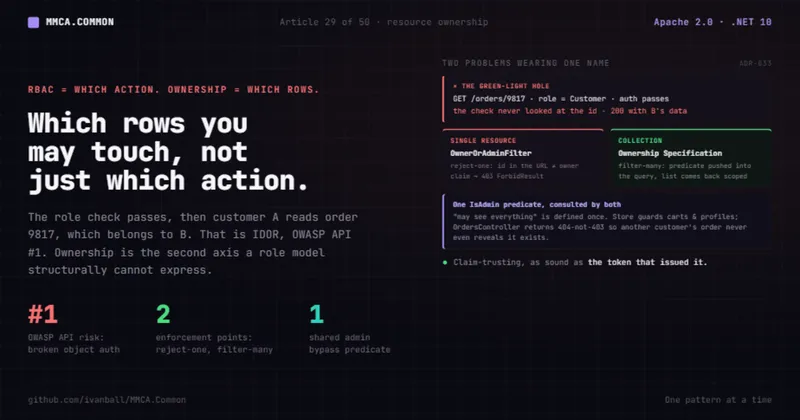
Article 24 covered what a role or permission lets you do. It said, explicitly, that "a customer may read only their own order" is a different concern. This is that concern. RBAC answers which action; ownership answers which rows, and the two are not the same check.
Picture the role check passing. A request arrives with a valid token, the principal carries the
Customer role, and your policy says a customer may call GET /orders/{id}. Authorization succeeds.
Nothing is wrong with the role check. It answered the question it was built to answer: is this caller
allowed to read orders. It is allowed.
Now substitute the id. Customer A, fully authenticated, requests GET /orders/9817, an order that
belongs to customer B. The role check passes again, because the role check never looked at the id. It
cannot. A role is a property of the principal: "this person may read orders." It says nothing about
which orders, because "which" is not a fact about the principal at all. It is a relation between the
principal and a specific row.
That is the axis RBAC structurally cannot express, and Article 24 said so out loud. Its trade-offs
section named the gap directly: "A customer may read only their own order is a different concern (an
OwnerOrAdminFilter), and a route that needs both composes the two." The permission layer decoupled
endpoints from role names and then stopped, on purpose. This article is the mechanism it pointed at.
Why it matters
The failure mode here has a name, and it is not obscure. The OWASP API Security Top 10 lists Broken Object Level Authorization (the modern label for the classic Insecure Direct Object Reference, IDOR) as API1, the number-one risk to web APIs. The shape is always the same: the endpoint authenticates the caller, authorizes the action, and then trusts an id from the URL without checking that the row behind that id belongs to the caller. Increment the integer, read someone else's invoice.
What makes it so common is that it hides behind a green light. Every role check passes. Every test that asserts "a customer can read an order" passes. The hole only appears when the order in the URL is not the caller's, and that is exactly the case a who-can-do-what test rarely sets up. You do not get a stack trace. You get a 200 with the wrong customer's data in it.
So the missing axis is not a nicety layered on top of RBAC. It is the half of authorization that the role model was never designed to carry, and leaving it implicit is how a perfectly "authorized" endpoint leaks across tenants.
The MMCA answer: two enforcement points, one bypass
The first instinct is to look for a single ownership abstraction. There is not one, and ADR-033 is explicit about why: there are two genuinely different problems wearing one name.
A single-resource route (GET /orders/{id}, GET /customers/{id}) has an id in the URL. The job is to
reject one request when that id is not the caller's. A collection route (GET /orders,
GET /shoppingcarts) has no id to check. The job is to narrow the result set to the caller's own rows
before it is ever returned. Reject-one and filter-many cannot be the same mechanism: a filter cannot
narrow a list without re-running the query, and a query predicate cannot 403 a single bad id. MMCA.Common
ships one piece for each, keyed on the same claim, sharing the same bypass role, and a third piece that
exists only because the filter refuses to guess: an attribute an action uses to declare that it has no
owner parameter to compare.
Single-resource routes get an action filter. OwnerOrAdminFilter
(Source/Presentation/MMCA.Common.API/Authorization/OwnerOrAdminFilter.cs:31) is a sealed
IAsyncActionFilter whose primary constructor takes ICurrentUserService and an
IOptions<OwnerOrAdminFilterOptions> (OwnerOrAdminFilter.cs:32-33), so the vocabulary it enforces is
host-configurable. It short-circuits to the action for a caller in the bypass role
(OwnerOrAdminFilter.cs:43, passing the configured settings.BypassRole); otherwise it reads the
caller's owner claim via GetClaimValue<int>(settings.OwnerClaimType) (OwnerOrAdminFilter.cs:49;
OwnerClaimType defaults to customer_id, OwnerOrAdminFilterOptions.cs:16) and returns a
ForbidResult (HTTP 403) if that claim is missing (OwnerOrAdminFilter.cs:51,
OwnerOrAdminFilter.cs:53) or if the requested owner parameter resolves to an int that does not equal
the claim (OwnerOrAdminFilter.cs:73, OwnerOrAdminFilter.cs:75). That parameter
(OwnerParameterName, default id, OwnerOrAdminFilterOptions.cs:31) is read from either a route
value (OwnerOrAdminFilter.cs:95-97) or, when absent from the route, a model-bound query or body
argument (OwnerOrAdminFilter.cs:102-104), by TryGetOwnerParameter (OwnerOrAdminFilter.cs:93,
called at OwnerOrAdminFilter.cs:57), both parses invariant-culture. Only a matching owner value falls
through to the action (OwnerOrAdminFilter.cs:79). It is registered as a scoped service by AddAPI
(Source/Presentation/MMCA.Common.API/DependencyInjection.cs:85, AddAPI declared at :45) and
applied per controller as [ServiceFilter(typeof(OwnerOrAdminFilter))].
The framework names no roles, so the host must. BypassRole is [Required] with no default
(OwnerOrAdminFilterOptions.cs:23-24), and AddAPI registers the options with
ValidateDataAnnotations() and deliberately not ValidateOnStart() (DependencyInjection.cs:91-92,
the rationale at :87-90): validating at startup would fail every host that never applies the filter,
so the data-annotation message lands on first resolve, in front of the host that actually uses it. A
host that applies the filter without naming a role gets that failure rather than a silent bypass for
nobody.
And when there is nothing to compare, the filter denies. That is the interesting default, because the
obvious one is wrong. If TryGetOwnerParameter cannot resolve the parameter (absent, not an int, or
carried inside a bound model), the request gets a ForbidResult (OwnerOrAdminFilter.cs:57,
OwnerOrAdminFilter.cs:63). Falling through to the action instead would read "nothing to compare" as
"nothing to enforce", which silently stops guarding any action whose parameter is optional or not an
integer: the guard disappears with no error, no exception and nothing for a who-can-do-what test to
catch. ADR-033 records deny-by-default as the deliberate choice
(033-resource-ownership-authorization.md:71-82). An action that genuinely has no owner parameter says
so out loud with [AllowMissingOwner]
(Source/Presentation/MMCA.Common.API/Authorization/AllowMissingOwnerAttribute.cs:21, an
AttributeTargets.Class | AttributeTargets.Method attribute with Inherited = true,
AllowMissingOwnerAttribute.cs:20), which the filter honors on the action or its declaring controller
through the endpoint metadata (HasAllowMissingOwner, OwnerOrAdminFilter.cs:61,
OwnerOrAdminFilter.cs:84). The opt-out excuses a missing parameter only: an action carrying a foreign
owner id is still denied, and a missing owner claim is still denied regardless.
Collection routes get an ownership Specification. OwnershipHelper
(Source/Presentation/MMCA.Common.API/Authorization/OwnershipHelper.cs:10) is a static helper. Its
GetOwnershipSpecification<TSpec, TId> (OwnershipHelper.cs:34) takes the bypass role as a required
argument (OwnershipHelper.cs:38) and returns null for a caller who holds it
(OwnershipHelper.cs:45, OwnershipHelper.cs:47), and otherwise reads the caller's id claim
(GetClaimValue<TId>(claimType), OwnershipHelper.cs:50) and builds a specification through a supplied
factory (OwnershipHelper.cs:51); a convenience overload defaults the claim name to "customer_id"
(OwnershipHelper.cs:64-69, the literal at :69) and still requires the role (:67). The object it
hands back is a Specification<TEntity, TIdentifierType>
(Source/Core/MMCA.Common.Domain/Specifications/Specification.cs:15) whose Criteria is an
EF-translatable expression tree (Specification.cs:23). That is the same specification type from Article
6: it slots straight into the existing query pipeline, which translates the predicate to SQL, so a scoped
list query returns only the caller's rows. A null specification (the bypass case) applies no filter,
and because these are real specifications they compose, an AndSpecification (Specification.cs:81)
ties the ownership scope to any other criteria a query already carries.
One bypass role, on both. Both points call OwnershipHelper.IsAdmin (OwnershipHelper.cs:17), which
compares ICurrentUserService.Role
(Source/Core/MMCA.Common.Application/Interfaces/Infrastructure/Auth/ICurrentUserService.cs:22) to the
bypassRole its caller supplies, case-insensitively (OwnershipHelper.cs:20). That parameter has no
default value, and the XML doc says why: the framework declares no role names
(OwnershipHelper.cs:13-15). MMCA.Store passes its own RoleNames.Admin at both points
(OrdersController.cs:67, OrdersController.cs:69-71). One predicate, consulted by the filter and by
the helper, so a privileged caller sees and touches any resource through either path and you do not
maintain two definitions of "may see everything."
Notice the two deliberately different failure shapes. The single-resource filter denies with a 403
ForbidResult. The collection path never 403s: it returns a filtered, possibly empty, result set. Both
flow through the caller's normal Result/HTTP edge, not exceptions.
// Illustrative of shape: the two enforcement points, assembled from the real members.

// (1) Single-resource: the filter's core check (OwnerOrAdminFilter.cs:43-79), options-driven.
var settings = options.Value;   // OwnerOrAdminFilterOptions: OwnerClaimType, BypassRole, OwnerParameterName

if (OwnershipHelper.IsAdmin(currentUserService, settings.BypassRole))
{
    await next().ConfigureAwait(false);   // bypass-role short-circuit, both points share this predicate
    return;
}

var ownerId = currentUserService.GetClaimValue<int>(settings.OwnerClaimType);   // default claim: customer_id
if (ownerId is null) { context.Result = new ForbidResult(); return; }   // 403: no claim

// OwnerParameterName (default "id") is read from a route value OR a model-bound query/body argument.
if (!TryGetOwnerParameter(context, settings.OwnerParameterName, out var requestedId))
{
    // Deny by default: nothing to compare is not nothing to enforce. An action with no owner
    // parameter opts out explicitly with [AllowMissingOwner] and names the guard that replaces this.
    if (!HasAllowMissingOwner(context))
    {
        context.Result = new ForbidResult();   // 403: unresolvable owner parameter
    }
    else
    {
        await next().ConfigureAwait(false);
    }

    return;
}

if (requestedId != ownerId.Value)
{
    context.Result = new ForbidResult();   // 403: requested owner is not the caller's
    return;
}

await next().ConfigureAwait(false);   // only a matching owner value gets here

// (2) Collection: row-scope the list query with an ownership Specification (a controller).
//     The bypass role gets null (no filter); everyone else gets a spec the query translates to SQL.
//     BypassRole is required and has no default, so the host names it (Store: RoleNames.Admin).
private OrdersByCustomerSpecification? GetOwnershipSpecification() =>
    OwnershipHelper.GetOwnershipSpecification(
        currentUserService, id => new OrdersByCustomerSpecification(id), RoleNames.Admin);
How MMCA.Store wires it
This is not framework-only theory. MMCA.Store turns both points on in production. The filter guards the
shopping-cart and customer-profile controllers as a class-level
[ServiceFilter(typeof(OwnerOrAdminFilter))]
(MMCA.Store/.../Sales.API/Controllers/ShoppingCartsController.cs:50,
MMCA.Store/.../Identity.API/Controllers/CustomersController.cs:35). The ownership specification scopes
the list and read queries: ShoppingCartsController builds a ShoppingCartByCustomerSpecification
through a private GetOwnershipSpecification() method (ShoppingCartsController.cs:67-69) that filters
by Id, because a cart is keyed by its customer
(ShoppingCartByCustomerSpecification.cs:24, cart => cart.Id.Equals(customerId)), and OrdersController
builds an OrdersByCustomerSpecification the same way
(OrdersController.cs:69-71) that filters by CustomerId
(OrdersByCustomerSpecification.cs:18, order => order.CustomerId.Equals(customerId)), passing it into
each of its three query call sites (OrdersController.cs:110, :148, :182). Both hand the helper
Store's own RoleNames.Admin, because the framework offers no role name to fall back on.
Because both filtered controllers apply the filter at class level, deny-by-default forced an audit of
every action on them, and the ones with no owner parameter carry [AllowMissingOwner]: nine
application sites across the two, each with a comment naming the guard that replaces the parameter check.
Four are on ShoppingCartsController (ShoppingCartsController.cs:99, :114, :143, :179): the two
cart list overloads are narrowed to the caller by the controller's GetReadSpecificationAsync override,
so ownership is enforced in the query rather than on a route value, the lookup endpoint is gated by
[HasPermission(SalesPermissions.ShoppingCartsManage)] (:145), and the CSV export is row-scoped the
same way the lists are (more on that below). Five are on CustomersController
(CustomersController.cs:50, :62, :79, :111, :132), all of them gated by
[HasPermission(IdentityPermissions.CustomersManage)] (:52, :64, :81, :113, :131), a capability
rather than a role name (ADR-020). The last of those, CreateAsync, is the telling one: its remarks say
that a guard which holds by accident is one a later signature change can remove without anyone noticing
(CustomersController.cs:124-129).
OrdersController is the instructive one. It does not wear the class-level filter, because an order has
its own id and a separate foreign-key owner, so comparing the route id directly to customer_id would
be wrong. Instead it runs an explicit per-mutation ownership check, ValidateOwnershipAsync
(OrdersController.cs:507), which reuses the same OwnershipHelper.IsAdmin bypass through its IsAdmin
property (OrdersController.cs:67) and then splits into two denial shapes on purpose. A caller carrying no
customer_id claim at all gets Error.Forbidden, a 403 (OrdersController.cs:515,
OrdersController.cs:517-521): nothing was looked up, so there is no resource whose existence a 403 could
leak, and this matches the filter's own missing-claim ForbidResult. Only an owner mismatch, where the
claim is present but the order is someone else's, returns Error.NotFound, a 404 rather than a 403
(OrdersController.cs:530-532), so the response does not reveal that another
customer's order exists (the rationale is in the method's own summary, OrdersController.cs:502-506).
That is the same axis, hand-fit to a resource whose owning id is not its route id.
The query endpoints carry a third guard the mutating check does not need, and both filtered controllers
carry it. RequireResolvableOwner (OrdersController.cs:83-93) runs before the query on both
GetAllAsync overloads and GetByIdAsync (call sites at OrdersController.cs:103, :137, :174). It
exists because GetOwnershipSpecification() returns null for two different reasons, a bypass-role
caller (scoping deliberately skipped) or a caller whose customer_id claim cannot be resolved, and only
the first may run unscoped. RequireResolvableOwner rejects the second with the same Error.Forbidden,
a 403, before the query ever runs, mirroring the missing-claim branch of ValidateOwnershipAsync for
reads and lists too. ShoppingCartsController carries an identically named gate
(ShoppingCartsController.cs:81-91, called at :107, :127 and :189), even though its class-level
filter already refuses a claim-less caller through the missing-claim branch: a guard that holds by
accident is one a later change can remove without anyone noticing, so the collection reads state it
themselves. Both controllers' class-level doc comments name the pair that fail closed
(OrdersController.cs:38-45, ShoppingCartsController.cs:35-44).
The CSV export is where the two mechanisms meet, and the hook that joins them scopes every read. Without
a scoping hook the framework export would query with specification: null, and a Customer-role token
would read every customer's rows, so the gate is an extension point rather than a blanket role lock:
EntityControllerBase.GetReadSpecificationAsync()
(Source/Presentation/MMCA.Common.API/Controllers/EntityControllerBase.cs:597-599) is virtual and
supplies the specification for every read action, both GetAllAsync overloads, GetAllForLookupAsync,
GetByIdAsync and ExportAsync (summary at EntityControllerBase.cs:562-567). It defaults to
GetExportSpecification() (EntityControllerBase.cs:626), itself virtual and null, so a controller
that overrides neither queries unscoped. The export resolves the hook once per request, so the same
instance filters every page it streams (EntityControllerBase.cs:263-264), and a scoped GetByIdAsync
that filters a row out answers 404 rather than 403, because a "forbidden" would confirm the id exists
(EntityControllerBase.cs:588-590). ShoppingCartsController overrides the read hook
(ShoppingCartsController.cs:207-209, summary :194-198) and OrdersController overrides the export
hook (OrdersController.cs:249-250, summary :242-247), both returning the same
GetOwnershipSpecification() their list endpoints use, so it is the query and not the role that keeps one
customer out of another's rows, and each export still runs the RequireResolvableOwner gate
(OrdersController.cs:237, ShoppingCartsController.cs:189) that rejects the other caller a null can
stand for. CustomersController deliberately does not follow. Its collection reads are not row-scoped,
they are gated by the customer-management capability, so there is no ownership specification to reproduce,
and relaxing the export would make it more permissive than the list it mirrors
(CustomersController.cs:87-102, the gate at :113). The hook exists to make an export match its list
endpoints: where the list is scoped by a query, so is the export, and where the list is gated by a
capability, so is the export.
The options are what make the filter portable, and MMCA.ADC proves it on both halves. ADC applies the same
OwnerOrAdminFilter to its two bookmarks GET endpoints as a [ServiceFilter(typeof(OwnerOrAdminFilter))]
(MMCA.ADC/.../Engagement.API/Controllers/BookmarksController.cs:85 for the [HttpGet] at :84, and
BookmarksController.cs:106 for the [HttpGet("session-ids")] at :105), and configures
OwnerOrAdminFilterOptions with its own vocabulary in AddModuleEngagementAPI
(Engagement.API/DependencyInjection.cs:43, the Configure call at :45): the
ClaimTypes.NameIdentifier claim that the JWT bearer handler maps the token's sub onto (:53, with
the reasoning at :47-52), an Organizer bypass role (:54), and a userId query argument instead of a
route id (:55). The row-level half travels too: two Conference controllers override
GetExportSpecification() through the same OwnershipHelper.GetOwnershipSpecification, yielding an
OwnedByUserSpecification for an attendee and null for an Organizer
(MMCA.ADC/.../Conference.API/Controllers/Events/EventQuestionAnswersController.cs:85-90,
MMCA.ADC/.../Conference.API/Controllers/Sessions/SessionQuestionAnswersController.cs:107-112). Same
filter, same helper, different words, because the words are options rather than literals.
Trade-offs, honestly
The §11 review is blunt about the edges of this, and they are real.
- It is claim-trusting, not ABAC. Both points key entirely on the configured owner claim
(
customer_idby default,ClaimTypes.NameIdentifierin ADC) being present and correct. They do not evaluate arbitrary resource attributes, ownership hierarchies, or delegated access. The question they answer is the narrow "is this row mine," with one bypass role, and nothing richer. If your rules need resource attributes or shared ownership, this is not that mechanism, and a parameter would not make it that mechanism. - Its correctness rests on the token. Because the check trusts the owner claim, it is exactly as
trustworthy as the upstream token validation that put the claim there (ADR-004). A missing claim 403s in
the filter and yields a
nullspecification in the helper, and thatnullmeans "no scoping," so a caller must never read a missing claim as the bypass role. The validated principal is load-bearing. - It is opt-in, so the risk moved rather than vanished. Neither point is automatic. A controller that
omits the
[ServiceFilter], or a query that forgets to pass the ownership specification, leaks across customers silently. The two-point split sharpens the risk: one route can guard its mutations and forget to scope its list, or the reverse. Inside a controller that does wear the filter, deny-by-default makes a forgotten guard fail closed and visible: an unresolvable owner parameter 403s rather than slipping through, so every exemption is a declared[AllowMissingOwner]you have to justify in review. That is a better failure mode, not a solved problem, because the attribute is an assertion the compiler cannot check. This is the same audit-the-inventory caveat the permission layer and the idempotency filter carry, and it is honest to name it. - The filter compares an owner parameter, not the resource's own key. It checks its configured
OwnerParameterName(defaultid), resolved from a route value or a model-bound query or body argument, against the configured owner claim. That works when the parameter is the owning id, as for a cart or a customer profile keyed by the customer. It does not hold for an order, whose own id differs from its foreign-key owner, which is why Store'sOrdersControllerreaches for the specification and an explicit check instead of the class filter. The comparison is still claim-trusting and not ABAC: it matches an id against a claim, it does not evaluate resource attributes. Pick the tool that matches how the resource is keyed.
None of these argue for leaving ownership implicit. They are the boundary of what a claim-trusting ownership axis is for, and the boundary is the point.
Apply this even without MMCA
The pattern carries to any web API, framework or not:
- Treat ownership as a second axis, not a corollary of the role check. "May read orders" and "may read this order" are different questions. Answer both, explicitly, at every route that takes an id.
- Split reject-one from filter-many. Single-resource routes 403 on a mismatch. Collection routes push an ownership predicate into the query so the list comes back already scoped. Do not try to make one mechanism do both: post-filtering a fetched list leaks and breaks paging counts.
- Express the row-scope as a composable predicate. A specification (or any reusable, query-translatable
predicate) lets the ownership filter ride the same query path as sorting and paging, and
And-compose with whatever else the query already filters on. - Give the two points one shared bypass, and let the host name it. Define "may see everything" once, have both the filter and the query-scoper consult it, and keep the role name in configuration so the library never ships a role your application did not declare.
- Trust the claim only as far as you trust the token. Ownership keyed on a claim is only as sound as the validation that issued it, and a missing claim must fail closed, never default to the bypass role.
The takeaway: a passing role check is half an answer. RBAC tells you the caller may perform the action; ownership tells you which rows the action may touch, and a route that handles user data needs both, kept as separate, composable checks.
What we covered: why a role check that passes can still leak another customer's data (the Broken
Object Level Authorization / IDOR risk RBAC structurally cannot see), the axis Article 24 explicitly
scoped out, how MMCA.Common fills it with two enforcement points (OwnerOrAdminFilter that 403s a
single-resource route whose id mismatches the caller's owner claim, and OwnershipHelper that
builds an ownership Specification to row-scope collection queries) sharing one IsAdmin bypass whose
role name the host supplies, why the
filter denies when it cannot resolve an owner parameter and how [AllowMissingOwner] makes each exemption
explicit, how MMCA.Store wires all of it (why OrdersController splits its denials, 403 for a missing
claim and 404 for someone else's order, instead of using the class filter, and how both Sales controllers
row-scope their CSV export through the GetReadSpecificationAsync and GetExportSpecification hooks
rather than gating it to a role), and the honest limits: it is
claim-trusting not ABAC, it trusts the token (ADR-004), and it is opt-in so a controller that never
applies it still leaks.
Next in the series: defending the API edge, rate limiting for authenticated callers and brute-force protection for the anonymous auth surface.
MMCA.Common is Apache-2.0 licensed and open source. Star the repo, read the 2-minute ADR-033 behind this
pattern, or dotnet add package MMCA.Common.API and try it.
- ⭐ Repo: https://github.com/ivanball/MMCA.Common
- 📄 ADR-033 (resource-ownership authorization): ADR-033: Resource-Ownership Authorization (Row-Level + Action Filter) in the docs site.
Tags: .NET, C Sharp, Security, Software Architecture, Web API