Data & persistence · No. 10
Database-per-service inside a monolith (and why)
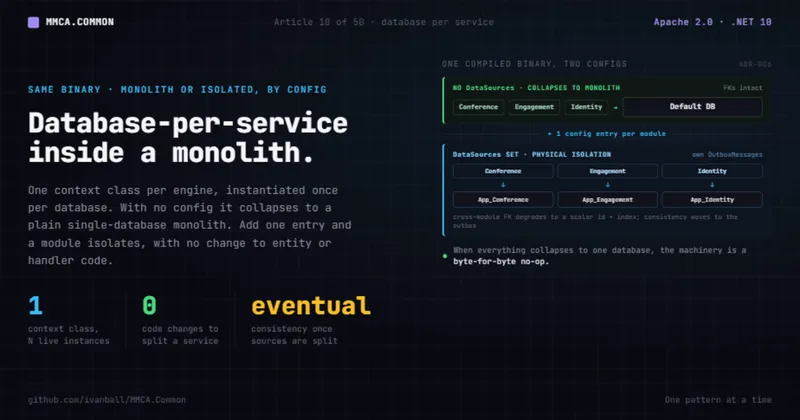
One DbContext class. Many databases. A host with no extra configuration behaves
exactly like a single-database monolith, and the same code runs against per-service databases the day
you split. Here is how, and the one consistency guarantee you give up.
Most "database per microservice" advice assumes you already have microservices. You do not, on day one. You have a monolith, one connection string, and a reasonable wish to not paint yourself into a corner. The usual answer is to either share one database forever (and inherit a coupling you can never unwind) or to split the databases prematurely (and inherit distributed-systems pain before you have a single user). Neither is good.
MMCA.Common does something quieter. It runs database-per-service semantics inside the monolith, in a way that collapses to a plain single-database monolith when you have not configured anything, and expands to physically separate databases when you have, with no change to your entity or handler code. The swap point is present from the first commit and free until you use it.
Why it matters
Two failures hide in the shared-database monolith, and both surface at the worst possible time.
The first is the coupling itself. Once a foreign key spans two modules, those modules can never be deployed or scaled independently. You can call them "modules," but at the schema level they are one thing. The eventual extraction is a data migration, which is to say a rewrite with a maintenance window.
The second was a concrete bug in this codebase. When the modules were first extracted into separate
service processes, they still pointed at one shared SQL database with one OutboxMessages table.
Every service's OutboxProcessor polled that same table with no origin filter, so the services
raced to claim each other's outbox rows. That race is the proximate reason ADR-006 was written.
Physical isolation is simpler and stronger than bolting an OriginService filter onto a shared
table, so the decision was: each service owns its own database, with its own OutboxMessages.
The MMCA answer: one context class, one instance per database
The single most counter-intuitive fact, and the one every other choice flows from: there is exactly
one concrete context class per engine (SQLServerDbContext, PostgreSQLDbContext,
SqliteDbContext, CosmosDbContext), each a sealed subclass of the abstract base
ApplicationDbContext. The framework deliberately does not split per module into
ConferenceDbContext, EngagementDbContext, and so on. Yet a real deployment runs four separate
SQL databases, one per module, all served by the single SQLServerDbContext class.
How does one class serve four databases? It is instantiated once per physical database. Each
instance carries a different connection string and builds a different EF model that contains only its
own database's entities. The piece that stops EF from reusing the first model for all four is
DataSourceModelCacheKeyFactory, which keys EF's internal model cache by (context type, physical
source name) rather than by context type alone. Without it, the first model built would silently be
reused for every database, which is a quiet and catastrophic bug.
Routing: where does an entity live?
An entity's home database is never declared on the entity. It is derived at startup from its EF configuration class. Three cooperating pieces do this:
- Every entity resolves to a
DataSourceKey(Engine, Name): the engine from the configuration base class (EntityTypeConfigurationSQLServer/PostgreSQL/Cosmos/Sqlite), and the name from a[UseDatabase("X")]attribute, falling back to the module name derived from the entity's namespace, falling back to"Default". DataSourceResolver(singleton) is the logical-to-physical mapper. It reads theDataSourcesappsettings section and builds a logical-name-to-physical-key map.EntityDataSourceRegistry(singleton) reflects over the configuration assemblies and maps every entity to its physical source, so routing never depends on a model having already been built. The scan is built lazily on first access (and rescans once on a lookup miss to pick up module assemblies loaded later), yet it is always one complete pass over every configuration, independent of any model build. It fails fast if two configurations claim one entity for different databases. An entity lives in exactly one database.
The collapse property: monolith and distributed are the same code
Here is the feature that makes the whole thing work. DataSourceResolver collapses logical
sources. A logical name with no connection string, or whose connection string equals the top-level
default, collapses onto the shared Default source. Two logical names sharing a connection string
collapse to one canonical physical source.
The consequence: a host with no DataSources configuration behaves exactly like a single-database
monolith. One context, one change tracker, foreign keys intact, transactions intact. Add one config
entry pointing a module at a separate database, and that module's data is now physically isolated,
with no change to entity or handler code. This collapse is the single property that makes the
monolith and the distributed deployment run the same code path.
Building the contexts: the factory pair
Two factories turn a DataSourceKey into a live context. PhysicalDbContextFactory (singleton,
never pooled because each instance carries per-source state) creates the raw context for a given
key. Above it, DbContextFactory (scoped) is the per-request coordinator: it caches one context per
DataSourceKey within a scope, so every repository targeting the same database shares one change
tracker, and it owns the cross-source save, transaction, and disposal coordination.
Cross-source relationships degrade automatically
EF cannot enforce a foreign key into another database. So CrossDataSourceDegradeConvention, a
model-finalizing convention, reshapes any relationship whose two ends resolve to different physical
sources. It removes the cross-source FK constraint but keeps the scalar FK column plus a
compensating index, so the value is still stored and queryable. It ignores the CLR navigation
members that point at the foreign entity, and removes the foreign entity types from this model
entirely. Runtime navigation across the boundary then flows through the INavigationPopulator
batch-loader (its own pattern, in another article), and cross-source consistency becomes the outbox's
job, not a transaction's.
The elegant part: when every entity collapses onto one database (the monolith case), nothing is foreign, and the convention is a structural no-op. The model it produces is byte-for-byte the single-database model. The swap point exists, is tested, and costs nothing when unused.
What it looks like in configuration
You do not write routing code. You write configuration, and the same compiled binary becomes a
monolith or a set of isolated services depending on what is in appsettings.json.
// MONOLITH: no DataSources section. Every logical source collapses onto Default.
// One database, one change tracker, FKs intact. Identical to a plain single-DB app.
{
  "ConnectionStrings": { "Default": "Server=...;Database=App;..." }
}

// DATABASE-PER-SERVICE: each module points at its own physical database.
// CrossDataSourceDegradeConvention now degrades any cross-module relationship to a scalar FK,
// and the per-source OutboxProcessor only ever drains its own OutboxMessages table.
{
  "ConnectionStrings": { "Default": "Server=...;Database=App;..." },
  "DataSources": {
    "Conference": { "SQLServerConnectionString": "Server=...;Database=App_Conference;..." },
    "Engagement": { "SQLServerConnectionString": "Server=...;Database=App_Engagement;..." }
  }
}
The entity classes, the [UseDatabase] attributes, the repositories, and the handlers are identical
across both. The only thing that changed is the config.
The third axis: which customer owns the row
Source name is one axis of partitioning, and the engine is another (that is the next article). Neither of them is a tenant. ADR-073 adds the third axis, "which customer does this row belong to," and the reason it belongs in this article is that it lands as one more filter plus one more override on the routing you have already seen, rather than as a parallel mechanism.
Shared-schema tenancy is a second named query filter. An entity that implements ITenantEntity
gets a required 64-character TenantId column, an index on it that widens to
(TenantId, IsDeleted) when the entity is soft-deletable too, so it matches the composed
predicate instead of handing deleted rows back for the server to discard, and the predicate
e => CurrentTenantId == null || e.TenantId == CurrentTenantId, applied to every matching entity
type by ApplyTenantFilters beside the soft-delete pass in OnModelCreating. EF10 lets a global
filter carry a name, so Tenant composes with SoftDelete by AND and neither one knows the other
exists. The predicate embeds the context itself as a typed constant rather than closing over the
tenant string, and that detail is load-bearing: EF rewrites a context-typed constant to the executing
context at query-compile time, so one cached model per source serves every tenant and the tenant
value travels as a SQL parameter instead of baking a compiled model per customer. A null tenant is
the system context and sees everything, which is what keeps the outbox loop, the migration runner,
and the seeders working: they have no request, so they have no claim.
Resolution is claim first, then header, and it fails closed. TenantResolutionMiddleware runs
immediately after UseAuthentication (a claim-first order needs HttpContext.User already
populated), is registered unconditionally, and passes every request straight through until
Tenancy:Enabled is on. With RequireTenant (true by default) a request that resolves no tenant on
a non-excluded path is answered with a 400 ProblemDetails rather than allowed through unscoped,
because an unscoped request reads across every tenant, which is the exact outcome tenancy exists to
prevent.
Writes sit on an invariant rather than on discipline. A dedicated TenantSaveChangesInterceptor,
separate from the audit and domain-event interceptors and registered between them, stamps TenantId
on inserts and throws CrossTenantWriteException on any added, modified, or deleted entry belonging
to a different tenant. With no tenant resolved it lets an already-tenanted row through as-is (that is
how a background worker drains one tenant's work) and refuses only the insert that has no tenant to
supply. Reads are just as narrow: the repository's ignoreQueryFilters: true drops the named
SoftDelete filter only, through one shared array used at all eight call sites, so a
soft-delete-inclusive read still carries the tenant filter and cannot cross tenants by accident.
Database-per-tenant is then the smallest possible extension of everything above. A per-tenant entry
overrides the connection string for one source and keeps the same DataSourceKey, so the scoped
DbContextFactory clones the resolver's PhysicalDataSource with the override, EF's model cache key
is unchanged, and one compiled model still serves every tenant's database:
// DATABASE-PER-TENANT: "acme" shares the pooled database and is separated by the query filter alone.
// "globex" re-points one source at its own database. Same key, different connection string.
{
  "Tenancy": {
    "Enabled": true,
    "Tenants": {
      "acme": {},
      "globex": {
        "DataSources": {
          "Default": { "SQLServerConnectionString": "Server=...;Database=Helpdesk_Globex;..." }
        }
      }
    }
  }
}
Because an override changes where a source points rather than what a source is, the pieces around it
keep working unchanged. The entity registry, the migrations assembly, and the per-source outbox all
survive: the outbox simply enumerates (source, tenant) pairs and drains one extra unit per tenant
that keeps its own copy of a source, with no OutboxMessage schema change at all (no TenantId
column, so no forced migration for every consumer on upgrade). The per-scope context cache gains a
guard that throws if the scope's tenant changes after a routed context exists, which restates
one-scope-one-tenant where it would otherwise break silently. Cache entries get their isolation one
layer up, in the caching decorators, since a singleton cache cannot observe scoped state; that
belongs with the caching pattern rather than here.
The whole thing is opt-in and inert until a host asks for it: AddMultiTenancy(configuration) on top
of AddInfrastructure, and nothing else. MMCA.Helpdesk is the reference adopter and configures two
tenants on purpose, one per isolation mode: acme shares the pooled database behind the filter,
globex gets its own. ADC and Store, both single-tenant products, do not adopt it and pay nothing.
The honest costs are the mirror image of the design: shared-schema means a forgotten ITenantEntity
marker fails no build and silently includes that entity's rows in every tenant's queries, and
fail-closed means an identity provider that stops emitting the claim returns 400 on every non-excluded
route rather than degrading to a reduced view.
Trade-offs, honestly
ADR-006 lists the bill in plain terms, and it is a real bill.
- No distributed transactions. When a save spans sources,
DbContextFactory.ExecuteInTransactionAsyncopens a transaction per source and commits them sequentially, best-effort. There is no two-phase commit. If the second commit fails after the first succeeded, you have a partially applied change, and the outbox is what eventually reconciles the downstream effects. What the framework does buy you is that the partial state is observable rather than inferred: the commit loop records the partition at the failure point, so the thrownTransactionCommitAmbiguousExceptionnames each source's outcome (CommittedSources,AmbiguousSource,RolledBackSources) and appends that per-source verdict to its message, and the operator or the replaying caller can see exactly which half of the commit landed. On the single-source host every deployment runs today, that one source is the ambiguous outcome and the other two lists are empty. This is the central trade: you give up atomicity across sources to get autonomy. - Eventual consistency across sources. Once data is split, consistency between services flows through the outbox and broker, not a shared transaction. Reads can observe a window where one service is ahead of another. That is correct for the architecture, but it is a behavior your product logic has to expect.
- Referential integrity across services is the application's responsibility. The compensating index survives; the FK enforcement does not. A dangling cross-service reference will not be caught by the database. You catch it, or you tolerate it.
- More to operate. Each service gets its own migrations project and its own backup and restore concern. Four databases is four times the provisioning, migration, and disaster-recovery surface of one.
None of these argue against the design. They argue for choosing when to split deliberately, source by source, rather than all at once or never. The collapse property is exactly what lets you delay the split until a specific source actually needs it.
Apply this even without MMCA
The mechanism is EF-specific, but the discipline ports to any stack.
- Decide an entity's home logically, not physically. Route by module or bounded context, with a default that lands everything in one database until you say otherwise. Then "split a service" is a config change, not a code change.
- Make the single-database case a true no-op. If your multi-database machinery changes behavior when there is only one database, you will be too afraid to ship it. It must be byte-for-byte identical to the simple case until configured.
- Never let a foreign key cross a service boundary. Keep the scalar id and an index for queries, drop the constraint, and load the other side explicitly. The constraint you keep across a boundary is the constraint that blocks your eventual split.
- Make the outbox your cross-source consistency story before you split, because the day you have two databases you no longer have a transaction that spans them.
The rule of thumb: design so that "one database" and "many databases" are the same code on two configs. If they are two different code paths, you have not built a swap point, you have built two systems and a migration between them.
What we covered: why a shared database quietly forecloses extraction (and the literal shared-outbox
race that prompted ADR-006), how one SQLServerDbContext class becomes one model per database via
DataSourceModelCacheKeyFactory, how DataSourceResolver and EntityDataSourceRegistry route
entities, the collapse property that makes monolith and distributed the same code,
CrossDataSourceDegradeConvention reshaping cross-source relationships, how the same routing extends to
a third axis (a second named query filter for the tenant, and database-per-tenant as a connection-string
override behind the same key), and the one guarantee you give up: no two-phase commit, eventual
consistency across sources, with the outbox as the reconciler.
Next in the series: polyglot persistence, the Engine axis that re-points an entity between SQL Server, PostgreSQL, Cosmos, and SQLite without touching the domain.
MMCA.Common is Apache-2.0 licensed and open source. Star the repo, read the 2-minute ADR-006 behind this design, or install it and watch the single-database case behave like a plain monolith.
- ⭐ Repo: https://github.com/ivanball/MMCA.Common
- 📄 ADR-006 (database per service): ADR-006: Database per Service in the docs site.
dotnet add package MMCA.Common.API
Tags: .NET, C Sharp, Software Architecture, Data Engineering, EF Core